Optical Illusions Explained
When your brain lies to you - discover why optical illusions work and what they reveal about perception.
When your brain lies to you - discover why optical illusions work and what they reveal about perception.
Stare at the center, then look away - see motion that isn't there!
Try this: Stare at the center for 20 seconds, then look at your hand or the wall.
You'll see swirling motion - that's the Motion Aftereffect!
Your brain has motion-detecting neurons that adapt after prolonged stimulation. When the motion stops, these neurons are "tired" and fire less - so opposite-motion neurons dominate, creating phantom movement!
Are these squares the same color? Your brain says no, but...
Square A and B are EXACTLY the same color! Your brain compensates for the shadow, assuming A must be lighter "in reality." This is called color constancy - it helps us recognize objects under different lighting.
Which line is longer? Your depth perception is being tricked!
The arrows create a false sense of depth. Outward arrows suggest "far corners" (like inside a room), making the line seem further away - and therefore larger. Inward arrows suggest "near corners" (like building edges).
Objects that can exist on paper but never in reality
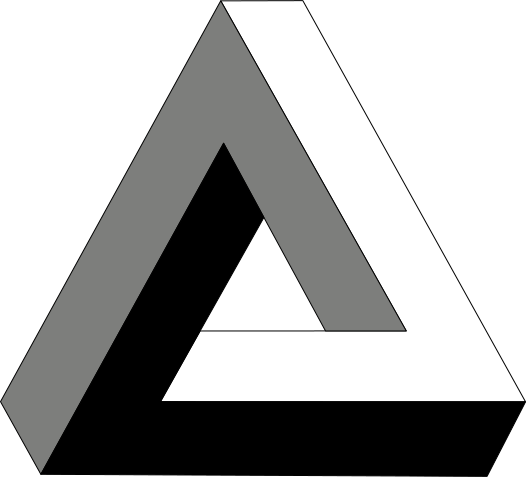
Each corner looks correct, but together they're impossible
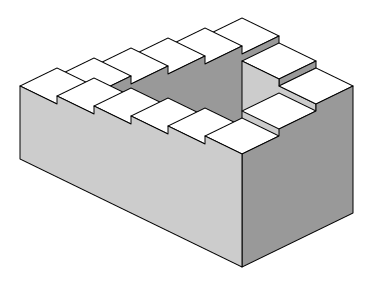
Walk forever, never go up or down
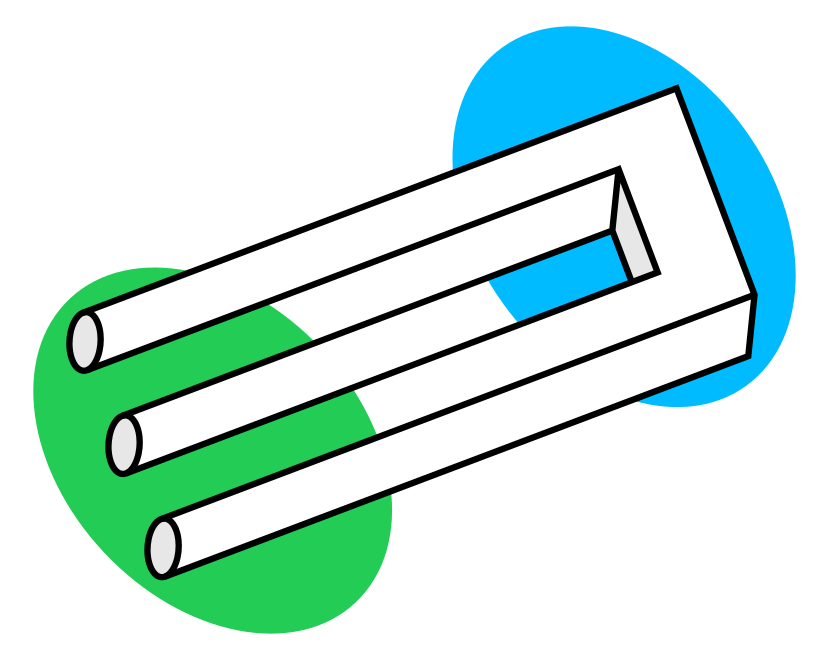
Is it 2 prongs or 3?
These objects exploit how our brain interprets 2D lines as 3D objects. Each local section makes sense, but the global structure is contradictory. Artists like M.C. Escher made famous artwork using these principles!
Stare at the dot, then look at white - see the opposite color!
Your cone cells (color receptors) become fatigued when staring at one color. When you look at white, the tired cones respond weakly while others respond normally - creating the complementary color: green → magenta, red → cyan, blue → yellow.
Do you see gray dots at the intersections? Look directly - they vanish!
Your retinal cells inhibit their neighbors. At intersections, there's more white area nearby, causing more inhibition - so the intersection appears darker. But when you look directly, your high-resolution fovea overrides this effect!
The Hermann Grid was first described by German physiologist Ludimar Hermann in 1870. Over 150 years later, scientists are still debating the exact mechanism!
You've discovered how your visual system makes assumptions - and sometimes gets tricked.
Tired neurons create phantom movement when stimulation stops
Your brain compensates for lighting, sometimes incorrectly
2D lines trigger 3D assumptions that distort size perception
Retinal cells influence neighbors, creating ghost dots
Put your new knowledge into practice!