Teaching with Clean Water Lab
For science and engineering teachers, co-op leaders and parents. One period from the river to the sea, how to pair it with the bottle filter lab, the benches where students build a filter from its parts, what students get wrong and where the app answers it, and the sheet and the setup.
Using this with a class? Make a free class and add your students yourself: each gets a username and password, with no email or Google account needed. Or give them one join code. Using Google Classroom? Post the link there; with a free class, the link also puts each student in your class, so you see their work. mytekDev is also available from the Google Workspace Marketplace, so your school's Google admin can install it for everyone.A first lesson: One period: test the river and guess, settle and filter it until it looks clear, find the germs still in it, kill them, then boil the clear farm well and watch the nitrate go up, and put seawater through a filter, then through reverse osmosis, and read the cost strip.
Set up a free class Share to Google Classroom- About these notes
- One period: from the river to the sea
- With the bottle filter lab, and the benches
- A second period: missions and puzzles
- What students get wrong, and where the app answers it
- What the app simplifies, on purpose
- Grades 4 and 5, middle school and high school
- The sheet and the setup
- Standards
About these notes
Clean Water Lab is a bench drawn from the side. The source sits on the left (a jug of water, a window of air, or the space station's tank), the cup on the right, and between them a line of stages joined by pipes: a settling tank, a sand column, a pot on a flame, a membrane with its pressure gauge, a still under glass. Students pick the source, tap or drag stages into the line, press Run and test the cup on the meters: Cloudiness, Germs, Salt, and the chemicals the source carries (nitrate, arsenic, iron, lead, fuel and oil). The water is Safe only when every meter is green. Under the bench, the cost strip says what the line took for the number of people it serves: how much water it drew, its energy, its waste, its supplies, and a water budget bar.
Each stage removes what the WHO tables and the treatment literature say it removes, in the order it sits: chlorine in muddy water is used up and shielded, chlorine before reverse osmosis eats the membrane, a cold coil in dry air gets nothing. A stage in a bad spot is never refused; it works badly and its card says why. Every stage keeps the books, so the water and every dissolved thing that go in come out in the cup, the waste, the steam or the stage. The numbers are model values inside published ranges, not a test of anyone's water.
One period: from the river to the sea
- Would you drink this? (5 minutes) On the projector, the muddy river. Press Test the jug: cloudiness 150, germs about 2,000 in a 100 mL sample, salt 300 mg in a liter. Before anyone builds, each student taps a first move: filter it, boil it, add chlorine, or let it settle. The guess is saved with the project.
- Clear is not clean (12 minutes) Students put Alum and settle and Sand filter in the line and press Run. The cup comes out clear: cloudiness 0.3, green. The germ meter is still red, about 6 in 100 mL. Press Look closer to see the drop magnified with its germs. Then add Chlorine and run again: every meter green, and the stamp says Safe. Ask what would have happened with chlorine alone: try it. The mud uses up the chlorine and the card says so.
- The farm well (10 minutes) Switch to Farm well. It looks perfect: cloudiness 0.5, no germs, salt 500. The test finds nitrate at 25 mg in a liter, and the limit is 10. Ask whether boiling will fix it, and let them try. Nitrate goes up, to 26.3: boiling killed nothing that was there and sent some of the water off as steam. Now all the stages are open; Ion exchange or Reverse osmosis takes it down (to 2.5 and 5.5).
- The sea and the cost (13 minutes) Switch to Sea. Sand filter and Carbon filter leave the salt at 35,000 mg in a liter. Build Sand filter, Reverse osmosis, Add minerals back, Chlorine, and run it for 30 people. The cup passes. Now read the strip: 515 L of seawater in for 225 L made, 290 L of waste including brine 1.8 times saltier than the sea, electricity like a microwave running 38 minutes, and the line under the cup's test: 18.1 kg of salt came in, 65.1 g is in the cups and 18 kg left in the waste. Then try Solar still alone: no plug, and 107 square meters of glass. Which would an island with solar panels choose, and which a village with a field and no power?
- Write it down (5 minutes) Open the Sheet: which meter fooled your eyes, which stage did the most work, what did your line cost and leave behind, and what would you change for a town with no electricity.
With the bottle filter lab, and the benches
The app is built to sit beside the real bottle filter, not replace it. Build the filter first: gravel, sand, charcoal, and a jar of muddy water. It comes out clearer, and the class has no way to test for germs. Then put Bottle filter in the app's line on the same river and press Run, and the meters show what the jar could not. Make it on the Bottle filter stage gives the same build as a bench: plug the neck, choose the layers from the neck up, rinse or not, pour. Its tests end with "Is it safe to drink?" and the answer is always no, and its build sheet prints.
Eleven stages have a Make it bench where the stage is built from its parts in the real order, with Adult work marked: the biosand filter (sieve, wash, layers, the water level at rest, the diffuser), the clay pot (burnout material, drying days, firing temperature, silver), the solar still (liner, depth, cover, slope, seals), sunlight bottles, the alum and Moringa jar tests, a folded cloth, the arsenic filter, the fog net and the carbon filter. Run the tests says what passed and what failed and why; Use this build puts its numbers in the line. A biosand filter whose sand was washed too many times lets water rush through untreated; a pot dried too fast cracks. The jar test runs six jars on the student's own water: on the muddy river, 50 mg of alum in a liter settles it from 150 to 10.7 NTU, and 150 mg leaves it at 101.4.
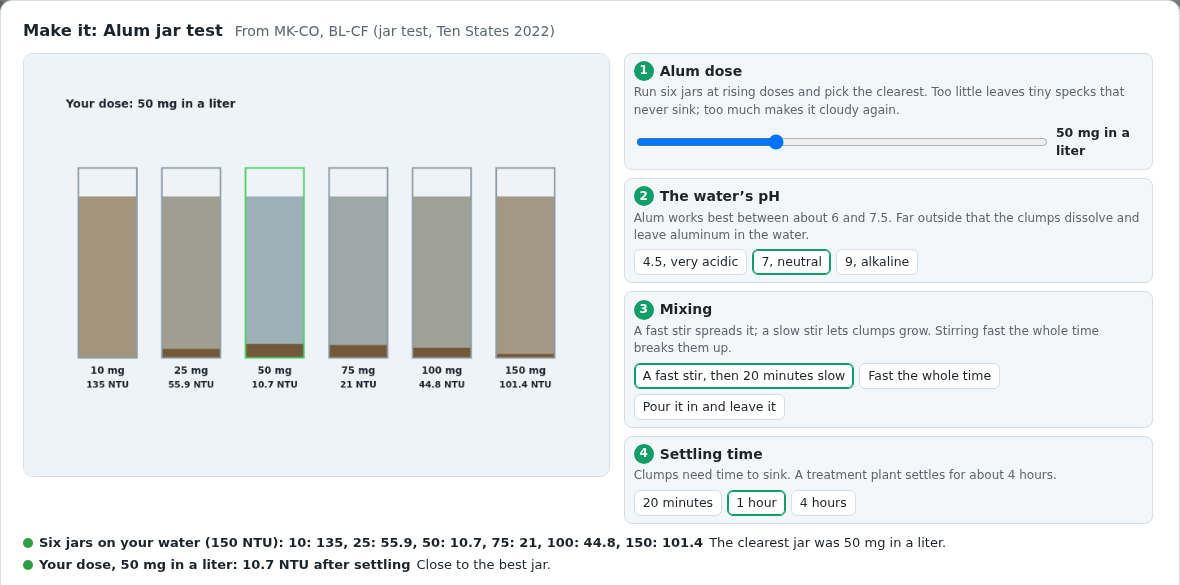
The alum jar test on the muddy river. Too little alum leaves specks that never sink; too much clouds the water again.
A second period: missions and puzzles
A mission sets a source, the people to serve and what is on hand, and checks the line against all of it after each run. Eight are built: a riverside camp of 30 with a stove and about 15 kg of firewood a day; a farm family's well; a delta village of 50 with a hand pump, no power and arsenic in the water; a family of 5 after a flood with one gas canister a day; an island school of 200 with 20 kWh of solar power and 300 square meters to spare; a foggy hillside village of 100; four scientists in the desert with a 10 kWh generator; and a space station crew of 7 that has to get back nearly every drop. Setup prints a passing line for each one, with its energy.
Good ones to give a class: the flood (boiling for 5 people would need 1.6 gas canisters a day against the one they have, so the line that works is a chemical one, and in a real flood the answer is bottled water or water the town says is safe), the delta well (the arsenic has to be aired before an iron filter can catch most of it), and the desert (a cold coil would need 23.8 kWh a day against a 10 kWh generator; a sorbent harvester runs on the sun).
Puzzles: two mystery jugs with no label (name the source from its test, then make it safe), four broken lines to fix in one or two changes (chlorine ahead of the mud, chlorine eating a reverse osmosis membrane, UV in front of the mud, lead from old pipes), and three fewest-stages puzzles with the still, the distiller and reverse osmosis ruled out.
What students get wrong, and where the app answers it
| What students say | Where the app answers it |
|---|---|
| Clear water is safe | The river after Alum and settle and Sand filter reads cloudiness 0.3 and germs about 6 in 100 mL. The farm well is clear from the start and carries nitrate at two and a half times the limit. |
| A filter takes out salt | Seawater through Sand filter and Carbon filter: the salt meter stays at 35,000 mg in a liter. Only a stage that pulls the water away from the salt moves it. |
| Dissolved salt disappears | The line under the cup's test keeps the books: for 30 people on reverse osmosis, 18.1 kg of salt comes in a day, 65.1 g is in the cups, 18 kg leaves in the waste. The solar still bench's drop test dries with no white ring because the salt stayed in the basin. |
| Boiling removes everything | Boiling kills every germ and leaves what is dissolved a little stronger: the farm well's nitrate goes from 25 to 26.3, the delta well's arsenic from 200 to 210.5 micrograms. |
| Chlorine works in any water | In the muddy river the mud uses up the chlorine and hides germs from it; UV light is shaded the same way. Both need water at 1 NTU or less. |
| The water on a cold coil came through the metal | Test the air first: humid air at 30 °C holds about 24 g of water in each cubic meter, and the window shows it as vapor. On a desert night the dew point is under 5 °C and the coil gets nothing: the water was in the air. |
| Evaporated water is gone | In the solar still the water runs down the inside of the glass to the gutter, and the water budget bar counts the steam a boil sends off, in liters. |
| Desalination solves water shortage | The strip shows its price: 515 L of seawater in for 225 L made, brine 1.8 times saltier than the sea, and electricity. A solar still makes the same water with no plug and needs 107 square meters of glass for 30 people. |
What the app simplifies, on purpose
- The sources are typical values inside published ranges: a river with E. coli at 2,000 in 100 mL, a farm well at 25 mg of nitrate, the sea at 35,000 mg of salt in a liter. None is a real place, and a real well needs a real lab test.
- Chlorine works at one temperature and pH (20 °C, pH 7), with its dose set to 1, 2 or 4 mg in a liter and a 30 minute wait plus any storage tank. Disinfection by-products are left out.
- Chemicals are only the ones a source carries: nitrate, arsenic in its two forms, iron, lead from old pipes, fuel and oil from floodwater, ammonia on the station. Pesticides, PFAS, hardness and scaling are not modeled.
- Every line is sized to the people it serves, and the strip says what that takes (square meters of glass, stoves, liters of seawater) instead of a slowest stage capping the output.
- Running is 1 day, 1 week or 1 month: long enough for a biosand filter to grow its living layer at 30 days and for mud to clog a membrane over a week. Carbon, iron and resin never fill up; the stage's card says how a real one is kept up (a resin tank refreshed with salt each week, the iron cleaned about once a year).
- Look closer shows the cup, or the jug before a run, not any point along the line.
- The high school settings are fixed: reverse osmosis on seawater runs at 59 bar and keeps 45% of the water, and the coil, the UV dose and the chlorine wait do not change.
- Germs are expected counts. Safe on germs means fewer than one expected in a 100 mL sample for every kind.
Grades 4 and 5, middle school and high school
| Grades 4 and 5 | Middle school | High school | |
|---|---|---|---|
| Sources | River, Farm well, Sea, Humid air | All eleven | All eleven |
| Stages | Eight: settle, sand, carbon, boil, chlorine, still, cold coil, minerals | Six to start, all of them after the farm well | The same |
| The test | Faces: Looks, Germs, Salt, and Chemicals when the source has any | Meters with numbers and limits | Germs split into bacteria, viruses, Giardia and Cryptosporidium; chlorine left in the cup; the dew point on the air test |
| Energy | In words: sunlight, a fire, electricity | As comparisons, such as a microwave running 38 minutes | In kWh |
| Supplies | Named | Grams or kilograms a day and a month | With the multiplication shown |
| Missions | The camp, the farm well and the island school | All eight | All eight |
The sheet and the setup
The Sheet in the app's header puts the line, the cup's test and a picture of the bench on one page with four questions: which meter fooled your eyes, which stage did the most work and on what, what the line cost and what it left behind, and what you would change for a town with no electricity. Hand in needs a run and an answer to every question. It saves with the project, or prints.
Setup sets which sources and missions students can pick, whether a guess comes before the first test, and whether the puzzles are on. It shows an answer key worked out live from the model: a line that meets each mission, its electricity or fuel a day, and the lesson of the mission. Set it on a starter project and hand that out: the setup travels with it.
Standards
The engineering standards fit best, and none of them limits the numbers shown. The others are kept inside their boundaries.
- MS-ETS1-1 to 4, and MS-ETS1-4 most of all: "Develop a model to generate data for iterative testing and modification". A mission is the criteria and constraints; the meters and the strip are the data.
- MS-ESS3-3: the clarification names water usage and water pollution. Brine and energy are the impacts the strip monitors.
- MS-ESS3-4: freshwater as a resource and liters for each person a day; its clarification's "science does not make the decisions for the actions society takes" fits the desalination question.
- MS-PS1-4: boiling, the still, the distiller and the cold coil are changes of state of water, a pure substance the clarification names.
- MS-ESS2-4: the still and the air sources as the water cycle in a box. Boundary kept: no quantitative latent heat, so middle school sees energy as comparisons.
- 5-PS1-1 at the grades 4 and 5 level: the clarification names evaporating salt water. Boundary kept: no atomic-scale mechanism of evaporation, so that level shows the salt left behind and no particles. 3-5-ETS1-1 to 3 for a need, criteria and fair tests.
- HS-ETS1-1 to 4: HS-ETS1-4 begins "Use a computer simulation", and HS-ETS1-3 names cost, safety, reliability and environmental impacts. HS-ESS3-1 for access to fresh water, HS-ESS3-4 for refining a solution that reduces impact.
- Texas TEKS §112.7(b)(6)(C) in grade 5, §112.26(b)(6)(B) and (11)(B) in grade 6, §112.27(b)(6)(D) in grade 7, and Environmental Systems §112.50(6)(B) and (10)(D).
More help
Is something on this page wrong or not clear? Write to us.
Page last reviewed November 2026.
Google, Google Classroom and Chromebook are trademarks of Google LLC.