Dig Site
A real dig is slow and careful, and it destroys the site as it goes: once the soil is off, the only record of where a thing lay is the one you wrote. Dig Site puts that in a student's hands. They open a square, scrape it down with a trowel, brush a find clean and record it before they lift it, sieve the bucket for the beads a trowel misses, and read the layers in the trench wall. Then they say what the site was, when, and what happened to it, with each claim pointing at its evidence. And a site is a history told in a few sentences, so a student builds one of their own: a farmhouse yard, a workshop in the desert, a platform in the rainforest, with things placed exactly where they want them found, 3D models from their Files included, and hands it to a partner to dig.
Using this with a class? Make a free class and add your students yourself: each gets a username and password, with no email or Google account needed. Or give them one join code. Using Google Classroom? Post the link there; with a free class, the link also puts each student in your class, so you see their work.A first lesson: Everyone opens the Farmhouse Yard and digs the same square for one class period, recording every find before lifting it. Compare field logs: who has unstratified finds, and what can those finds never tell us? For a second period, everyone builds a site for a partner: pick a look, tell its history in sentences, place one thing where it will be reached and one where it will not, and swap.
Set up a free class Share to Google ClassroomWhat a student actually does
They open the dig on a site where one square is already started and something is showing in the soil. Four tools, each with its own feel: the mattock takes the turf in big bites, the trowel scrapes a thin layer off flat and scratches what it touches, the brush takes a few millimeters of loose soil and never harms anything, and the fine pick gets under an edge. Soil comes away as crumbs with the scrape or hiss of the tool, and a click when it meets something hard. A find comes out a little at a time: the curve of a bottle, then its neck, then the whole thing, still sitting in a bed of soil, with a bar that shows how free it is. Lift it too early and a fragile one breaks.
Every find has two buttons. Record gives it a number, its layer, its square and its spot, and pins a tag in the soil. Lift takes it to the tray. A find lifted without a record is unstratified: nobody knows which layer it came from, so it can never date anything, and the tray says so. Scraped soil fills a bucket; a full bucket can be sieved, which catches the beads and buttons a trowel misses, or tipped on the spoil heap, which loses them. Dig through two layers at once and the bucket is mixed, and the bucket knows.
Some things are bigger than a square. A brick footing runs across three squares and stays where it is, recorded as one feature; a stoneware crock crushed in a trash pit comes out as eighteen sherds that fit back together on the join bench. In the lab a lifted find is cleaned, looked at closer, and named against a short list of types; a wrong name gets that type's dates with no warning, which is where the dating lesson later bites. The lab's rules can be written as sentences, as text, or as blocks: when a find is glass and has a seam over the lip, call it a machine-made bottle.
The layers tab is where it adds up. A section drawing of any trench wall, as deep as they dug. The order of layers, which is theirs to state and the app checks against what they could have seen. Each layer is no older than the newest thing recorded in it, with the working shown, and the rule itself is ten lines of code they can read, change and run on their own finds. The report asks what was here, when, and what happened to it, and each claim carries the evidence it rests on. Hand it in, and the site tells its own story beside their claims.
A site is a history: natural clay, a yard that built up from 1845 to 1890 with cut nails and pottery in it, a trash pit dug in 1880, a fire, fill brought in, a lawn. Students read it as sentences with words they can change, as text, or as blocks, and make a site of their own: choose where it is (a meadow, a desert with dunes and a pyramid on the horizon, a rainforest crowded with trees, a castle yard under its broken keep), tell what happened oldest first, and put things exactly where they want them found. The placement bench is the site from above: drag a thing to a square, set how deep it lies, and the column beside it shows which layer it lands in. A 3D model from the student's own Files, a dinosaur built in Dinosaur Lab say, becomes a thing to bury like any other. Four sites come ready-made: the Farmhouse Yard, a Roman villa's corner, a desert workshop of potters and scribes, and a platform in a rainforest.
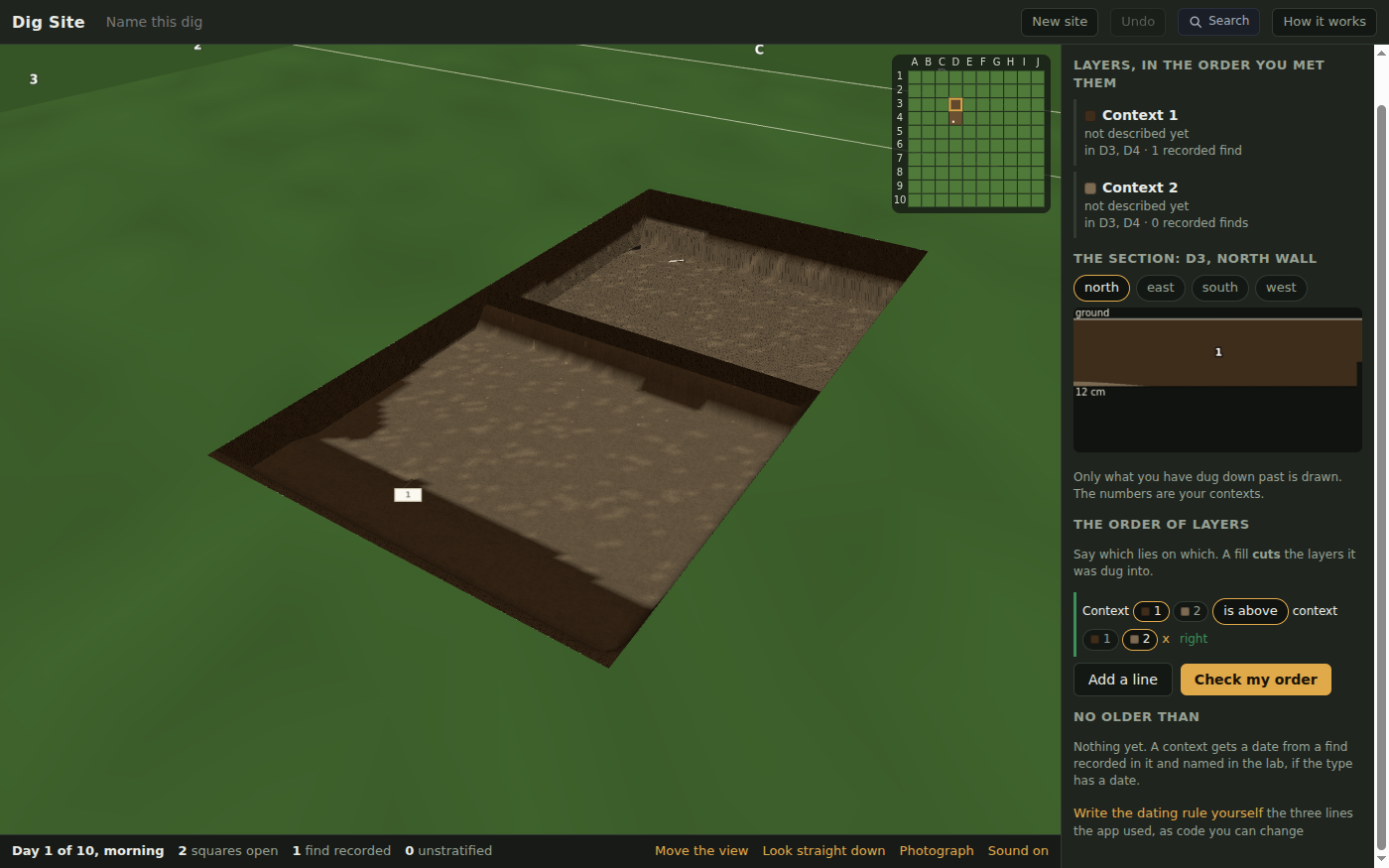
The layers read as history. The section is drawn only as deep as the student dug, the order is theirs to state and the app checks it against what they could have seen, and a date comes only from a find that was recorded and named.
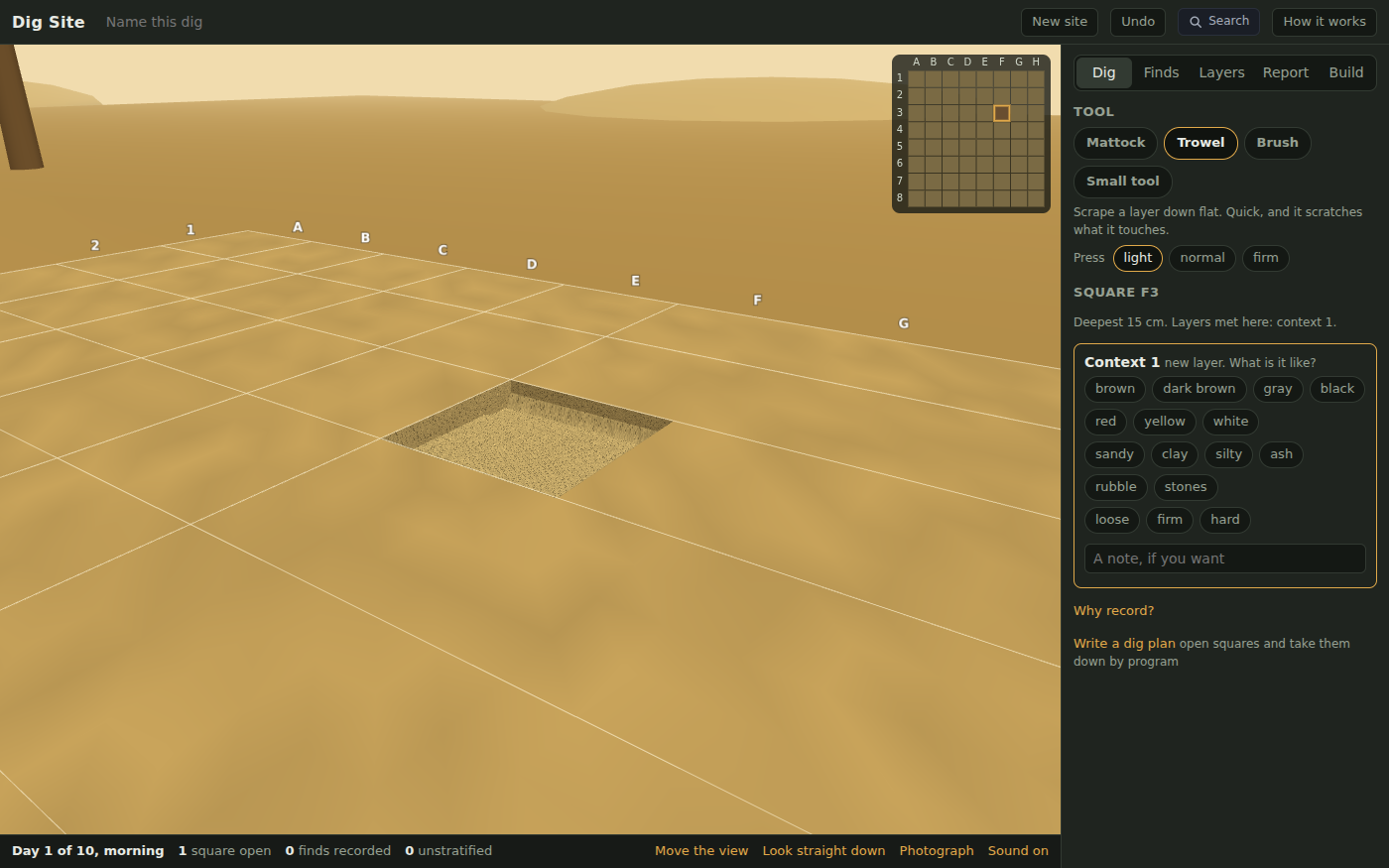
A site is somewhere. The Desert Workshop, one of five ready-made sites; a built site can be set in a meadow, a desert, a rainforest or a castle yard.
What they are learning while they play
Nothing here is presented as a lesson. This is what the activity is made of.
| What the student does | What it is |
|---|---|
| Records a find before lifting it, and once forgets to | Context and provenance. An object's meaning is mostly where it lay. The unstratified find in the tray is the lesson: it can be identified, but it can never say when a layer formed. |
| Reads the trench wall and states which layer lies on which | Stratigraphy and superposition. Lower is older, unless something cut through. A pit's fill is younger than every layer it cuts, which is what makes a pit the hardest and best thing to read. |
| Names a find in the lab and watches a layer get its date | Dating by what was made when. A layer is no older than the newest thing in it. A wrong identification moves the date, and the working line shows which find is holding it up. |
| Writes claims in the report and attaches evidence to each | Claim, evidence, reasoning. A claim with nothing behind it is a guess. The report will not let one stand without a find, a layer or a date beside it. |
| Chooses which squares to open in a ten-day season | Sampling under a budget. No one digs a whole site. A line of squares and a grid of them find different things; the plan is a strategy, and it can be written as a program. |
| Builds a site as a history, places things where a partner will or will not reach them, and watches it dug backward | Site formation, and a program that runs forward. The history runs oldest first and lays the ground down; the digger reads it newest first. Deciding what survives in which soil, and what lies too deep for a ten-day season, is the deepest version of the lesson. |
How to tell whether it landed
Ask, and let them show you. A student who has understood it can answer these without help.
- Which find in your tray is unstratified? What can it tell us, and what can it never tell us?
- How do you know context 3 is older than context 1? Show me on the section.
- Context 2 is no older than 1903. Which find says so, and what would change if you had named it wrong?
- Your bucket says mixed. What did you do, and what does it cost you?
- You had ten days. Why did you open the squares you opened?
Use it in your subject
Not a technology class? Then the app is how students show what they learned in your unit. More projects for every subject.
Social studies and history
Dig the Farmhouse Yard and write the report, then build a site for a partner, a workshop in the desert or a platform in the rainforest, and hide the one find that dates its pit.
Earth science
Draw the section of one trench wall by hand from the app's drawing, label the layers oldest to youngest, and explain the pit that cuts through them.
English language arts
Hand in the report as a claim, evidence, reasoning paragraph, then compare it with the site's own story and revise.
Computer science
Write the dig plan as a program, then the dating rule as code, run it on your own finds, and explain where your rule and the app's disagree.
Practical notes
- AgesAges 9 through high school. Younger students dig, record and sieve; middle schoolers read the layers and date them; older students write the rules and the report, and build a site for someone else.
- TimeA minute to the first find. One period digs a square and fills the tray; a second reads the layers and dates them; a third writes the report. Building a site for a partner is its own period.
- EquipmentA computer or Chromebook with a modern browser and a mouse or trackpad. Nothing to install. The trench is 3D, so a very old machine may be slow; it still works.
- CostFree. The app has no paid tier.
- PrepNone for the first period. Dig one square yourself first: it takes ten minutes, and you will meet the unstratified find before your students do. To hand out a site of your own, build it on the Build tab and share the project as a starter.
- In a groupEveryone can dig the same site, and the same square, and compare field logs and reports. Sites are measured in meters, the way every real dig is, and the app says so.
For co-ops, microschools, and classrooms
Give everyone the same site and the same question, what was here and how do you know, and compare reports. With a free account digs are saved and shared, a teacher can hand a built site out as a starter project, and the report prints as one sheet with the plan, the section, the claims and the find list.
Common questions
Is Dig Site free?
Yes. It runs in your browser and there is no paid tier. A free account adds saving, sharing and handing out a site you built, but nothing on this page is behind a paywall.
Does my child need an account to try it?
No. The demo on this page opens on a square already started. Make a free account to save a dig, hand it in, and build a site for someone else.
Are the sites real places?
No. The Farmhouse Yard, the Villa Corner, the Desert Workshop, the Rainforest Platform and the Castle Bailey are invented, but the kinds of finds are real and dated the way archaeologists date them: cut nails give way to wire nails in the 1890s, a bottle with a seam over the lip was made by machine after 1903, a Roman coin is no older than its emperor, faience beads belong to a span of centuries. There are no human remains in the app and never will be, which is why the desert site is a workshop and not a tomb, and the shipped sites are not sacred places or any living people's sites.
Can students bury things of their own?
Yes. On the Build tab a student tells a site's history, picks where it is, and places any find from the site's catalog exactly where they want it, by sentence or by dragging it on the placement bench. With an account, a 3D model from their Files, a dinosaur from Dinosaur Lab for instance, becomes a thing to bury too, and a built site is shared as a starter that each partner digs fresh.
Does it teach that digging things up is fine?
The opposite. Recording is the whole point, nothing has a money value, and the app says plainly that digging a site on public land in the US without a permit is against the law and that a find on your own land should be reported, not kept. Every report ends with: finds belong with their records, not in a collection.
Do I need to know how to code?
No. Digging, recording, the layers and the report need no code at all. Students who want to can write the dig plan, the sorting rules and the dating rule as sentences, blocks or text, and the dating rule as ten lines of JavaScript.
What subject can I log this as?
Most families log it as social studies or history, or earth science when the layers are the point, or writing for the report. The table above lists specifically what is covered, so you can pick the label your records need and point at the evidence.
Still have a question? Ask us, and a person will write back.
Where to go next
Start with Dig Site
Trying it costs nothing and takes about five minutes. An account is what makes the work last.
Dig Site is one of the making apps on the platform. It is a place to make things, not a course, and it is not a substitute for a teacher: it is at its best when an adult asks the questions above and takes the answers seriously.
Page last reviewed October 2026.