Dissection Lab
Many students may choose not to dissect, and the alternative they are given has to be worth the same grade. Dissection Lab is a frog dissection done in the same order and with the same tools as the lab at the bench: look the frog over and sex it, open the mouth, cut the skin and then the body wall along the lab's lines, pin the flaps back, take out the chest piece, and name each organ where it lies, lifting what covers it. Every cut has a depth, every mistake is logged for the teacher, and a lab sheet fills in as the student works. A fetal pig, a cow eye, an earthworm and a sheep heart are in the same app, each with its own steps and sheet.
Using this with a class? Make a free class and add your students yourself: each gets a username and password, with no email or Google account needed. Or give them one join code. Using Google Classroom? Post the link there; with a free class, the link also puts each student in your class, so you see their work. mytekDev is also available from the Google Workspace Marketplace, so your school's Google admin can install it for everyone.A first lesson: For a student who opts out, assign the whole lab over the same days the class dissects: they hand in the same kind of sheet and take the same practical. For the whole class, run steps 1 to 6 as a pre-lab the day before the real dissection, and the Practical tab the week after.
Set up a free class Share to Google ClassroomWhat a student actually does
They start with the frog back up on the tray and the probe in hand. Touching a part finds it: a card says where it is, what it does, and how theirs compares. They turn the frog over, decide whether it is male or female and say what they saw, then snip the corners of the jaw and look in the mouth: the tongue fixed at the front, the teeth on the upper jaw, the holes in the roof that come out at the nostrils.
Then the cuts. They pin the frog belly up, lift the skin with the forceps and cut along the lab's lines with the scissors, pull each flap back and pin it. The same again through the body wall, beside the dark abdominal vein, not on it. A cut that was not lifted goes into whatever is underneath, and the app says so and offers Undo; the log keeps it either way, for the teacher.
Inside, organs hide under others. A click with the forceps lifts the liver to show the gallbladder, the stomach for the pancreas, the coils of the intestine for the spleen. A female full of eggs has to have the egg masses snipped free and taken out first, the way every handout warns. The heart opens in a close-up, its sac snipped, its tip turned up to show the sinus venosus on its back.
Once everything is found, the digestive tract comes out to the side dish: the stomach cut open on its last meal, the intestine uncoiled along a ruler and measured. Then the kidneys and reproductive organs on the back wall, the nerves, and, if the teacher turns them on, the brain and the leg.
The Bench runs the leg's nerve and calf muscle as a simulation of the classic experiment: one pulse, two close together, trains faster and faster until the twitches fuse. Students can write the experiment as a program, or as blocks.
The fetal pig works the same way. The student ties it belly up and opens the abdomen with the skin and muscle cut together, the cuts behind the cord kept off the middle so a male's penis is spared. The flap holding the umbilical cord will not fold back until the umbilical vein, running up into the liver, is snipped. Inside are a liver far bigger than an adult's, lungs that have never held air, a thymus that fills the neck, and in the heart the short vessel that lets blood skip the lungs before birth.
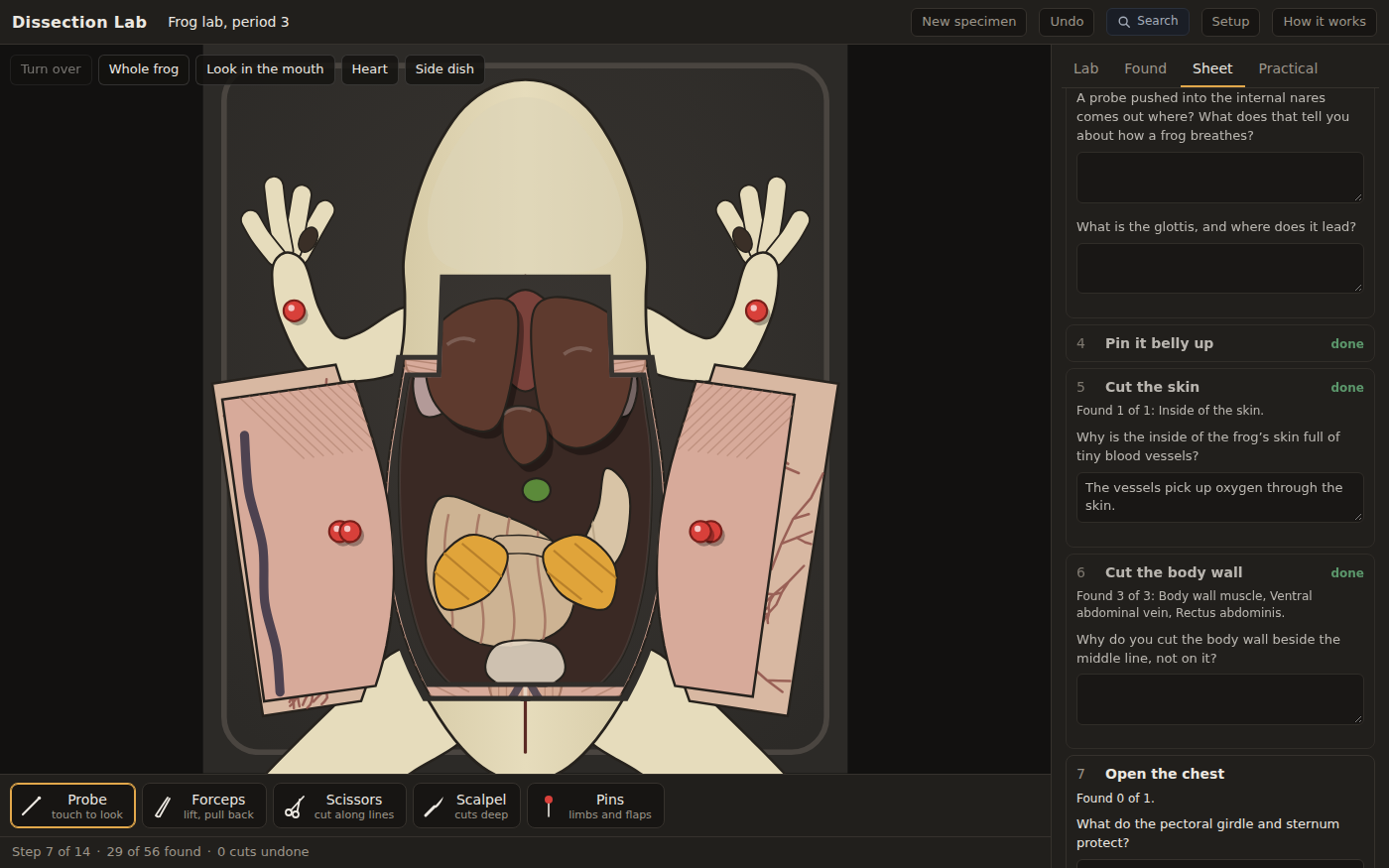
The sheet is the product. It fills in as the student works, checks what can be checked, and prints as the page the teacher grades.
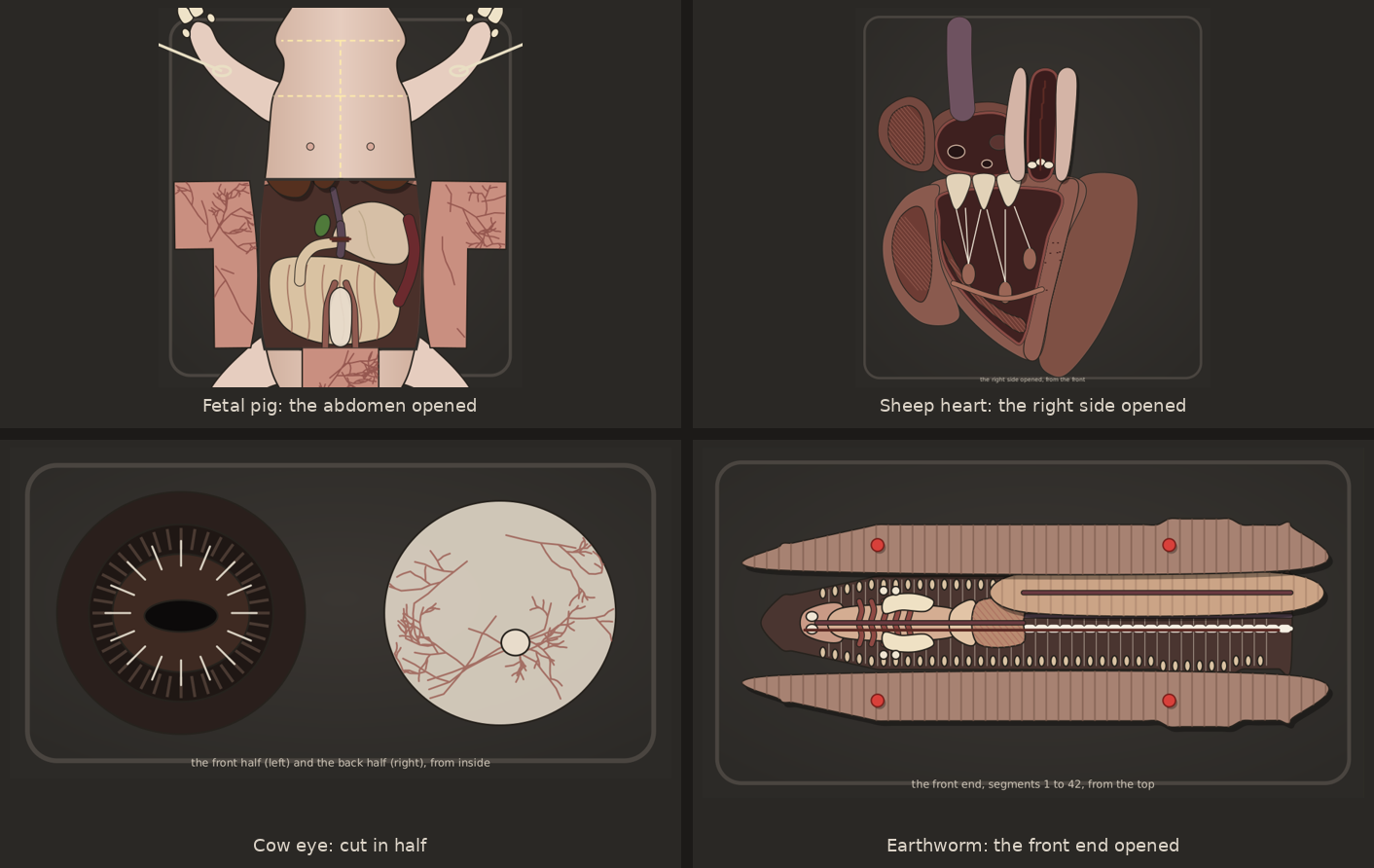
The other four specimens. Each has its own steps, cuts, cards, questions and practical.
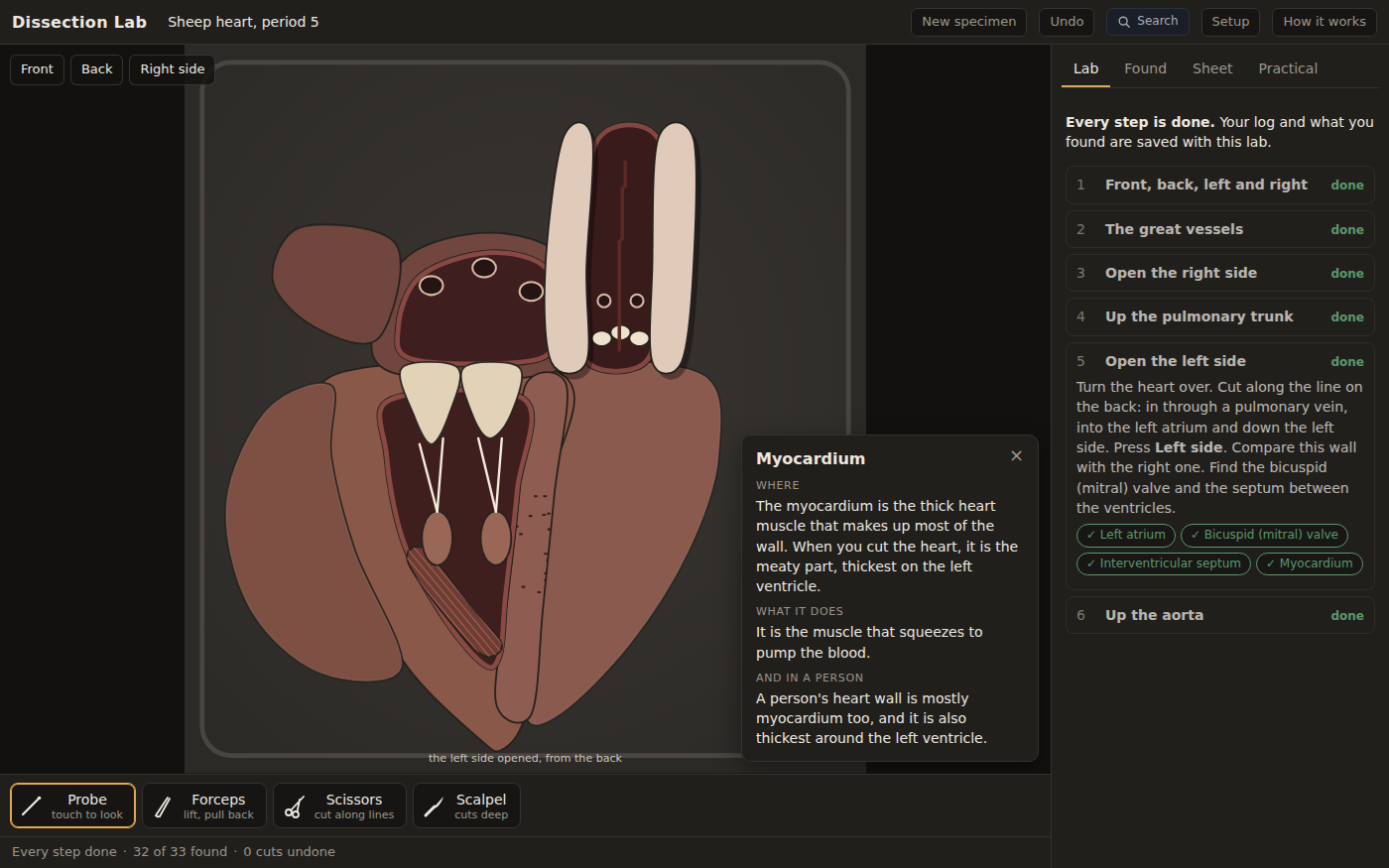
The sheep heart's left side opened. The wall is several times as thick as the right ventricle's, and the card says why.
Five specimens, each in its own lab's order
Press New specimen to switch. Each one follows the handouts teachers already use for it, compared step by step before it was drawn, and each comes with its own lab sheet, practical and label-the-diagram worksheet.
- Leopard frog. Fifteen steps over about four periods: the outside and sexing it, the mouth, the skin and the body wall cut and pinned back, the chest, the organs in place, the heart, the digestive tract taken out, the kidneys and reproductive organs, and, if the teacher keeps them on, the nerves, the brain, the leg and the Bench.
- Fetal pig. Eleven steps, written for high school biology and anatomy: the outside and the umbilical cord, sexing it, the mouth, tied belly up, the abdomen opened round the cord, the organs, the chest and neck, the heart opened, the digestive tract out, the kidneys and reproductive organs, and the pelvis.
- Cow eye. Six steps in one period: trim the fat and muscles, a scalpel slit and scissors round the middle, the vitreous and the retina, the shining tapetum, the lens (look through it at the print), and the cornea, iris and pupil.
- Earthworm. Eight steps in one period, the usual first dissection in middle school: tell top from bottom and head from tail, count the segments, find the pores, pin it, cut along the top without going into the gut, and name the organs from the five pairs of aortic arches to the nerve cord.
- Sheep heart. Six steps in one period: find the heart's own left and right, name the great vessels, open the right side and the left, and cut up the pulmonary trunk and the aorta, held so their valves are not cut. The sheet asks for the path of the blood through the heart and the lungs.
What the teacher gets back
- The log. Every cut, with what it went through, every undo, and the time spent on each step, so a careful student and a careless one do not look the same.
- The lab sheet. It fills in as the student works, checks the questions that can be checked, and prints as the page you grade, with an answer key.
- A label-the-diagram worksheet. Pictures of the specimen with numbered markers on the parts, and its key, printed from Setup.
- The practical. Timed stations, each the specimen with a pin in one part, on screen or printed on paper for the whole class.
- Help where a plan asks for it. Hints that name the next part to find, each one in the log, and assisted cutting, a Setup choice where a click on a dashed line makes the whole cut, for a student who cannot draw one.
What they are learning while they work
Nothing here is presented as a lesson. This is what the activity is made of.
| What the student does | What it is |
|---|---|
| Lifts the skin before cutting it, and once forgets to | Layers of the body wall. Skin, then muscle, then the body cavity. A cut has a depth, and what lies under a careless cut is damaged. |
| Lifts the liver to find the gallbladder | Organs in place. Where an organ is matters as much as what it is: the gallbladder sits between the lobes of the liver, under them. |
| Counts the chambers of the heart and turns it up | Three chambers and four. Two atria and one ventricle, against a person's two and two; the beat starts in the sinus venosus on the back. |
| Puts a bite of food's path in order | Body systems working together. Mouth, esophagus, stomach, small intestine, large intestine, cloaca: organs as one system, not a list. |
| Compares each part with their own | Comparative anatomy. A tongue fixed at the front, one opening for waste and eggs, no diaphragm: the same plan, built differently. |
| Sends pulses faster and faster on the Bench | Summation and tetanus. Twitches close together add up, and fast enough they fuse into one smooth pull. |
| Snips the umbilical vein before the cord's flap will move | Fetal circulation. An unborn pig gets oxygen and food from its mother through the cord: one vein in, two arteries out, and a shortcut in the heart past lungs that are not used yet. |
| Turns the heart over and finds its left side on their right | Left and right as the body sees it. Anatomy names sides for the specimen, not the viewer. The groove down the front and the firmer left ventricle say which side is which. |
| Compares the two ventricle walls after both sides are open | Structure follows the job. The left ventricle pushes blood round the whole body and the right only to the lungs, and the walls show it. |
| Holds the aorta up before cutting it, and once forgets to | Valves and what holds them. A valve lets blood go one way. The ones between the chambers are tied down by strings; the ones in the vessels have none, and tear easily. |
| Counts the segments and finds the pores on the right ones | A body plan in segments. The earthworm repeats one segment over a hundred times, and its organs sit in particular ones. |
How to tell whether it landed
Ask, and let them show you. A student who has understood it can answer these without help.
- Why do you cut the body wall beside the middle line, not on it?
- What did you have to move to find the gallbladder, and why was it there?
- How many chambers does the frog's heart have, and where does each beat start?
- What does the cloaca do that takes three openings in a person?
- Why does the force stop rippling when the pulses come fast enough?
- In the fetal pig, what held the cord's flap down, and where does that vessel lead?
- Which side of the sheep heart is its left, and how could you tell before any cut?
- Why is the left ventricle's wall so much thicker than the right one's?
- How does an earthworm get oxygen without lungs?
Use it in your subject
Not a technology class? Then the app is how students show what they learned in your unit. More projects for every subject.
Life science
Use the lab as a pre-lab: steps 1 to 6 the day before the real dissection, so the bench time goes to the organs.
Biology
Assign it in full to a student who opts out, with the same sheet and the same practical as the class.
Anatomy and physiology
Run the Bench's ladder of rates and plot peak force against pulses per second from the table.
Computer science
Write the heart's pacemaker as code, tie it off in code the way the real heart is tied, and compare with the model.
Anatomy and physiology
Open the sheep heart after the circulation unit: trace the blood on the sheet, then compare the two ventricle walls.
Life science
Start the year's dissections with the earthworm, one period, and the class practical the next day.
Practical notes
- AgesMiddle school through high school biology and anatomy. Middle school names parts from a word bank and is asked fewer of them; high school types names and finds the heart's chambers, the sinus venosus and the mouth in detail. The fetal pig is written for high school biology and anatomy; the earthworm and the cow eye suit middle school, and the sheep heart both.
- TimeFour periods of about forty-five minutes take a student through the whole frog lab, and steps 1 to 6 fit one period as a pre-lab. The fetal pig takes about three; the cow eye, the earthworm and the sheep heart one each.
- EquipmentA computer or Chromebook with a modern browser and a mouse or trackpad. Nothing to install. The tray is drawn, not 3D, so older machines are fine.
- CostFree. The app has no paid tier.
- PrepDo steps 1 to 6 yourself first; it takes about fifteen minutes. Open Setup to choose the level, the steps, the specimen and the practical, and to add your own questions.
- In a groupEvery student can get the same specimen and the same settings: set it up once and share it as a starter project.
For co-ops, microschools, and classrooms
Set the lab up once, with your level, your steps and your questions, and hand it out as a starter project. With a free account each student's lab is saved, the sheet prints as the page you grade, and the practical's score comes with it.
Common questions
Is Dissection Lab free?
Yes. It runs in your browser and there is no paid tier. A free account adds saving and handing the lab out, but nothing on this page is behind a paywall.
Can it be the alternative for a student who opts out of dissection?
That is what it is built for. It follows the real lab's order and tools, the student hands in the same kind of lab sheet, and the practical tests them the way the class is tested. Some states say what an alternative must be; California's law, for instance, asks that it take comparable time and effort. You decide whether it meets your course's goals.
Is there a fetal pig?
Yes, in the same app. Press New specimen and choose a fetal pig, or choose it in Setup. It has its own ten steps, cards, lab sheet and practical. The pig is drawn from public domain plates (Sisson's Anatomy of the Domestic Animals, 1914) and a public domain photograph, and checked against published fetal pig lab manuals.
Is there a cow eye?
Yes, in the same app. Press New specimen and choose a cow eye. Students trim it, cut it in half the way the handouts do (a scalpel slit, then scissors round the middle), find the retina, the optic disc and the shining tapetum, and look through the lens. The eye is drawn from public domain plates (Sisson, 1914) and checked against published cow eye guides.
Is there an earthworm?
Yes, in the same app. Press New specimen and choose an earthworm. Students tell the top from the underside and the head from the tail, count the segments to the clitellum, find the pores, pin it, and open the front end with a shallow cut along the top, held up so it does not go into the gut. Then they name the organs from the head back and lift the intestine for the nerve cord. The worm is drawn from public domain zoology texts (Sedgwick and Wilson, 1886; Marshall and Hurst, 1887) and checked against published classroom handouts.
Is there a sheep heart?
Yes, in the same app. Press New specimen and choose a sheep heart. Students tell its left side from its right, name the great vessels, open the right side and then the left the way the handouts do, compare the two ventricle walls, and find all four valves, holding each vessel up before cutting it so the valve is not cut. The sheet asks them to trace the blood through the heart and the lungs. The cards are checked against published classroom handouts and the OpenStax anatomy text.
Does it replace dissection for the whole class?
It is not offered that way. For the rest of the class it works as a pre-lab and as practice for the lab practical.
Is the anatomy accurate?
The drawings are traced from public domain anatomy plates (Ecker's Anatomy of the Frog, 1889, and a 1919 dissection manual) and checked against published lab manuals, and every line the app says about a part comes with its sources. Where common handouts disagree or are wrong, the app follows the sources: the ovaries make the eggs, the oviducts carry them.
Is it gory?
No. The frog and the pig are illustrated in the colors of a preserved specimen, and a preserved specimen has no blood. A student who opted out because a real dissection upset them can do this one.
Is the physiology bench real data?
It is a simulation of a classic experiment, built so its shapes sit inside the ranges published teaching labs give. The app says so, and its numbers read as about.
Do I need to know how to code?
No. The program box on the Bench is optional, and it takes plain sentences or blocks.
Still have a question? Ask us, and a person will write back.
Where to go next
Start with Dissection Lab
Trying it costs nothing and takes about five minutes. An account is what makes the work last.
Dissection Lab is one of the making apps on the platform. It is not a substitute for a teacher: it is at its best when an adult asks the questions above and takes the answers seriously.
Page last reviewed October 2026.
Google, Google Classroom and Chromebook are trademarks of Google LLC.