English projects students build, not just write
A book report can come from anywhere. A branching story where every choice Romeo can make has to hold up against the play cannot, and neither can a poem a student set to music with every stress on the beat. These three projects start from a text you already teach and ask students to make something that only works if they read it closely. Each one has a finished example you can open right now, a one-period version for trying it out, a rubric that grades the reading rather than the software, and a brief you can print.
The fork in the road
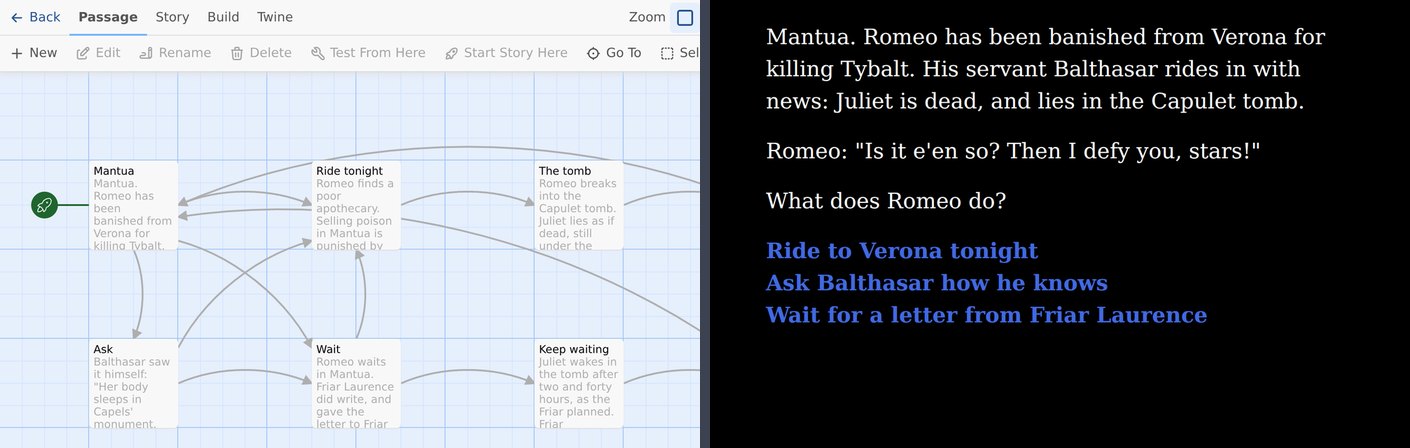
A branching retelling of a turning point in the text. Each choice the reader can make is one the character really faced, the path the author chose is told in the text's own words, and at least one ending shows what the author's choice ruled out.
The one-period version
Everyone opens Romeo in Mantua and plays every path. Then each student adds one passage: a choice Romeo could have made that the story leaves out, with a line from the play that shows why he would not have made it.
The full project
- Choose the turning point in the text and list the choices the character really had.
- Write a passage for each choice, quoting the text wherever the story follows the author.
- Link the choices so every path reaches an ending.
- Write one ending the author rules out, and end it with a question about why.
- Swap with a partner, who has to find the author's path without the book.
The finished piece has to answer
- What did the character actually have to choose between?
- Which line in the text shows why the author's choice fits this character?
- What does the ending the author rules out tell you about the story's theme?
What they hand in
The story's share link and one paragraph: why did the author choose this path for this character?
Grading it: the reading, not the software
| Evidence | Quotes are accurate and placed where the story follows the text. |
| Character | Every choice is one this character could really have made. |
| Theme | The ruled-out ending is explained in terms of what the story means. |
| Structure | Every path works and reaches an ending. |
What a student had to know to make this
The plot well enough to find the real decision point, and the character well enough to argue why the author's choice fits. A branch that does not follow from the text is obvious the moment someone plays it.
Common Core Reading: Literature, standard 3 at each grade (how incidents, dialogue and characters drive the plot and reveal character) and standard 1 (citing textual evidence). ISTE Student Standard 1.6 (Creative Communicator).
The journey in the book
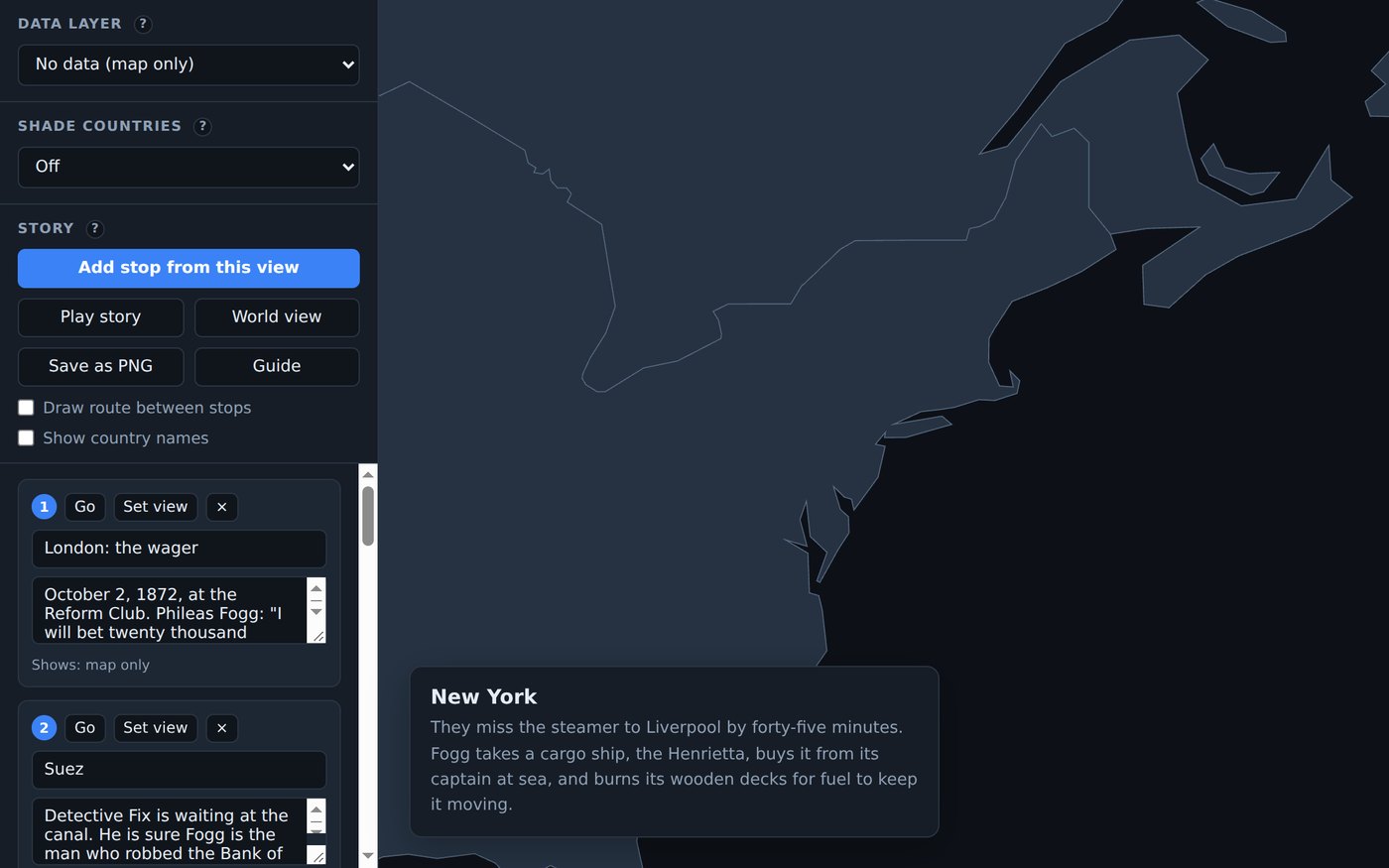
A guided map tour of the journey in a book, The Odyssey, Hatchet, Walk Two Moons, a stop for every place the story goes. Each caption is a quote from the text that captures what happens there, and one sentence on how the place changes the character.
The one-period version
Open the Eighty Days tour and play it. Each student picks one stop and replaces its summary with the single line from the novel that best captures what happens there, then explains the choice to a partner.
The full project
- List every place the story goes, in order.
- For each place, choose one quote that captures what happens there.
- Build a stop for each place, with the quote and one sentence on why the place matters to the character.
- Play the tour back and check that the order matches the book.
- Present it and argue which place changed the character most.
The finished piece has to answer
- How does each place change the character or move the plot?
- Which place matters most, and why?
- What would the story lose if it happened somewhere else?
What they hand in
The tour's share link, with the chapter for every quote.
Grading it: the reading, not the software
| Sequence | The places are in the order the story visits them. |
| Evidence | Every quote is accurate, well chosen and located by chapter. |
| Setting | Each caption says how the place shapes the story, not only what happens there. |
| Argument | The student makes a case for which place matters most. |
What a student had to know to make this
The whole plot in order, and how setting shapes it. Choosing one quote per place means rereading, and a student who skimmed runs out of good quotes fast.
Common Core Reading: Literature, standard 1 (citing textual evidence) and standard 3 (how setting and incidents shape the plot and the characters). ISTE Student Standards 1.3 (Knowledge Constructor) and 1.6 (Creative Communicator).
A poem set to music
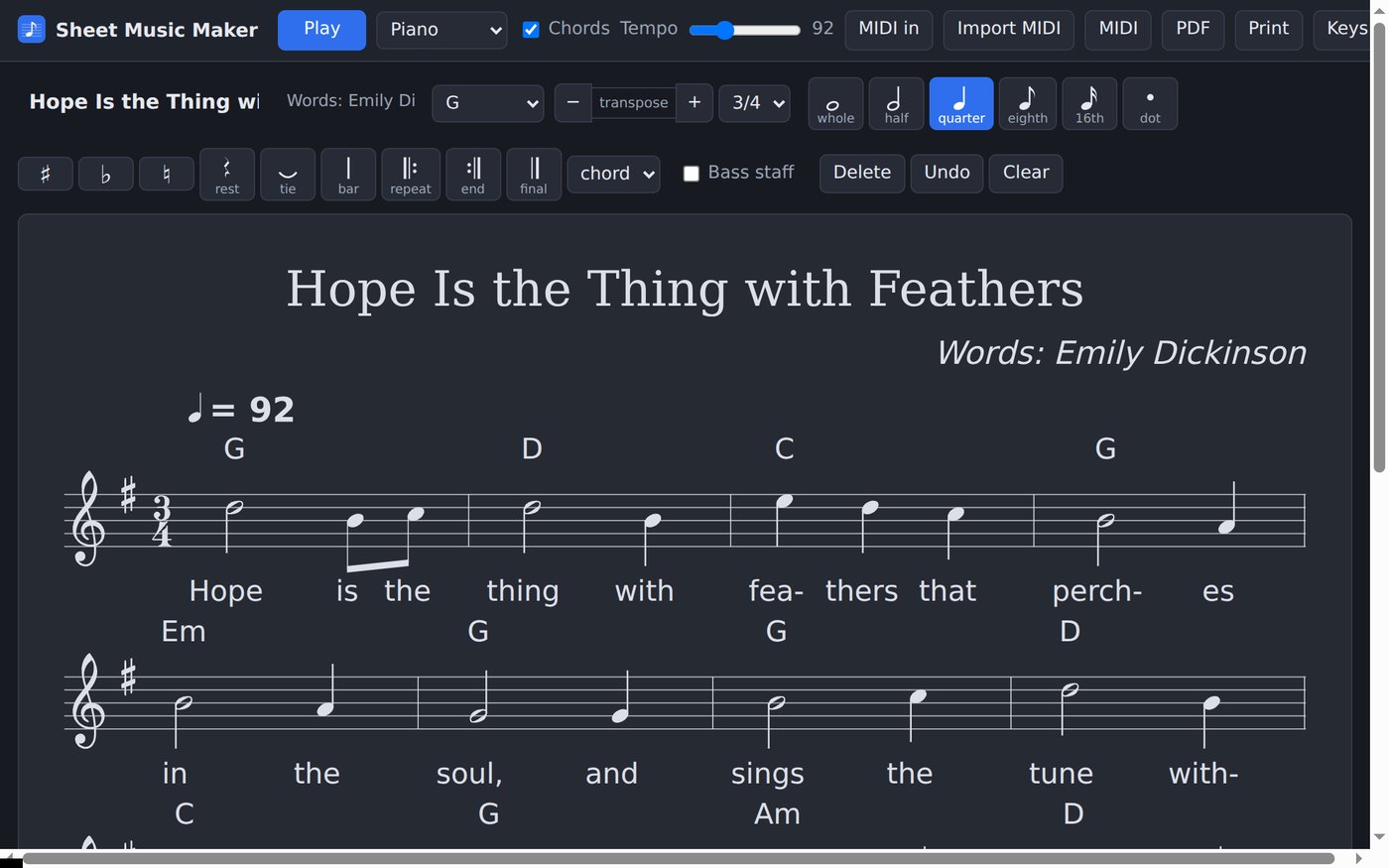
A short poem set to a melody so that every stressed syllable lands on a strong beat, printed as lyrics under the notes. Students hear meter instead of only marking it, and a word on the wrong beat sounds wrong.
The one-period version
Open the Dickinson setting and press Play. Students mark every stressed syllable in the stanza on paper, check that each one falls on a downbeat, and find the one place where they would argue with the setting.
The full project
- Choose a short poem and read it aloud until the stresses are clear.
- Mark every syllable as stressed or unstressed.
- Pick a time signature: some poems want two beats to a bar, some want three.
- Play or type the notes so each stressed syllable starts a bar, and add the words as lyrics.
- Play it back, fix any word that lands on the wrong beat, then perform it or print the lead sheet.
The finished piece has to answer
- Which syllables are stressed, and how did you decide?
- Why this time signature for this poem?
- Where did the poem fight the music, and what did you do about it?
What they hand in
The share link, the printed lead sheet, and the poem with its stresses marked.
Grading it: the reading, not the software
| Scansion | Stressed and unstressed syllables are marked correctly. |
| Setting | Stressed syllables fall on strong beats throughout. |
| Choices | The time signature and any exceptions are explained. |
| Readability | The lyrics line up with the notes, so anyone can follow along. |
What a student had to know to make this
Where the stresses fall in every line, which is exactly what scansion asks. The difference is that the ear checks the work: a stressed syllable on a weak beat sounds wrong to the whole class.
Common Core Reading: Literature, standard 4 (how word choice and sound, including rhythm and meter, shape a poem's meaning and tone). ISTE Student Standard 1.6 (Creative Communicator).
In short
These are project-based alternatives to the book report and the analysis essay for grades 5 to 12. Students build a branching story around a turning point in the text, a map of the journey in a book with a quote at every stop, or a short poem set to music so its stressed syllables land on strong beats, in free browser apps that run on Chromebooks with no install and no student email.
Common questions
I am not a tech person. Can I run these?
Yes. Open the finished example the day before and spend five minutes with it. Students pick up the controls faster than any adult; your part is the reading, which you already know.
Do students need accounts?
Not for the one-period versions: the examples open in the browser with no sign-up. To save their own work they need a free account, and a free class holds up to 50 students with no email needed. Work is private by default, and you can open any student's projects from your class page.
Can a student just ask an AI to do it?
Parts of it, as with any assignment. But these are built in class, in front of you, and each one is explained out loud: why this choice, why this quote, why this beat. That is much harder to hand off than a written report, and much easier for you to check.
Are the example texts free to use?
Yes. Romeo and Juliet, Around the World in Eighty Days and Emily Dickinson's poem are all in the public domain, so the examples quote them freely. Students can do the same with any text your class is reading.
Start with a free class
Open one of the examples yourself, then set up a class and hand out the brief.