Aquaponics Lab
In aquaponics the fish feed the plants and the plants clean the water for the fish, and everything depends on bacteria nobody can see. Aquaponics Lab makes that loop visible. Students build a system, a tank, a grow bed, the air and the filters, stock it with fish, plant greens, and run a year hour by hour. The Loop bench shows the nitrogen on every arrow, from the feed to the fish to the bacteria to the plants, so when the ammonia climbs they can see where the loop broke. Then they write the program that runs the system for them, and harvest in pounds.
Using this with a class? Make a free class and add your students yourself: each gets a username and password, with no email or Google account needed. Or give them one join code. Using Google Classroom? Post the link there; with a free class, the link also puts each student in your class, so you see their work.A first lesson: Everyone starts from the same media bed system and stocks it the same day the water is new, which skips cycling. Run a month and watch the ammonia on the Loop bench. Then start over, cycle the water first, and stock after. Compare the fish lost and the first harvest, and ask what the bacteria needed time to do.
Set up a free class Share to Google ClassroomWhat a student actually does
They start from one of four systems, a media bed, a raft, channels, or a desktop system the size of a 10 gallon tank, and set it up on the System bench. The tank can be a tote, a stock tank, a barrel, an aquarium or an in-ground pond, with or without a lid and insulation. The bed can be gravel with worms in it, a floating raft or channels. They choose how the water gets air, an air pump and stones, a venturi, a waterfall, and whether a battery keeps the pump running through an outage. Outdoors the weather is a climate's; indoors it is a room, with a heater and grow lights if they want them.
On the Stock bench they choose the fish, tilapia, channel catfish, bluegill, yellow perch, rainbow trout, koi, goldfish or hybrid striped bass, how many and how big, and a balance meter says whether the bed can keep up with them. The bed is planted with greens and fruiting crops, from lettuce, kale and basil to tomatoes, peppers and strawberries. The Schedule bench sets the timers and the daily chores: feeding, topping up, testing the water.
The Loop bench is why the app exists. It draws the system as a loop, with the nitrogen in grams on every arrow: feed into the fish, ammonia out of them, bacteria turning it to nitrite and then nitrate, the plants taking it up. Meters show the pH, the oxygen, the temperature and each nitrogen level, and a chart follows the year. New water has no bacteria, so a student who stocks fish on day one sees the ammonia rise, and learns why growers cycle a system first.
On the Program bench they write the controller: eachDay and eachHour, feeding a ration, testing the water, switching the air and the heater, planting what is safe for the month. It can be written as blocks in a Glassbox drawer or as code, and it pays the bill in electricity and feed, not in time. The Book keeps every chore and every harvest in pounds, the Cards bench holds twelve challenges, a year of food, six dark hours, no heater and no chiller, and the Report prints the plan, a build sheet and a year card.
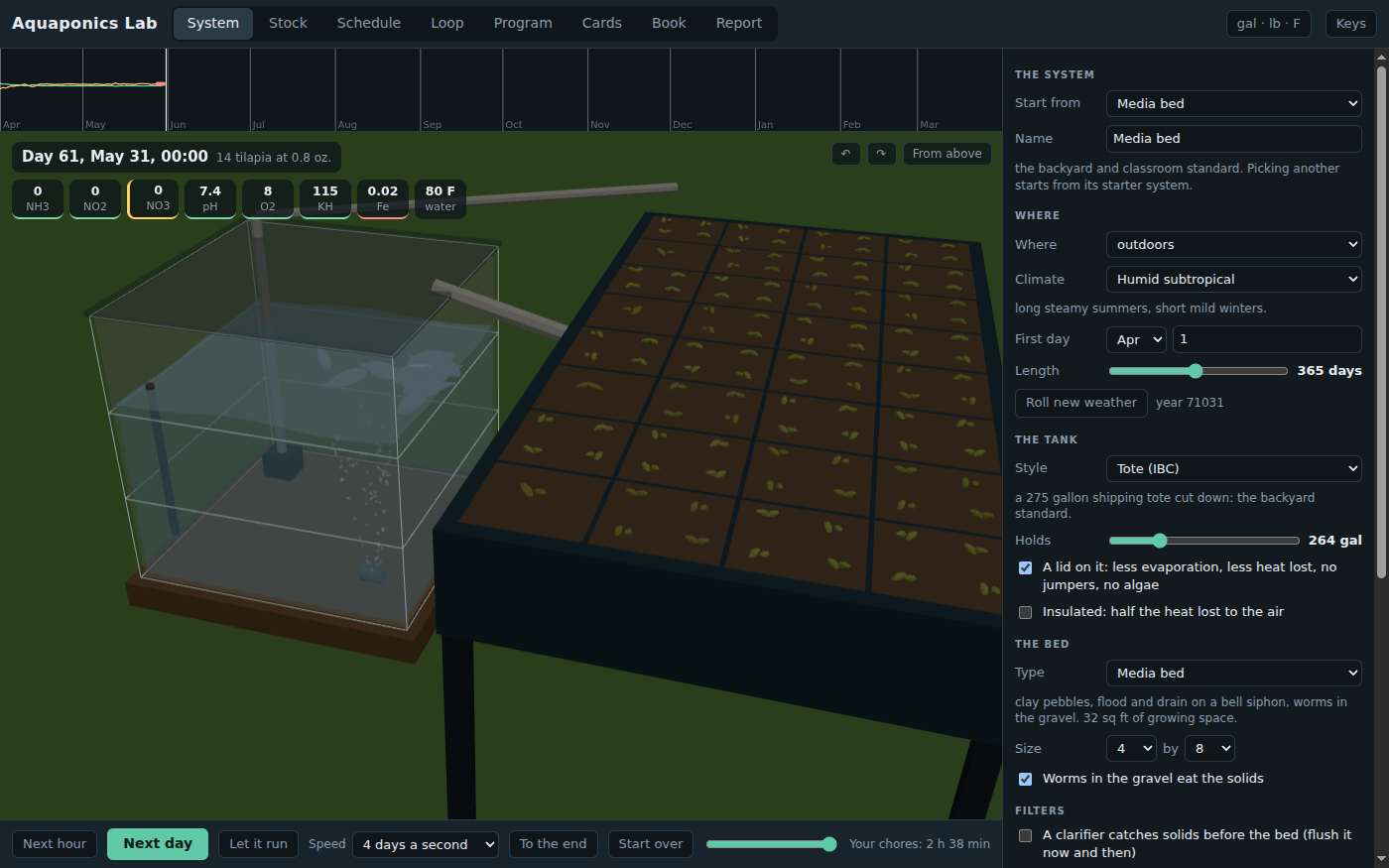
The System bench, a month earlier: the tank, the bed, the air and the climate are all choices, and each one changes how the year goes. The meters across the top are the water.
What they are learning while they play
Nothing here is presented as a lesson. This is what the activity is made of.
| What the student does | What it is |
|---|---|
| Stocks fish on day one and watches the ammonia climb | The nitrogen cycle. Fish give off ammonia, bacteria turn it into nitrite and then nitrate, and plants take the nitrate up. The Loop bench shows each step in grams, so a broken link shows where it broke. |
| Adds more fish than the bed can handle and reads the balance meter | Ecosystems in balance. The fish make nutrients and the plants use them. Too many fish and the water fouls; too few and the plants go hungry. The meter says which side it is on. |
| Loses fish in a power outage with no air backup | Dissolved oxygen. Warm water holds less oxygen, and fish use more of it at night. A few dark hours without a pump is enough to show why growers keep a battery for the air. |
| Keeps the pH between the fish's limits and the plants' limits | Chemistry and tradeoffs. Bacteria make the water more acid, fish and plants each prefer a range, and buffering costs something. Holding the pH is a compromise the student has to manage. |
| Writes a controller that feeds by the temperature | Sensors, conditionals and control. Cold fish eat less and leftover feed fouls the water. A program that reads the temperature before it feeds is a real control rule. |
| Works out pounds of feed per pound of fish | Efficiency and units. The feed conversion ratio is how fish farmers judge a system. The Book has every gram, so the student can work it out. |
How to tell whether it landed
Ask, and let them show you. A student who has understood it can answer these without help.
- Point to the arrow on the Loop bench where the ammonia turns into something else. What does that work?
- Why did the fish die when you stocked them on the first day?
- What happened in the outage, and what would have prevented it?
- Your nitrate keeps climbing. What could you change: the fish, the plants, or the feed?
- Read me your controller. What does it do on a cold night?
Use it in your subject
Not a technology class? Then the app is how students show what they learned in your unit. More projects for every subject.
Biology
Run a new system twice, once stocked on day one and once after cycling, and use the Loop bench to explain the difference with the nitrogen cycle.
Chemistry
Track pH, ammonia, nitrite and nitrate across a year and explain each turn in the chart.
Computer science
Write a controller that feeds by temperature and keeps the air on at night, then compare its year with the timers on the Report bench.
Agriculture and CTE
Design the desktop system, print its build sheet, and price it against a real tank. An adult does the building.
Practical notes
- AgesAges 10 through high school. Younger students build a system and run it by hand; middle schoolers read the Loop bench and balance fish against plants; older students write the controller.
- TimeTen minutes to stock a system and run a month. A good session is forty-five minutes: a system, a year, and one change that fixed something.
- EquipmentA computer or Chromebook with a modern browser. The system is 3D, so a very old or very slow computer may struggle. Nothing to install. A printer for the build sheet and the year card.
- CostFree. The app has no paid tier.
- PrepNone. Open the page and go. Run the starter system for a month yourself first; it takes ten minutes.
- In a groupEveryone can run the same system and compare the pounds of fish and greens. The model is part worked out and part rules of thumb, and the lab says which parts.
For co-ops, microschools, and classrooms
Give everyone the same system and the same fish, and see whose year grows the most food with the fewest fish lost. With a free account the systems are saved and shared, and a shared system plays its year back on its page.
Common questions
Is Aquaponics Lab free?
Yes. It runs in your browser and there is no paid tier. A free account adds saving and sharing, but nothing on this page is behind a paywall.
Does my child need an account to try it?
No. The demo on this page is the complete lab. Make a free account to save a system, share it, and keep the sheets it prints.
How real is it?
Some of it is worked out the way fish farmers and growers do it: the thermal growth coefficient for how fast a fish grows, the nitrogen in the feed and where it goes, how much oxygen water holds. Some of it is rules of thumb fitted to the guides, like how fast the filter grows in and what stress does to a fish. The lab lists which is which. Use it to understand a system, and a local guide before building one.
Can we build a real one from it?
The build sheet describes a small desktop system, and it says plainly to ask an adult, to check local rules, never to release fish, and that nothing grown in it is to be treated as safe to eat.
How is it different from Garden Lab?
Garden Lab is soil: a grid bed outdoors or in a greenhouse, with a robot to program. Aquaponics Lab is water: fish and plants in one loop. They share their weather and some crops, but not projects.
What subject can I log this as?
Most families log it as biology or chemistry, or agriculture. The table above lists specifically what is covered, so you can pick the label your records need and point at the evidence.
Still have a question? Ask us, and a person will write back.
Where to go next
Start with Aquaponics Lab
Trying it costs nothing and takes about five minutes. An account is what makes the work last.
Aquaponics Lab is one of the making apps on the platform. It is a place to make things, not a course, and it is not a substitute for a teacher: it is at its best when an adult asks the questions above and takes the answers seriously.
Page last reviewed October 2026.