Aquarium
The most common mistake with a first fish tank is putting fish in it too soon. The water looks clean, but the bacteria that make fish waste safe have not grown yet, and the fish get sick. Aquarium lets students make that mistake for free. They set up a 3D tank the way a real keeper does, cycle the filter, stock it, feed it and change the water, and watch six numbers tell them how it is going. Every fish runs a small program, which students can read and change: what it does when it is hungry, when a bigger fish comes near, when it wants to hide. Then they publish the tank, and anyone can watch it live and feed it.
Using this with a class? Make a free class and add your students yourself: each gets a username and password, with no email or Google account needed. Or give them one join code. Using Google Classroom? Post the link there; with a free class, the link also puts each student in your class, so you see their work.A first lesson: Half the class starts from the empty tank and stocks fish right away; the other half cycles the filter first. Run a week and compare the ammonia and the fish. Then everyone opens the planted community tank and changes one fish's brain, a tetra that hides when the angelfish comes near, and describes what changed in the school.
Set up a free class Share to Google ClassroomWhat a student actually does
They start from one of three tanks: an empty one with fresh water and a new filter, which is where a real tank starts; a five gallon desk tank with one betta, the classic first tank; or a twenty gallon planted community tank that is already cycled, with tetras, guppies and corydoras. They choose the tank's size, the sand or gravel, and decorate it with plants, rocks, driftwood, a castle or a shipwreck, or 3D models from their Files.
Then they keep it. Time runs at a minute a second or a day a minute. The filter and the light run on 24 hour schedules, a heater holds the temperature it is set to, and the hand switches feed the fish, change a quarter of the water or net a fish out. Six numbers say how the water is: ammonia, nitrite, nitrate, oxygen, temperature and algae. In a new tank the filter does nothing until its bacteria grow, and a forecast shows the curve, so a student who stocks too soon can see the ammonia coming. Overstock, overfeed, or let the filter stop, and the tank says so. A journal keeps what happened.
There are seven kinds of fish, neon tetras, guppies, goldfish, bettas, corydoras, angelfish and plecos, each with the numbers a keeper would recognize, how big it grows, how messy it is, what temperature it likes, where in the tank it swims and how hardy it is. Fish grow from half size, get hungry, school with their own kind and hide from bigger fish.
Each fish runs a small brain, and tapping a fish opens its card and its brain in a Glassbox drawer, as blocks or as code. A brain senses what is near, the nearest food, a bigger fish, a hiding spot, a wall ahead, and decides: swim toward, hide, school with. Every species starts with a default brain written the same way, so students can read it before they change it. Then they publish the tank. Its page shows it live, catching up on the time since it was last saved, and visitors can feed it.
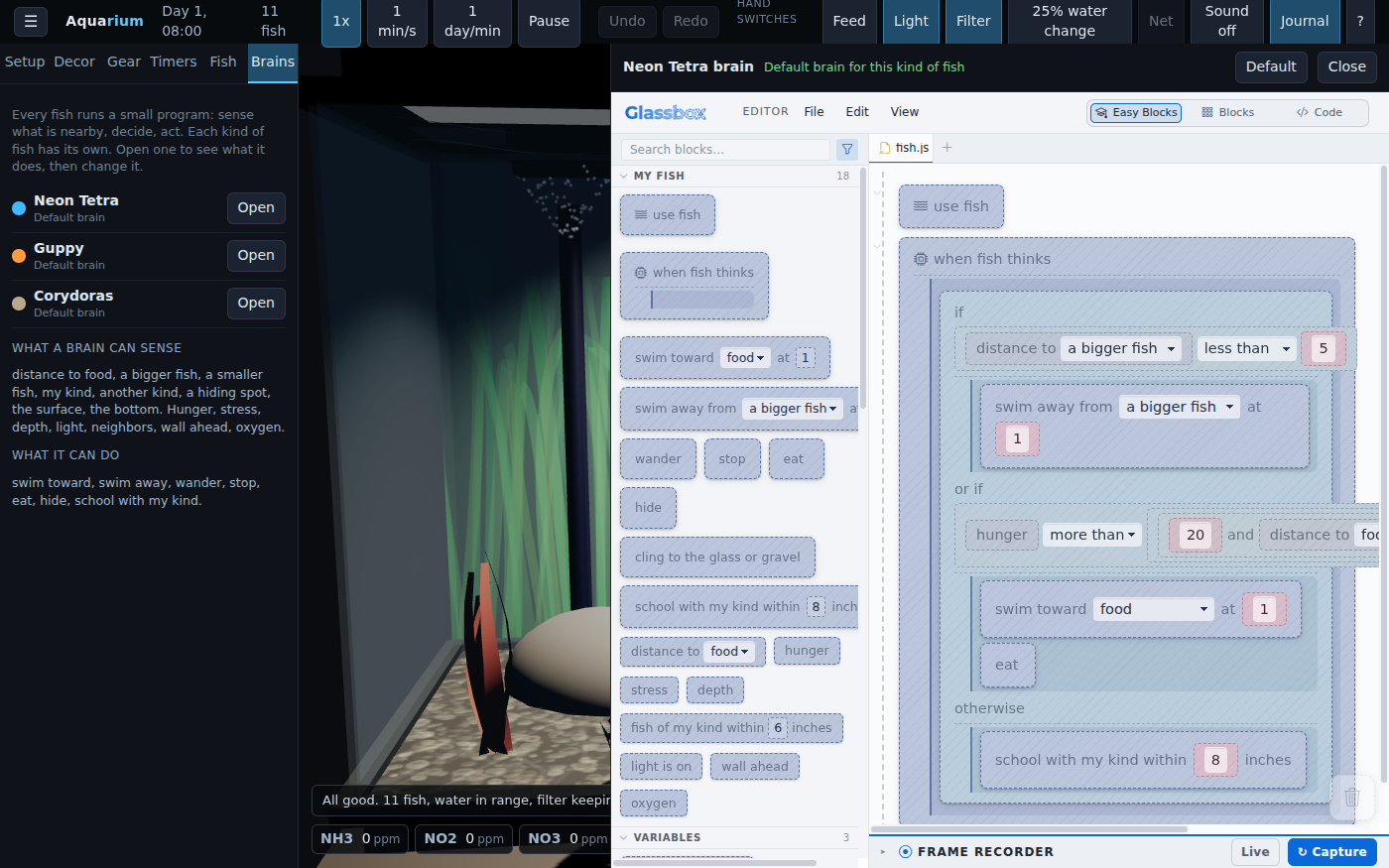
A neon tetra's brain, as blocks. Flee a bigger fish, eat when hungry, otherwise stay with the school. Every species starts with one like it, and a student changes it and watches the tank.
What they are learning while they play
Nothing here is presented as a lesson. This is what the activity is made of.
| What the student does | What it is |
|---|---|
| Stocks a new tank on day one and watches the ammonia climb | The nitrogen cycle. Fish waste becomes ammonia, bacteria turn it into nitrite and then nitrate, and a new filter has no bacteria yet. The numbers and the forecast show each step. |
| Puts in too many fish and reads what the tank says | Carrying capacity. A tank can only clean up after so much fish. Past that, the water fouls whatever else the student does. Stocking slowly is how keepers stay under the line. |
| Changes a quarter of the water and watches the nitrate drop | Dilution and maintenance. Nitrate builds up between water changes. A 25 percent change takes a quarter of it away. Doing it on a schedule is the routine every keeper learns. |
| Writes a brain that makes a tetra hide when the angelfish comes near | Conditionals and sensing. A brain senses what is around, decides and acts. If a bigger fish is near, hide; otherwise, school. Small rules make behavior a student can watch. |
| Watches a school form from three simple rules | Emergent behavior. Each fish only follows its neighbors, keeps its distance and matches their heading, yet the school moves as one. Nothing in the code describes the school itself. |
| Speeds time up and reads the forecast | Models and prediction. The forecast runs a copy of the tank ahead and shows what the water will do. Predicting before acting is what models are for. |
How to tell whether it landed
Ask, and let them show you. A student who has understood it can answer these without help.
- Why did the fish get sick in the new tank, when the water looked clean?
- What does the filter do, and why does it need weeks before it works?
- Read me your fish's brain. What does it do when a bigger fish swims close?
- Your nitrate keeps climbing. What can you do about it, and what causes it?
- Why do the tetras swim together when nothing in their brain says school?
Use it in your subject
Not a technology class? Then the app is how students show what they learned in your unit. More projects for every subject.
Biology
Cycle a new tank with no fish, record the ammonia, nitrite and nitrate every few days, and explain the curve with the nitrogen cycle.
Computer science
Write a brain for one species that hides from bigger fish and schools otherwise, and describe the behavior it makes.
Math
Work out how much nitrate is left after one, two and three 25 percent water changes, and check it against the tank.
Pet care
Plan a real first tank, its size, its fish, its cycling time and its routine, and check the plan in the simulator before buying anything.
Practical notes
- AgesAges 8 through high school. Younger students decorate, stock and keep a tank; older students read the water numbers and write fish brains.
- TimeA few minutes to a tank of their own. A good session is thirty to forty-five minutes: a tank cycled, stocked and kept for a simulated month.
- EquipmentA computer or Chromebook with a modern browser. The tank is 3D, so a very old or very slow computer may struggle. Nothing to install. It works on a phone too.
- CostFree. The app has no paid tier.
- PrepNone. Open the page and go. Watch the demo tank for a few minutes first.
- In a groupEveryone can start from the same tank and compare. There is no score and no winning: a tank is a pet that can be explained.
For co-ops, microschools, and classrooms
Give each student a tank to keep for a week of class time and compare the journals. With a free account the tanks are saved and shared, and a shared tank runs live on its page, where classmates can watch and feed it.
Common questions
Is Aquarium free?
Yes. It runs in your browser and there is no paid tier. A free account adds saving and sharing, but nothing on this page is behind a paywall.
Does my child need an account to try it?
No. The demo on this page opens on a cycled community tank with fish in it. Make a free account to set up a tank of their own, keep it and share it.
Can the fish die?
They can, if the water goes bad, it gets too cold, or a predator is hungry, the way it would in a real tank. A switch turns that off for a class: fish still get sick and the journal says why, but none die.
Is it a game?
No. There is no player, no score and no winning. It is a living tank: keep it well and it thrives, neglect it and it tells you why.
Will it help us set up a real tank?
It teaches the parts that trip up first-time keepers: cycling the filter before adding fish, not overstocking, and changing water on a schedule. A local fish store or a keeper's guide should have the last word on a real tank.
How is it different from Aquaponics Lab?
Aquarium is the fish you program: a tank to keep, and a brain for each fish. Aquaponics Lab is the system you program: fish and plants in one loop, grown for food.
What subject can I log this as?
Most families log it as biology or science, or computer science when the fish brains are the point. The table above lists specifically what is covered, so you can pick the label your records need and point at the evidence.
Still have a question? Ask us, and a person will write back.
Where to go next
Start with Aquarium
Trying it costs nothing and takes about five minutes. An account is what makes the work last.
Aquarium is one of the making apps on the platform. It is a place to make things, not a course, and it is not a substitute for a teacher: it is at its best when an adult asks the questions above and takes the answers seriously.
Page last reviewed October 2026.