Math projects students build, not just fill in
A worksheet asks for the answer. These projects make students predict it, build something, and then check the prediction against what they made: the angle between the copies in a symmetry drawing, the fraction of a bar a drum hits take up, the number of cubes in a model they built. The math has to be right or the thing does not come out right. Each project has a finished example you can open right now, a one-period version, a rubric that grades the math rather than the software, and a brief you can print.
Symmetry you can see
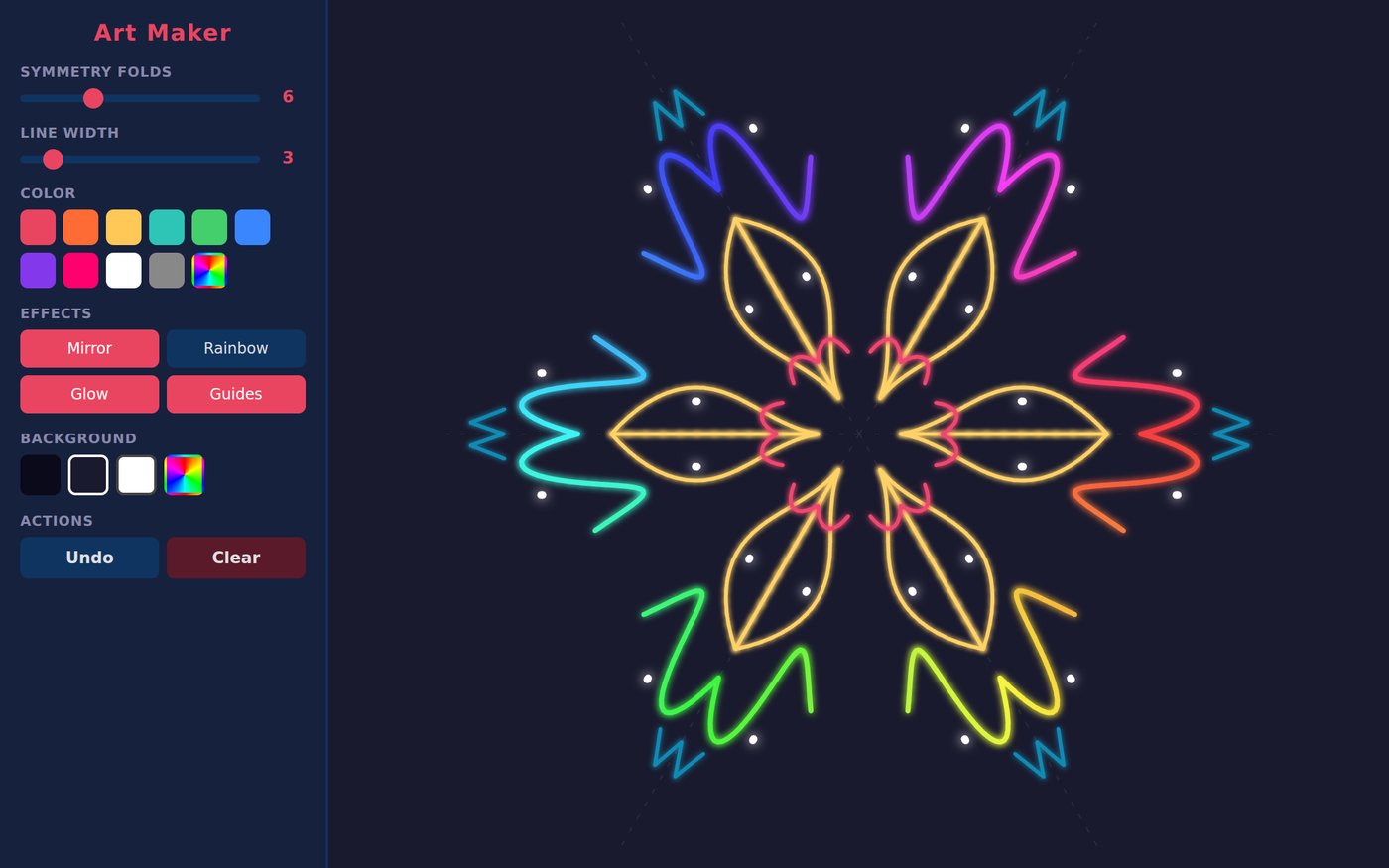
A drawing where every line repeats around the center. Students choose how many times, from 2 to 16 folds, and before each change they predict the angle between the copies. Then they draw and check. With Mirror on, every copy is also reflected, so the same drawing has both kinds of symmetry to find.
The one-period version
Everyone opens the six-fold drawing. Before touching anything, each student writes down the angle between neighboring copies. Then they change to 4 folds, predict again, and draw a line to check. Finish with 5 folds, where the angle is not a whole number of tens.
The full project
- Pick a fold count and write down the angle between neighboring copies before drawing: 360 divided by the number of folds.
- Draw a design, then count its lines of symmetry and its order of rotational symmetry.
- Repeat at two other fold counts, one of them odd.
- Switch Mirror off and on, and describe what changes in the symmetry.
- Find a real object with the same symmetry, a flower, a snowflake, a wheel or a logo, and show the match.
The finished piece has to answer
- What is the angle between copies at 8 folds, and at 5?
- How many lines of symmetry does your design have with Mirror on, and with it off?
- Which fold counts make a design that looks like a snowflake, and why that number?
What they hand in
The drawing's share link, and a table with the fold count, the predicted angle, the lines of symmetry and the order of rotation for each design.
Grading it: the math, not the software
| Prediction | Each angle is written down before drawing, as 360 divided by the fold count. |
| Accuracy | Angles, lines of symmetry and order of rotation are correct for each design. |
| Comparison | The student explains what Mirror changes, in words about reflection and rotation. |
| Connection | A real object is matched to one of the designs, with its symmetry named. |
What a student had to know to make this
That a full turn is 360 degrees and the copies split it evenly, and the difference between reflection and rotation. The app shows the answer instantly, so the prediction has to come first.
Common Core 4.G.A.3 (lines of symmetry), 4.MD.C.5 and 4.MD.C.7 (angles as parts of a full turn, and adding angles), with 8.G.A.1 (properties of rotations and reflections) for older students.
Fractions you can hear
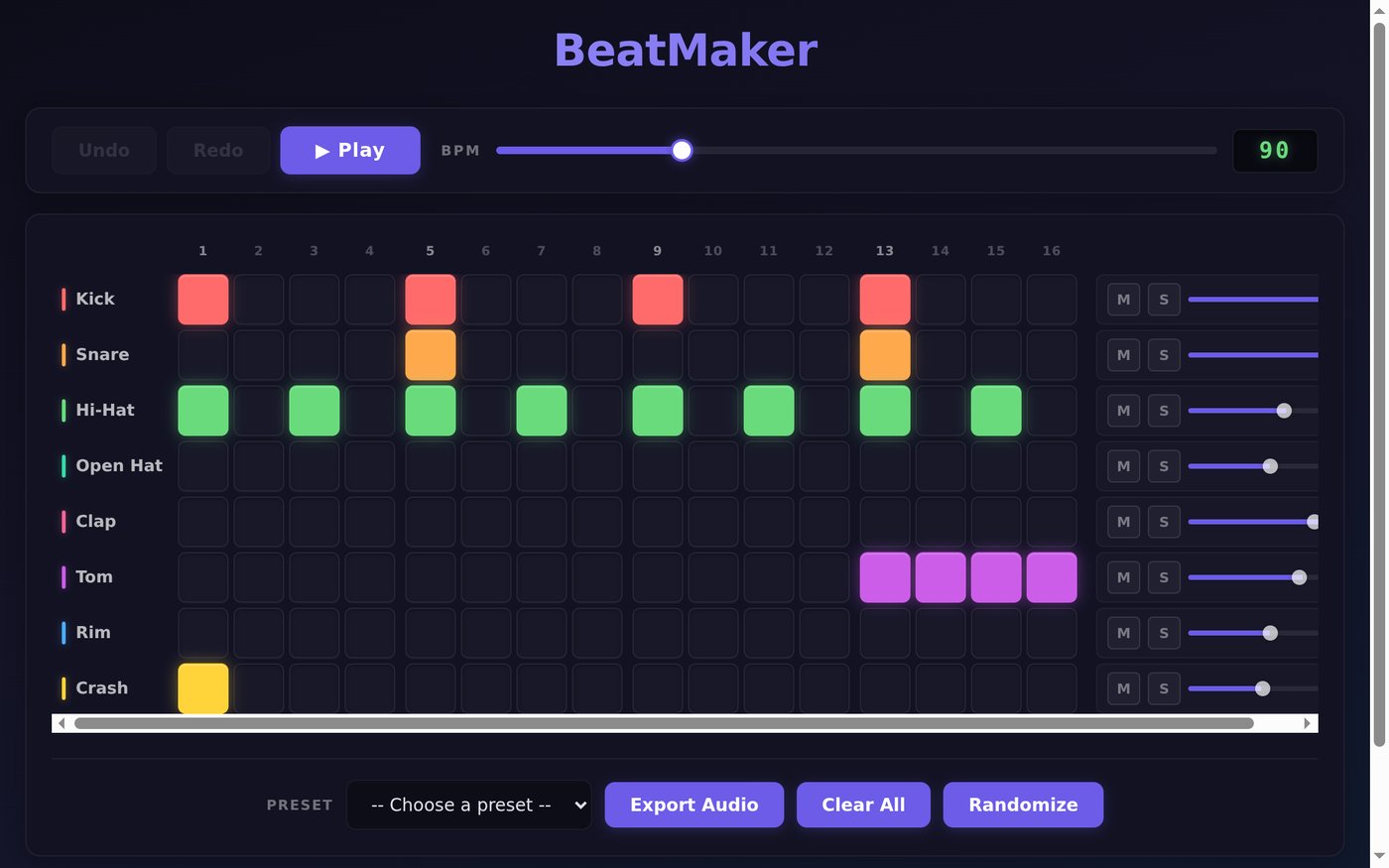
A one-bar drum beat on a grid of sixteen steps, where every drum's pattern is a fraction of the bar. Students build a beat, write each drum down as a fraction, and check the sums by ear: four sixteenths take up the same time as one quarter, and the beat sounds wrong if they do not.
The one-period version
Open the example and press Play. Mute every row but the hi-hat and ask how many hits there are in the bar and what fraction each one is. Do the same for the kick and the tom. Then ask the question the beat answers: how many sixteenths make a quarter?
The full project
- Count the steps in one bar and write down what fraction of the bar one step is.
- Build a beat with at least one drum on quarters, one on eighths and one on sixteenths.
- Write each drum's pattern as a fraction of the bar, and add up the time a group of hits covers.
- Change the tempo and work out how long one beat and one bar last in seconds.
- Play it for the class and explain one fraction sum they can hear.
The finished piece has to answer
- What fraction of the bar is one step, one beat, and two beats?
- How many eighths make a half, and where can you hear that in your beat?
- At 90 beats per minute, how long does one beat last? One bar?
What they hand in
The beat's share link, and a written score: each drum as a fraction, one addition that matches something in the beat, and the length of a bar in seconds.
Grading it: the math, not the software
| Fractions | Each drum's pattern is written as the right fraction of the bar. |
| Equivalence | At least one sum or equivalence is shown and matched to the beat. |
| Rate | The length of a beat and a bar in seconds is worked out from the tempo. |
| Explanation | The student explains a fraction the class can hear, out loud. |
What a student had to know to make this
That a fraction is equal parts of one whole, here one bar, and that fractions with different denominators can cover the same time. The ear is the check: a beat that is off by a sixteenth sounds off.
Common Core 3.NF.A.1 (unit fractions), 4.NF.B.3 (adding fractions with like denominators) and 5.NF.A.1 (unlike denominators), with 6.RP.A.3 (unit rates) for the tempo question.
Volume by the cube
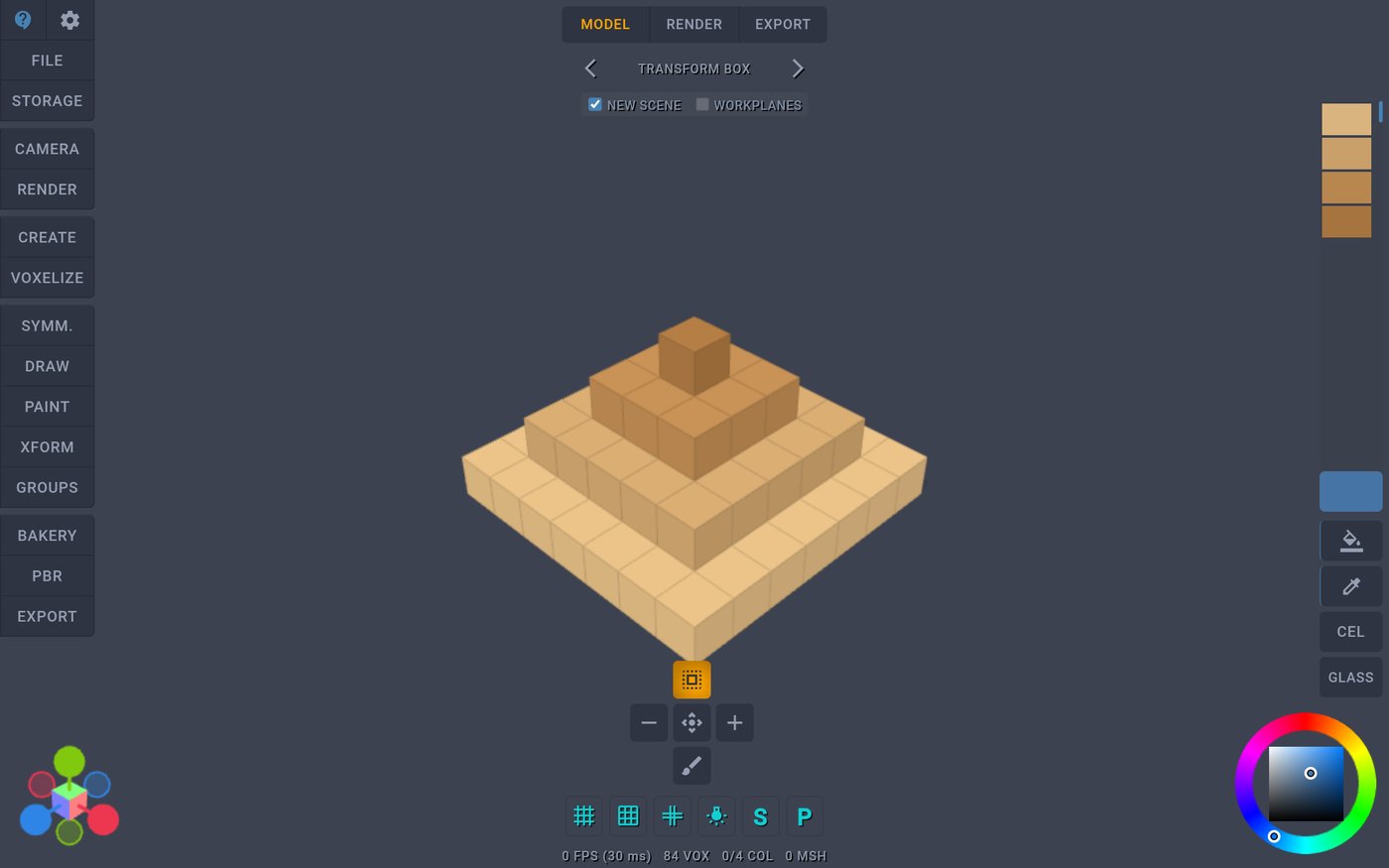
A model built out of unit cubes, where counting the cubes is measuring the volume. Students work out the volume and surface area of a shape on paper first, build it, and check the volume with the app's Measure Volume tool, which counts every cube in a box they drag.
The one-period version
Open the stepped pyramid. Students work out its volume layer by layer before counting, then check with Measure Volume. Then ask for the surface area, and let them argue about which faces count until they agree on 162.
The full project
- Sketch a shape made of rectangular prisms and work out its volume and surface area on paper.
- Build it in Voxel Art, one layer at a time.
- Check the volume with Measure Volume, and find the mistake if the numbers do not match.
- Change one dimension and predict the new volume before building it.
- Present the shape, the calculation and the check.
The finished piece has to answer
- What is the volume of each layer, and of the whole shape?
- Which faces count toward the surface area, and which are hidden?
- If every length doubled, what would happen to the volume?
What they hand in
The model's share link, the paper calculation, and the Measure Volume result that checks it.
Grading it: the math, not the software
| Volume | Worked out correctly before building, and checked in the app. |
| Surface area | Only the outside faces are counted, with the reasoning shown. |
| Decomposition | The shape is split into prisms, and their volumes are added. |
| Prediction | A change in one dimension is predicted before it is built. |
What a student had to know to make this
That volume is the number of unit cubes that fill a shape, and that a composite shape's volume is the sum of its parts. Building it makes the hidden faces obvious, which is where surface area usually goes wrong.
Common Core 5.MD.C.3, 5.MD.C.4 and 5.MD.C.5c (volume by unit cubes, and adding the volumes of composite solids) and 6.G.A.4 (surface area), with 7.G.B.6 for older students. The pyramid's 1 + 9 + 25 + 49 is also a sum of odd squares, an extension for high school.
In short
These are project-based alternatives to the math worksheet for grades 3 to 8. Students draw with rotational symmetry and predict the angle between the copies, build a drum beat and write it down as fractions of a bar, or build a stepped pyramid from unit cubes and find its volume and surface area, in free browser apps that run on Chromebooks with no install and no student email.
Common questions
I am not a tech person. Can I run these?
Yes. Open the finished example the day before and spend five minutes with it. Each app has one or two controls that matter for the math, and the brief names them. Your part is the math, which you already know.
Do students need accounts?
Not for the one-period versions: the examples open in the browser with no sign-up. To save their own work they need a free account, and a free class holds up to 50 students with no email needed.
Doesn't the app just give them the answer?
It checks the answer, which is the point. Every brief makes students predict first and write the prediction down, and then the app shows whether they were right. The grade is on the prediction and the explanation, not on the finished drawing, beat or model.
Will it run on our Chromebooks?
Yes. Everything runs in a browser tab with nothing to install. Voxel Art uses 3D graphics and loads more slowly on older machines.
Still have a question? Ask us, and a person will write back.
Start with a free class
Open one of the examples yourself, then set up a class and hand out the brief.