Art Maker
Draw one line and it appears eight times around the center, mirrored, glowing, in any color. Art Maker is a kaleidoscope you draw into, and it makes something beautiful out of any scribble, which is exactly why it gets students thinking about symmetry. It opens on a neon mandala made of just six strokes. Add your own, change the number of folds, and switch on Rainbow. Free, in the browser, no account needed to try it.
Using this with a class? Make a free class and add your students yourself: each gets a username and password, with no email or Google account needed. Or give them one join code.A first lesson: Everyone draws the same single stroke at 3, 6 and 12 folds, then the room sorts the results into the shapes they look like in nature: flowers, snowflakes, starfish.
Set up a free classWhat a student actually does
They draw a quick line near the edge and it blooms into sixteen copies around the mandala. They drag Symmetry Folds down to 5 and draw again, and the new line repeats five times while the old ones keep their eight, so the picture now has two rhythms at once. They turn on Rainbow and the color starts changing around the circle. Within a minute they are drawing on purpose, planning where a stroke will land when it is copied.
From there it is a pattern studio. Anywhere from 2 to 16 folds, mirror on for snowflakes or off for pinwheels, line width, a palette of colors plus rainbow, glow for neon, guides that show the fold lines, and dark, navy, white or custom backgrounds. Undo takes back a stroke at a time, and with an account the piece saves and can be shared as a replay that draws itself stroke by stroke.
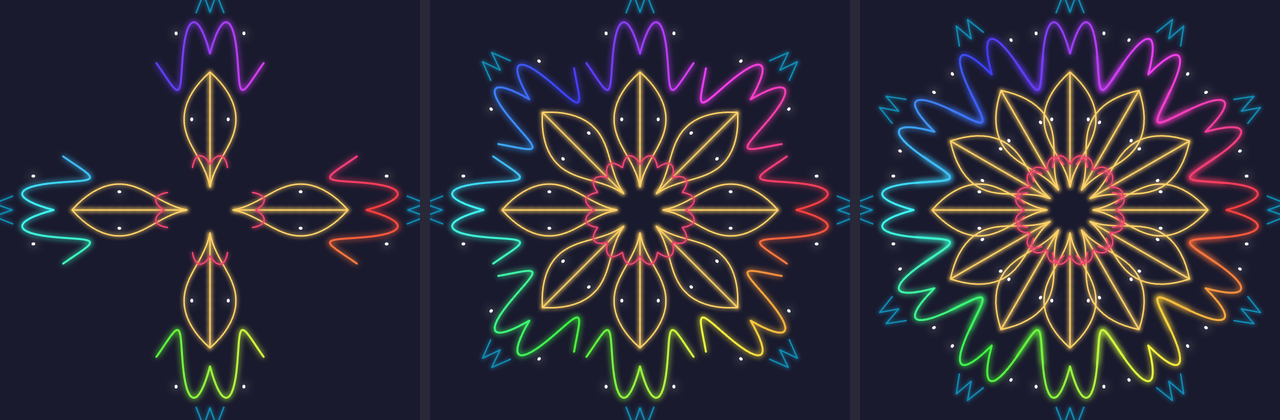
Six strokes, drawn once, repeated 4, 8 and 12 times around the center with a mirror image of each. Nothing else changed. That is rotational symmetry: turn the picture by one fold, a quarter, an eighth or a twelfth of a circle, and it lands exactly on itself.
What they are learning while they play
Nothing here is presented as a lesson. This is what the activity is made of.
| What the student does | What it is |
|---|---|
| Draws one line and sees eight | Rotational symmetry. A shape that looks the same after a turn has rotational symmetry. Eight folds means it matches itself every eighth of a circle. |
| Turns Mirror on and off | Reflection symmetry. A mirror line flips a shape. Mirror plus rotation gives a snowflake; rotation alone gives a pinwheel. |
| Changes 8 folds to 5 | Angles in a circle. Each fold is 360 degrees divided by the number of folds: 45 degrees for eight, 72 for five. |
| Turns on Guides | Lines of symmetry. The guide lines show where the copies are made, so a student can plan a stroke to cross one on purpose. |
| Draws near the center, then near the edge | Radius and scale. The same motion makes a tight knot near the middle and a wide ring at the edge. Distance from the center changes everything. |
| Switches on Rainbow | Color as a function. The rainbow color depends on where the line is around the circle, so position picks the hue. |
| Compares a result with a flower or a snowflake | Symmetry in nature. Starfish have five-fold symmetry, snowflakes six, many flowers five or eight. Patterns in nature often count the same way. |
| Plans a design before drawing | Design intent. Knowing every stroke will be copied changes how you draw. Good pattern designers draw one small part carefully. |
How to tell whether it landed
Ask, and let them show you. A student who has understood it can answer these without help.
- You drew one line. Why are there sixteen?
- How many degrees apart are the copies with 6 folds?
- Make something that looks like a snowflake. Then make it a pinwheel. What did you change?
- Where would you draw to make a small center instead of a big ring?
- Find something in nature with five-fold symmetry.
Practical notes
- AgesAges 5 through high school. Young children make beautiful things right away; older students plan patterns and work out the angles.
- TimeSeconds to the first pattern. A finished piece takes ten to thirty minutes.
- EquipmentAny computer, Chromebook or tablet with a modern browser. A mouse, a touch screen or a stylus all work. Nothing to install.
- CostFree. The app has no paid tier.
- PrepNone. Open the page and go. Reading this page first takes about three minutes.
- In a groupEveryone can draw the same stroke at different fold counts, and the room compares what each number makes.
For co-ops, microschools, and classrooms
Assign each student a fold count from 3 to 12 and one rule, like a single stroke only, then line the results up in order. The room can see symmetry grow, and the angle math comes out of the pictures rather than the other way round.
- Anywhere from 2 to 16 folds, with or without mirroring.
- Rainbow, glow and guide lines that show the symmetry.
- Works with a mouse, a touch screen or a stylus.
- No install, no per-seat license. Student work is private by default.
Common questions
Is Art Maker free?
Yes. It runs in your browser and there is no paid tier. A free account adds saving and sharing, but nothing on this page is behind a paywall.
Does my child need an account to try it?
No. The demo on this page is the complete app with a starter mandala. Make a free account and the piece you made comes with you as your first project.
What ages is it for?
Ages 5 and up. It is one of the few tools here a young child can use happily straight away, and older students can go deep on the math of symmetry.
Does it work on a tablet?
Yes. Drawing with a finger or a stylus works well, and so does a mouse.
Can they share what they make?
Yes, with a free account. A shared piece plays back as a replay that draws itself stroke by stroke.
What subject can I log this as?
Most families log it as art or math. Symmetry, angles and circles are geometry, and color and composition are art. The table above lists specifically what is covered, so you can pick the label your records need and point at the evidence.
Where to go next
Start with Art Maker
Trying it costs nothing and takes about five minutes. An account is what makes the work last.
Art Maker is one of the making apps on the platform. It is a place to make things, not a course, and it is not a substitute for a teacher: it is at its best when an adult asks the questions above and takes the answers seriously.
Page last reviewed September 2026.