BotForge
A student designs a combat robot in 3D, programs how it fights, and takes it into an arena to find out whether it works. It opens on a finished spinner bot, so the first thing to do is change it and test it. Free, in the browser, no account needed to try it.
What a student actually does
They start with a spinner bot that already works. They spin up the weapon, open the stats to see its speed, damage and how long its battery lasts, then start changing things: a different weapon, a heavier chassis, bigger wheels. Every change moves the weight meter, and the bot has to stay under 200 kg, so every choice costs something somewhere else.
Then they decide how it fights. The Brain tab is a list of rules, like "when the enemy is to my left, turn left," that run in order many times a second, and a practice arena shows which rule is firing. When the rules are not enough, the same brain opens as blocks and then as JavaScript. Test in Rumblebots takes the bot into the arena to fight AI bots, and the loop of build, test, change is the whole game.
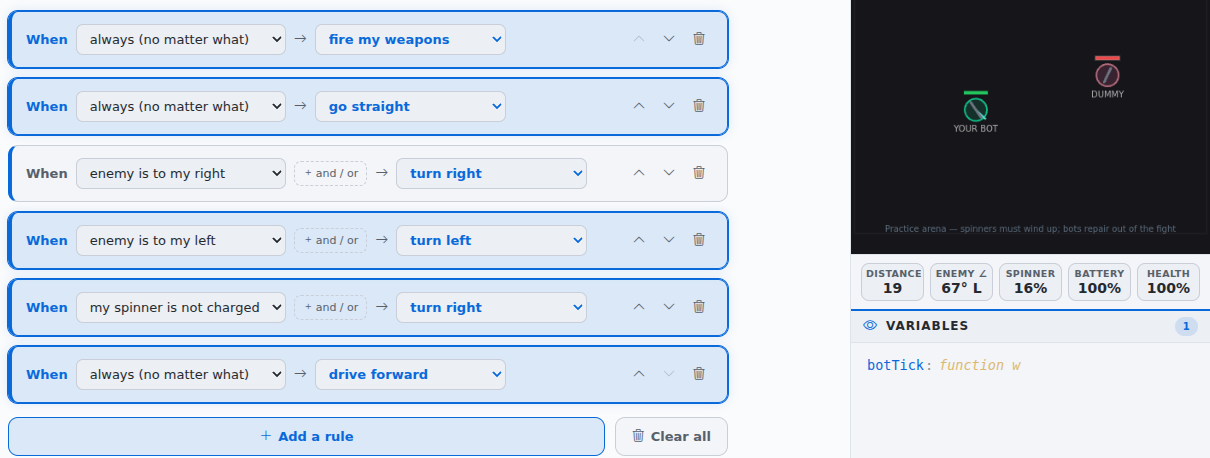
The bot's brain, as rules. Each card is one when-then decision, the ones glowing are true right now, and the practice arena beside them runs the rules against a dummy. The same brain can be opened as blocks or as JavaScript when a student is ready for more.
What they are learning while they play
Nothing here is presented as a lesson. This is what the activity is made of.
| What the student does | What it is |
|---|---|
| Keeps the bot under 200 kg | Design under constraints. Armor, weapons and batteries all weigh something. Adding one thing means giving up another. |
| Changes the gear ratio on the wheels | Torque and speed. A higher gear ratio shoves harder but tops out slower; a lower one is fast but easy to push around. Real motors make the same trade. |
| Winds up a spinner before it hits | Stored energy. A spinning weapon builds up energy over time and spends it in one impact, which is why it has to charge. |
| Watches the battery run down in a fight | Power budgets. Weapons draw more power than the battery puts back. The stats show how long the bot lasts before it browns out. |
| Moves heavy parts lower on the bot | Center of mass. A low, wide bot is hard to tip over. A tall one flips easily, and that decides fights. |
| Writes "when the enemy is to my left, turn left" | Conditionals. If this is true, do that. The rules are real program logic, just written as cards. |
| Reorders two rules and sees the bot behave differently | Order of execution. Rules run top to bottom and the later one wins, the same way lines in a program do. |
| Loses a fight, changes one thing, tests again | The engineering loop. Predict, test, compare, adjust. Changing one thing at a time is how you learn which change mattered. |
How to tell whether it landed
Ask, and let them show you. A student who has understood it can answer these without help.
- What did you give up to stay under 200 kg?
- Why does your spinner need to wind up before it hits?
- Show me the rule that makes your bot turn toward the enemy. What happens if you move it to the top?
- Your bot ran out of battery halfway through the fight. What would you change?
- Before you test your next change, tell me what you expect to happen. Were you right?
Practical notes
- AgesAges 9 through high school. Younger students build and battle from the templates; older ones tune the stats and write the brain in blocks or JavaScript.
- TimeA minute to a first change and a first fight. A satisfying session is thirty to forty-five minutes of build, test, change.
- EquipmentAny computer or Chromebook with a modern browser and a mouse or trackpad. Nothing to install. The arena opens in a new tab.
- CostFree. The app has no paid tier.
- PrepNone. Open the page and go. Reading this page first takes about four minutes.
- In a groupThe class can fight each other's bots in a private room, or everyone can test against the same AI bots and compare.
For co-ops, microschools, and classrooms
Set one weight limit and one rule, such as "change only one thing between tests," and the room turns into a design lab. Students make a prediction, run the fight, and argue about why it went the way it did. A private room lets the class fight each other's bots without anyone from outside.
- Private rooms for a class, alongside practice against AI bots.
- Nine short interactive explorations go deeper: flywheels, gear ratios, wheels versus tracks, armor, center of mass, power budgets, and coding a bot brain.
- No install, no lab setup, no per-seat license. Chromebooks are fine.
- A free teacher account covers up to 50 students, and student work is private by default.
Common questions
Is BotForge free?
Yes. The app and the arena run in your browser and there is no paid tier. A free account adds saving and your own list of bots, but nothing on this page is behind a paywall.
Does my child need an account to try it?
No. The demo on this page is the complete app with a starter bot, and it can go straight into the arena's practice mode against AI bots. Make a free account and the bot you changed comes with you as your first project.
Is this real programming?
Yes, in steps. The first level is a list of when-then rules that read like sentences. The same brain opens as blocks, and then as JavaScript, so a student moves to real code when they are ready and the bot keeps working the whole way.
What ages is BotForge for?
Ages 9 through high school. Younger students build from the templates and fight. Older ones work the numbers in the stats panel and program the brain.
Who else is in the arena?
Practice mode is the student against AI bots, nobody else. There is also an open public arena, and private rooms a teacher can set up for a class. The public arena is optional.
Does it install anything, and will it work on a Chromebook?
It installs nothing and runs in any modern browser, Chromebooks included. The builder is 3D and works with a mouse or a trackpad.
What subject can I log this as?
Most families log it as engineering or computer science. Gear ratios, energy and center of mass are physical science, the weight limit is design under constraints, and the brain is programming with conditionals. The table above lists specifically what is covered, so you can pick the label your records need and point at the evidence.
Where to go next
Start with BotForge
Trying it costs nothing and takes about five minutes. An account is what makes the work last.
BotForge is one of the making apps on the platform, and RumbleBots is its arena. It is a place to make things, not a course, and it is not a substitute for a teacher: it is at its best when an adult asks the questions above and takes the answers seriously.
Page last reviewed September 2026.