Fire Lab
A campfire built from the heat, not from pictures of flames. Every piece of wood has a thickness, a moisture content and a temperature. A match has about ten seconds of heat and a log needs minutes of it. Tinder flashes and is gone. Kindling packed too tight smothers; kindling spread too wide never shares its heat. Wind bends the flame, blows a small one out, feeds a big one and throws embers past the ring. Water has to boil before the fire is out, and dirt over coals keeps them hot until the morning. Fire Lab is a safe place to get all of that wrong first, so the real fire, with an adult at a proper ring, goes right. Free, in the browser, no account needed to try it.
Using this with a class? Make a free class and add your students yourself: each gets a username and password, with no email or Google account needed. Or give them one join code. Using Google Classroom? Post the link there; with a free class, the link also puts each student in your class, so you see their work. mytekDev is also available from the Google Workspace Marketplace, so your school's Google admin can install it for everyone.A first lesson: Everyone lights a teepee from one match and puts it out cold, then the wind comes up to 15 and the room finds out which lays still light. The fire log is the exit ticket.
Set up a free class Share to Google ClassroomWhat a student actually does
They drag a log into the ring and take a match to it, because everyone does. The match burns out and the card says why: ten seconds of heat against a piece that needs minutes. Then the pencil test, sorting the bin into tinder thinner than a matchstick, kindling pencil to thumb, and fuel thumb to wrist. Then grass alone, which flashes and dies. Then the teepee outline, twigs leaning over the grass and sticks outside those, and the match through the door. It lights. They feed it, thin first, and when the kindling is going the fuel outlines appear.
Then the part most people skip: the bucket, the stir, the bucket again, and the back of the hand over the ash. Warm is not out. The log takes the fire only when the hand says cold. After that the ring is theirs: wind at 15 and a match that dies until they kneel upwind or build the lean-to, an ember on the leaves outside the ring, dirt on the coals and a morning breeze that finds them, a ban day where the right fire is a stove, a pot that the teepee boils fast and the cabin boils steadily, and a program that feeds a fire by rules from a fixed pile of wood.
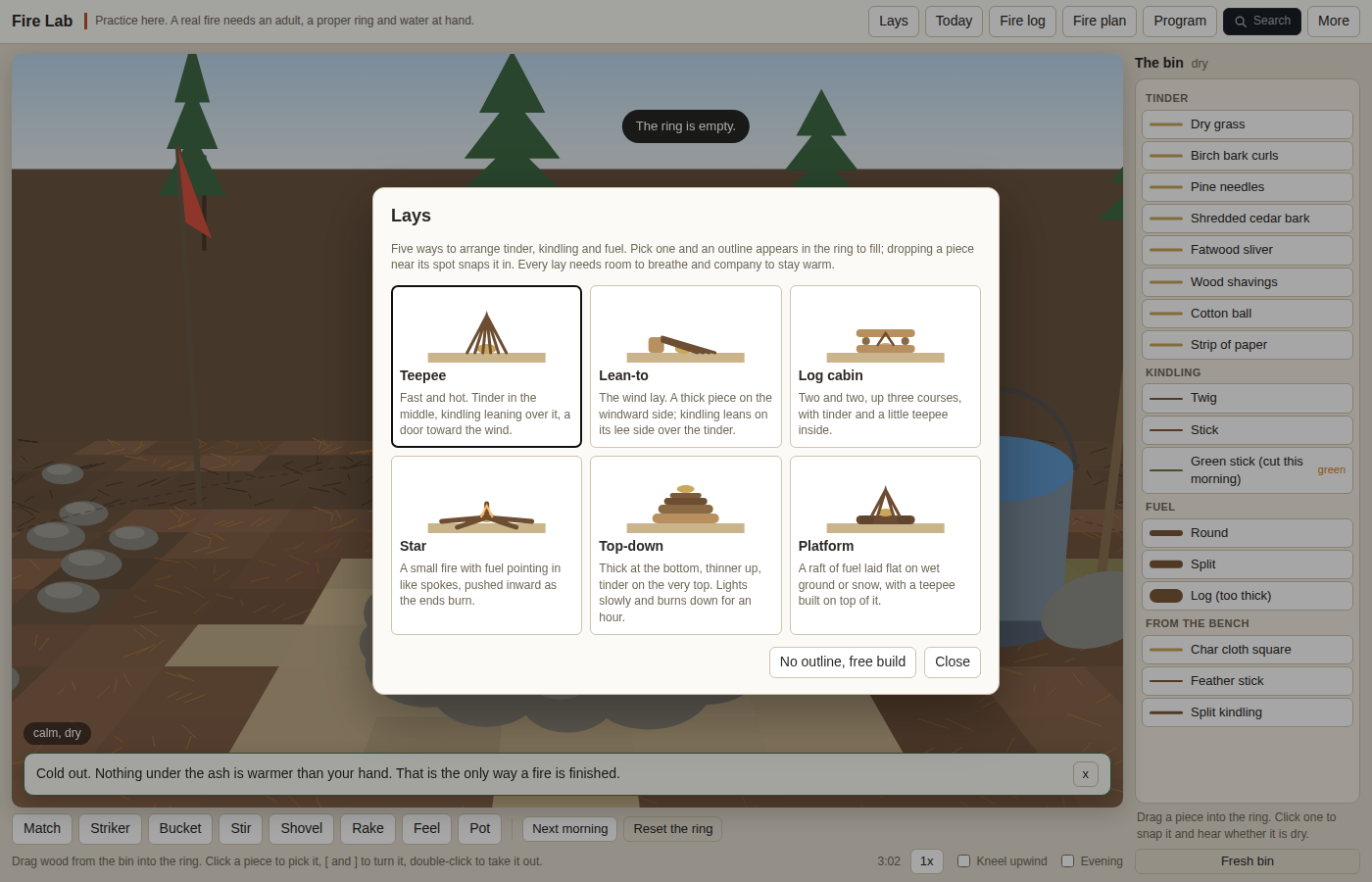
Five ways to arrange tinder, kindling and fuel. None of them is scripted: the same model of heat, air and moisture makes the teepee fast and hot, the lean-to light in wind, the log cabin steady, the star thrifty and the top-down slow and long.
What they are learning while they work
Nothing here is presented as a lesson. This is what the activity is made of.
| What the student does | What it is |
|---|---|
| Sorts the bin into three piles | The fire triangle, in order. Heat, fuel and air. A match lights tinder, tinder lights kindling, kindling lights fuel. Skip a size and the heat has nowhere to go. |
| Watches a match burn out against a log | Heat capacity and surface. A thin piece has lots of surface per gram and heats in seconds. A log is the same wood with the heat spread through a hundred times the mass. |
| Sees the grass flash and die with the kindling still in the bin | Ignition takes time as well as heat. Wood flames at about 300 degrees with a flame touching it. Tinder gives eight seconds of flame; the kindling has to be close enough to reach that in time. |
| Builds a pile that smokes grey and dies | Air, and the packing of a fire. Pieces pressed against each other starve. Pieces far apart never share heat. A lay is the shape that gives both: room to breathe and company to stay warm. |
| Loses the match to the wind, then lights the lean-to | Wind cools a small flame and feeds a big one. The same breeze takes a match and makes a fire roar. A wall to windward shelters the match; the plume feeds the kindling on the lee. |
| Sees damp wood hiss and smoke white | Water has to boil off first. Every gram of water in the wood costs 2,260 joules before the surface can climb past 100 degrees. That is why wet wood is slow and why the smoke goes white. |
| Stamps an ember on the leaves and rakes the circle | Why the clear ring is three big steps. Embers fly downwind and land on whatever is there. On bare soil they die. On dry leaves they smolder. The circle is the distance an ember flies. |
| Drowns, stirs and feels, or shovels dirt on and presses Next morning | Out cold. Dirt insulates coals and keeps them above ignition for hours. Water takes the heat away, stirring reaches what is underneath, and the back of the hand is the only test. |
How to tell whether it landed
Ask, and let them show you. A student who has understood it can answer these without help.
- Why did the match do nothing to the log, and what would you light first?
- The grass flashed and went out. What had to be in place before the match?
- Your pile is smoking grey and the flames are dying. What is wrong with it, and what do you do?
- The wind took your match twice. Name two ways to light the fire anyway.
- The flames are gone and you shoveled dirt over the coals. Is the fire out? How would you know?
Use it in your subject
Not a technology class? Then the app is how students show what they learned in your unit. More projects for every subject.
Science
Heat transfer by radiation and convection, ignition temperature, moisture and latent heat, the fire triangle, combustion as a chemical change. The Ranger heat card prints temperature, heat in and heat out for any piece while it burns.
Outdoor skills and safety
The pencil test, five fire lays, kneeling upwind, the clear circle, water at hand, drown-stir-feel, fire bans and when a stove is the right fire. Practice for the fire-safety card a troop issues, and for a family's first backyard fire.
Computer science
Program the tender: a tend(fire, pile) function in JavaScript that feeds a fire by rules from a fixed pile, scored on how long the fire gives heat. Sensing, conditions, and the cost of greed.
Practical notes
- AgesGrades 3 to 5 use Little mode, where a grown-up figure lights the fire once the ring is ready and the child builds, sorts and puts out. Grades 5 to 8 use Scout mode, the whole ring. Ranger mode adds the numbers, gusts, stones from the stream, a branch over the ring and a tent too close, for middle school science and for scouts preparing for the real thing.
- TimeThe first fire, lit and put out cold, takes ten minutes. The wind, the embers and the morning after take another twenty. A satisfying session is forty-five minutes.
- EquipmentA computer, Chromebook or iPad with a modern browser and a mouse, trackpad or touch screen. Nothing to install. No real fire, no matches, nothing to buy.
- CostFree. The app has no paid tier.
- PrepNone. Open the page and go. Reading this page first takes about four minutes. Every screen carries the line that this is practice and a real fire needs an adult, a proper ring and water at hand.
- In a groupEveryone lights the same teepee from one match, then the wind comes up and the room compares lays. The fire log is the exit ticket: lay, time to flame, time to coals, embers out, how it was put out, cold out or not.
For troops, co-ops, microschools and classrooms
A troop gets one evening at a fire ring and twelve scouts, each with one match and one try. Most of what there is to learn happens in the thirty seconds nobody can replay. Here every scout replays it as often as they like, with the reason on a card, before the first real fire. Families with a backyard pit learn the pencil test, the lays and drown-stir-feel on a rainy night and do it for real at the weekend.
- Five lays plus the platform for wet ground, each behaving as it does because of the same model of heat and air.
- Three modes: Little builds and a grown-up lights it, Scout is the whole ring, Ranger adds the numbers and the hazards.
- A fire log and a printable fire plan: the lay, the wood list and the safety checklist for the real one.
- A free teacher account covers up to 50 students, and student work is private by default.
Common questions
Is Fire Lab free?
Yes. It runs in your browser and there is no paid tier. A free account adds saving and sharing, but nothing on this page is behind a paywall.
Does my child need an account to try it?
No. The demo on this page is the complete app with an empty ring and a full bin. Make a free account and the fire log comes with you as your first project.
Does it teach children to light fires?
It teaches them what a fire needs and what puts one out, on screen, with an adult named on every page as the one who says when. Nothing in the app is a liquid fuel, nothing burns that is not firewood or natural tinder, the knife and saw are a leader's lesson and are not shown, and an ember never leaves the clearing. The real fire is the test, and the adult is the one who says when.
What ages is it for?
Little mode suits ages 6 to 9: the child sorts, builds and puts out, and a grown-up figure lights it after checking the ring. Scout mode suits 9 to 14. Ranger mode, with the heat card and the hazards, suits middle school science and older scouts.
Does it work for Scouts BSA or Girl Scouts requirements?
It is practice for them, not a substitute. A leader still watches a real fire. It covers what the fire-building requirements ask about: when to use fire, tinder, kindling and fuel, building and putting out a fire, and when a stove is the right choice.
Is the fire realistic?
It is a model, kept simple on purpose, and the Ranger heat card says so. Ignition temperatures, moisture, the latent heat of water and the public campfire-safety rules come from published sources listed in the spec; how heat moves between pieces is the app's own, tuned so the real rules fall out of it: thin before thick, dry before wet, room to breathe and company to stay warm.
Can it be used on an iPad?
Yes. Drag with a finger, tap a bin item to hear whether it is dry, and the Turn button turns a picked piece. Sound starts after the first tap.
Still have a question? Ask us, and a person will write back.
Where to go next
Start with Fire Lab
Trying it costs nothing and takes about five minutes. An account is what makes the work last.
Fire Lab is one of the science apps on the platform. It is a practice ring: the real fire needs an adult, a proper ring, water at hand and a place where fires are allowed.
Page last reviewed October 2026.
Google, Google Classroom and Chromebook are trademarks of Google LLC.