Storm Lab
A thunderstorm needs damp air near the ground, air that gets cold quickly going up, and something to push the air up. A tornado needs wind that grows and turns with height as well. Storm Lab lets students mix those ingredients and watch what the sky does with them: a few small clouds, a thunderstorm, a spinning supercell, a tornado. Then the storm crosses a small town, the students rate it from the damage it left the way a survey team does, and they decide how the town should build and when its siren should sound.
Using this with a class? Make a free class and add your students yourself: each gets a username and password, with no email or Google account needed. Or give them one join code. Using Google Classroom? Post the link there; with a free class, the link also puts each student in your class, so you see their work.A first lesson: Everyone starts from the same cool gray day with no storm in it and has to make a thunderstorm out of it, writing down each change and which ingredient it gave the storm. Then the class compares lists.
Set up a free class Share to Google ClassroomWhat a student actually does
They pick a kind of day, like Summer afternoon, and press Make the storm. A bubble of air rises from the ground, makes a cloud where it cools enough, and keeps rising or stops. Under the sky one line says what happened, and why: An ordinary thunderstorm, or The cap held, or No cloud because the air is too dry. A checklist of five ingredients shows which were there.
Then they change the sky. Each ingredient is a slider described in words, like warm, sticky or a weak lid, with the numbers behind a switch. When a sky makes no storm, the lab works out, by trying each slider on its own, the smallest change that would make one, and a Try it button shows it.
With wind that grows and turns with height, a storm can start to spin. A supercell shows five tornado ingredients, the ones forecasters multiply together, and some runs make a tornado. Sent across the town, it damages buildings according to the Weather Service's damage tables, and the student surveys it and gives it its rating.
Then they get the town ready. They spend a limited budget on hurricane straps, anchor bolts, tie-downs and a safe room, and send the same storm again to see what that saved. On the Warn bench they write the rules for the town's tornado siren and test them on a season of 34 storms, against the Weather Service's own record. A storm can be saved as a challenge for a friend: the same storm, the same town and the same money.
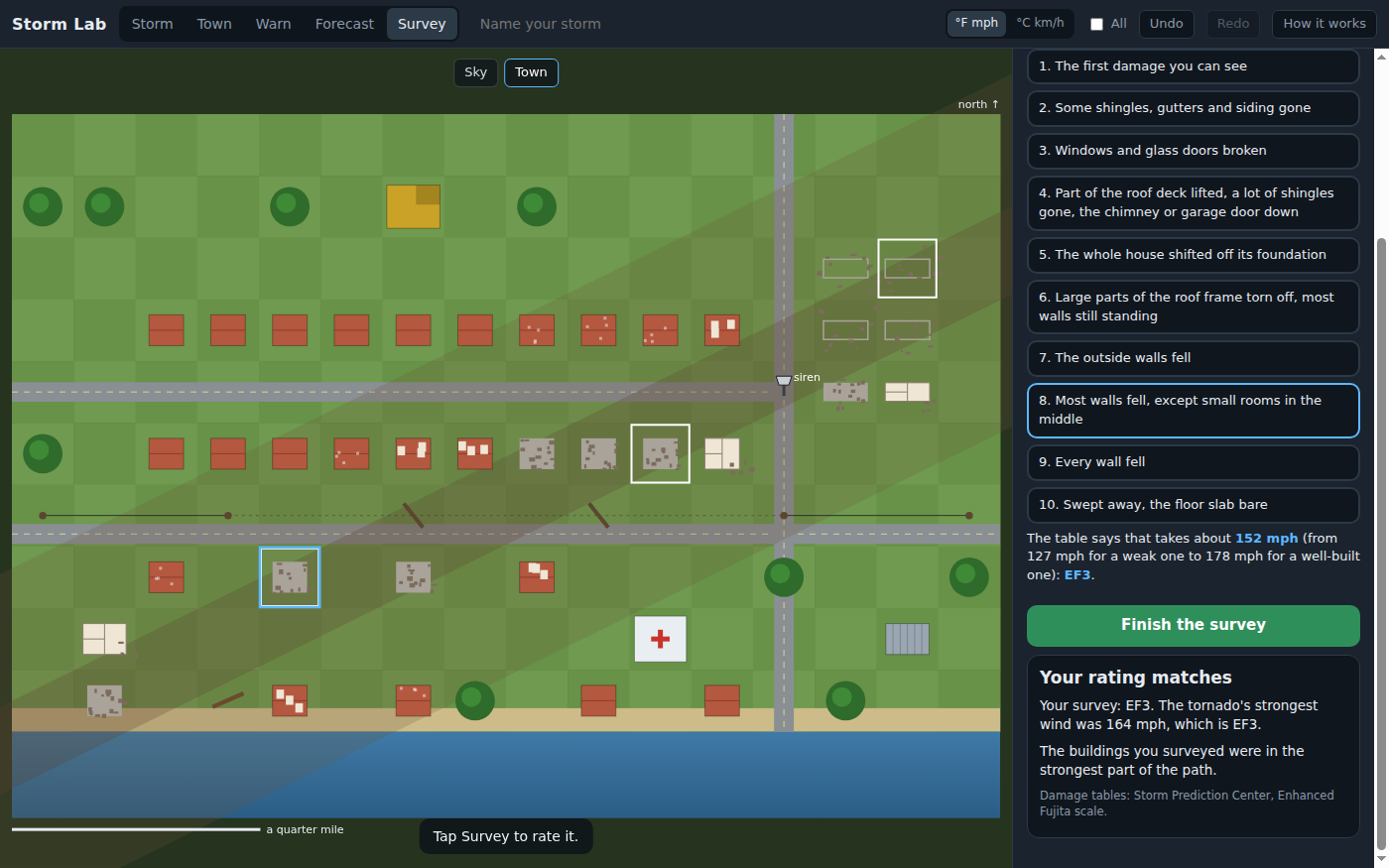
A damage survey. The student taps three damaged buildings, picks the line in the Weather Service's damage table that matches what each one shows, and the rating comes from the damage, the way a real survey team rates a tornado.
What they are learning while they play
Nothing here is presented as a lesson. This is what the activity is made of.
| What the student does | What it is |
|---|---|
| Makes a storm from moisture, instability and lift, and sees which one was missing when there is none | The ingredients of a thunderstorm. Forecasters check the same few things every morning: damp air near the ground, air that cools quickly with height so a rising bubble stays warmer than its surroundings, and something to push the air up. Take one away and there is no storm. |
| Breaks a strong cap three different ways | Air masses and stability. A layer of warmer air above the ground holds rising air down. More moisture, a weaker lid or a stronger push each get a bubble through it, for different reasons. |
| Turns an ordinary storm into a supercell with the wind alone | Wind shear. Wind that grows with height tilts a storm, so its rain falls beside the updraft and the storm lasts. Wind that also turns with height can make the whole storm rotate. |
| Rates a tornado from the damage it left | The Enhanced Fujita scale. A tornado's wind is almost never measured. It is estimated from what it did to buildings whose strength is known, using the Weather Service's damage tables. |
| Spends a budget on straps and bolts, and sends the storm again | Engineering for natural hazards. Straps hold a roof to its walls and bolts hold the walls to the foundation. Either alone saves little; together they carry the wind's force to the ground. |
| Writes siren rules and scores them on a season of storms | Warnings and their tradeoffs. Warning earlier catches more tornadoes and sounds for more storms that never make one. The Weather Service warns for about three tornadoes in four, and about three warnings in four are false alarms. |
| Drags the chart a forecaster reads from a weather balloon | Reading a sounding. Temperature and dew point against height, with the rising bubble's path. Where the bubble is warmer than the air is the storm's fuel; where it is colder is the lid. |
| Writes the rising bubble as a loop, in blocks or as code, and checks it against the lab | Computational modeling. The lab works out a storm's fuel by lifting a bubble step by step and adding up how much warmer it is than the air around it. A student can write that loop and get the same number. |
How to tell whether it landed
Ask, and let them show you. A student who has understood it can answer these without help.
- The desert day is very hot. Why does it make no storm?
- There was plenty of fuel under the cap. Why did nothing happen until something changed?
- Why does a storm that leans last longer than one that stands straight up?
- Why does a survey team want to know how a house was built before it rates a tornado?
- Would you rather your siren missed a tornado or sounded for nothing? What happens to a town that hears a lot of false alarms?
Use it in your subject
Not a technology class? Then the app is how students show what they learned in your unit. More projects for every subject.
Science
Weather and natural hazards (NGSS MS-ESS2-5 and MS-ESS3-2): make a thunderstorm from its ingredients, explain why a cap holds storms down, and use wind shear to explain supercells and tornadoes.
Engineering
Strengthen a town within a budget, test it against the same storm, and compare. Write a building code and test it on four storms.
Math
Read the season's table as rates: the share of tornadoes warned for and the share of sirens that were false alarms, against the Weather Service's own.
Computer science
Write the rules for a tornado siren as sentences, Glassbox blocks or text, and test them on a season of storms. Older students write the rising bubble as a loop.
Practical notes
- AgesAges 11 through high school. Younger students make storms from the example days and read the checklist; older ones read the sounding chart, write siren and forecast rules, and write the rising bubble as code.
- TimeA minute to a first storm. A satisfying session is thirty to forty-five minutes. The free teaching notes plan four lessons.
- EquipmentA computer or Chromebook with a modern browser. Nothing to install.
- CostFree. The app has no paid tier.
- PrepNone to try it. The teaching notes take about fifteen minutes to read.
- In a groupEveryone can start from the same example day, then compare what each student changed and what it made.
For co-ops, microschools, and classrooms
Start everyone on the same day with no storm in it and see who can explain their storm best, not who makes the biggest one. With a free account the storms are saved and shared, and a storm can be sent to a friend as a challenge: can their town do better with the same money?
Common questions
Is Storm Lab free?
Yes. It runs in your browser and there is no paid tier. A free account adds saving and sharing, but nothing on this page is behind a paywall.
Does my child need an account to try it?
No. The demo on this page is the complete lab. Make a free account to save a storm, share it, and send it to a friend as a challenge.
Is it a game about destruction?
No. Some students have lived through a tornado, a hurricane or a flood, and the lab is written for them too. There is no score for damage and nothing that celebrates it. The only sound is a short siren wail, and it is off unless a student turns it on. The best moments are a rating that matches the damage and a town that stood.
How real is the weather?
The rising bubble is worked out the way forecasters work it out, and its cloud base matches real weather balloon launches. The damage comes from the Weather Service's own damage tables. Some parts are the lab's own simplifications, such as how strongly each kind of lift pushes, and the lab says which ones.
Does it do hurricanes and winter storms too?
Yes. The hurricane bench has warm ocean water as its fuel and a town on the coast with a storm surge. The winter storm bench decides between snow, sleet and freezing rain from the layers of warm and cold air the snow falls through.
Are there lesson plans?
Yes, free teaching notes with four lessons of forty-five minutes for ages eleven to fourteen, each step written in the words on the screen.
What subject can I log this as?
Most families log it as earth science. The table above lists specifically what is covered, so you can pick the label your records need and point at the evidence.
Still have a question? Ask us, and a person will write back.
Where to go next
Start with Storm Lab
Trying it costs nothing and takes about five minutes. An account is what makes the work last.
Storm Lab is one of the making apps on the platform. It is a place to experiment, not a course, and it is not a substitute for a teacher: it is at its best when an adult asks the questions above and takes the answers seriously. It is not a forecast: for real weather, listen to your local weather service.
Page last reviewed October 2026.