Drink Lab
A drink shop's menu says 100% or 50% sugar. Drink Lab says grams. Students design boba, coffee, lemonade, smoothies and more from real ingredients and see exactly what ends up in the cup: sugar, caffeine, calories, temperature, even how fast the ice melts. It opens on a brown sugar milk tea with more sugar than a can of soda. Turn it down, watch it get made, and see who on the tasting panel still wants it. Free, in the browser, no account needed to try it.
Using this with a class? Make a free class and add your students yourself: each gets a username and password, with no email or Google account needed. Or give them one join code.A first lesson: Everyone designs a drink that at least four of the six panel members love while staying under the sugar in a can of soda, then explains what they traded to get there.
Set up a free classWhat a student actually does
They see that the milk tea has 52.6 grams of sugar, more than a can of soda. They set Sugar to 50% and expect half; they get 39.5 grams, and have to work out where the rest is hiding. They open Taste and meet the panel, a little sibling, a grandparent, an athlete, a dairy-free friend, a boba regular and a barista, each wanting something different. Then they press Play under Build and watch the drink get made, step by step, from steeping the tea to the lid.
From there it is a design lab. Eight kinds of drink, from coffee and tea lattes to lemonade, smoothies, hot chocolate, milkshakes and mocktails, and well over a hundred ingredients with real sugar, caffeine and allergen data. The Build is an ordered list of steps they can change, and order matters: pour hot tea straight onto ice and most of the ice melts. Look designs the cup, lid, straw, label and drizzle, and Card turns the drink into a menu card.
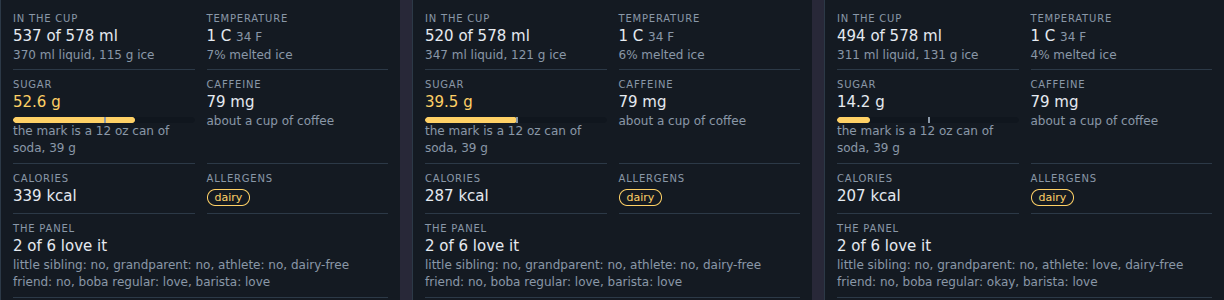
One milk tea at 100%, 50% and 0% sugar. Half sugar is 39.5 g, still more than a 12 oz can of soda, because the pearls, the drizzle and the milk carry sugar of their own. Even 0% has 14.2 g. The panel moves too: at 0% the athlete loves it and the boba regular goes lukewarm.
What they are learning while they play
Nothing here is presented as a lesson. This is what the activity is made of.
| What the student does | What it is |
|---|---|
| Sets sugar to 50% and gets 39.5 g | Reading nutrition. Sugar hides in more than the syrup. Pearls, sauces and milk all count, and the label percent is not the whole story. |
| Compares the drink with a can of soda | Benchmarks. A number means more next to something familiar. The soda-can mark turns grams into something you can picture. |
| Watches the ice melt minute by minute | Heat transfer. Warm room, cold cup: heat flows in and melts the ice. An insulated cup slows it down, and the lab shows by how much. |
| Pours milk slowly and it layers | Density. Heavier liquids sink and lighter ones float. That is how layered drinks get their stripes. |
| Moves a step earlier in the Build | Order of operations. The same ingredients in a different order make a different drink. Recipes are procedures, like programs. |
| Checks the caffeine | Dosage. Caffeine comes from the tea or coffee and scales with how much and how long it steeps. Some people should skip it. |
| Tries to please the dairy-free friend | Allergens. One ingredient can rule out a whole drink for someone. The lab flags it and suggests a swap. |
| Designs for all six on the panel | Designing for people. No drink pleases everyone. Choosing who you are making it for is the first design decision. |
How to tell whether it landed
Ask, and let them show you. A student who has understood it can answer these without help.
- Why is 50% sugar not half the sugar?
- Where is the sugar in a 0% sugar milk tea coming from?
- Why does the ice melt faster in one cup than another?
- What happens if you pour the hot tea in before the ice? Why?
- Make a drink the athlete loves. What did you give up?
Practical notes
- AgesAges 9 through high school. Younger students design drinks and watch the numbers; older ones chase a target and explain the tradeoffs.
- TimeSeconds to the first number that surprises them. A satisfying session is twenty to forty minutes.
- EquipmentAny computer or Chromebook with a modern browser. Nothing to install, and no real drinks needed.
- CostFree. The app has no paid tier.
- PrepNone. Open the page and go. Reading this page first takes about three minutes.
- In a groupEveryone can start from the same milk tea and race to the same target, like four panel members under 39 g of sugar.
For co-ops, microschools, and classrooms
Set a target, say a drink four of the six panel members love with less sugar than a can of soda, and let everyone chase it. The winning recipes are different, and each student can say exactly which grams they cut and who they were willing to disappoint.
- Eight kinds of drinks, from boba and coffee to smoothies and mocktails.
- Real sugar, caffeine, calorie and allergen numbers for every ingredient.
- A six-person tasting panel with clashing tastes.
- No install, no per-seat license. Student work is private by default.
Common questions
Is Drink Lab free?
Yes. It runs in your browser and there is no paid tier. A free account adds saving and sharing, but nothing on this page is behind a paywall.
Does my child need an account to try it?
No. The demo on this page is the complete lab with a starter milk tea. Make a free account and the drink you changed comes with you as your first project.
Are the numbers real?
The sugar, caffeine, calories, densities and ice math come from real ingredient data and physics. How the panel feels about sweetness is a rule of thumb, and the lab says so.
Does it encourage kids to drink sugary drinks?
It does the opposite of a menu board: it shows the grams. Most students are surprised by the numbers, and the panel rewards drinks with less sugar as often as more.
What ages is it for?
Ages 9 through high school. Designing a drink works for anyone; chasing a nutrition target suits older students.
What subject can I log this as?
Most families log it as science or health. Density, heat transfer and dissolving are physical science, and sugar, caffeine and allergens are nutrition. The table above lists specifically what is covered, so you can pick the label your records need and point at the evidence.
Where to go next
Start with Drink Lab
Trying it costs nothing and takes about five minutes. An account is what makes the work last.
Drink Lab is one of the making apps on the platform. It is a place to make things, not a course, and it is not a substitute for a teacher: it is at its best when an adult asks the questions above and takes the answers seriously.
Page last reviewed September 2026.