Endless Runner Maker
An endless runner never runs out of level, and that is the interesting part: nobody built all of it. Endless Runner Maker shows students how. They build a few short pieces of level by hand, a road, a river with logs, a railway, and then write the mix, a small program that decides what the next row will be, forever. They choose whether the runner hops across the rows or runs three lanes at speed, dress it, pick a world and music, and press Try it. A bot plays their game twenty times to check every row can be crossed, and shows where it dies.
Using this with a class? Make a free class and add your students yourself: each gets a username and password, with no email or Google account needed. Or give them one join code. Using Google Classroom? Post the link there; with a free class, the link also puts each student in your class, so you see their work.A first lesson: Everyone starts from Road Crossing and plays it once. Then each student changes one line of the Mix, say making rivers come up twice as often after row 40, and runs the bot's dry run. Compare: whose change made the game harder, and whose made it impossible? The bot's report says where it died, which is the place to look.
Set up a free class Share to Google ClassroomWhat a student actually does
They start from one of six games, every one playable right away: Road Crossing, Sky Hop, Coin Field, Tunnel Rush, Lava Run and Traffic Dash, the hardest. Or from a blank one. Each game is either a hop, where the runner crosses rows one at a time and waits for a gap, or a run, where it races down lanes and dodges. The editor opens simple, in three tabs: Pieces, Mix and Look. A switch shows the rest, the Rules and the Check, for students who want them.
On the Pieces tab they build short pieces of level by hand, a few rows each. A row can be a field, a road, a river, a railway, a wall or a gap, and it holds what is on it: trees and rocks to stand behind, cars and trains on a road or a rail, logs to ride across a river, coins to collect, and power-ups, a shield, a magnet and a slow-down. Cars, logs and trains move in streams, and each one's speed and spacing is a slider.
The Mix is the program. It decides what the next row is, given n, the row number: plain pieces early, more rivers after row 40, a train every so often, a chance of a coin row. It can be read as cards in plain words, as blocks in a Glassbox drawer, or as code, and the same Mix is all three. The Mix can change the world as the run goes too, dusk at row 120 and night and rain at row 260. The Rules say what happens along the way: a line to the player at the start, the sweep that chases from behind, a faster sweep at row 40. The Look tab dresses the runner, a shirt, a hat, a face, a cape or wings, and picks one of ten worlds and the music.
Then they play it. Try it starts a run; R starts again with a new seed. The Check tab asks whether every row can be crossed, and its dry run lets a bot play the game twenty times and shows where it died, so a student can find the row that is impossible before a friend does. A shared game keeps a board of the longest runs, each one checked by replaying it, and a friend can watch a run or race the same world.
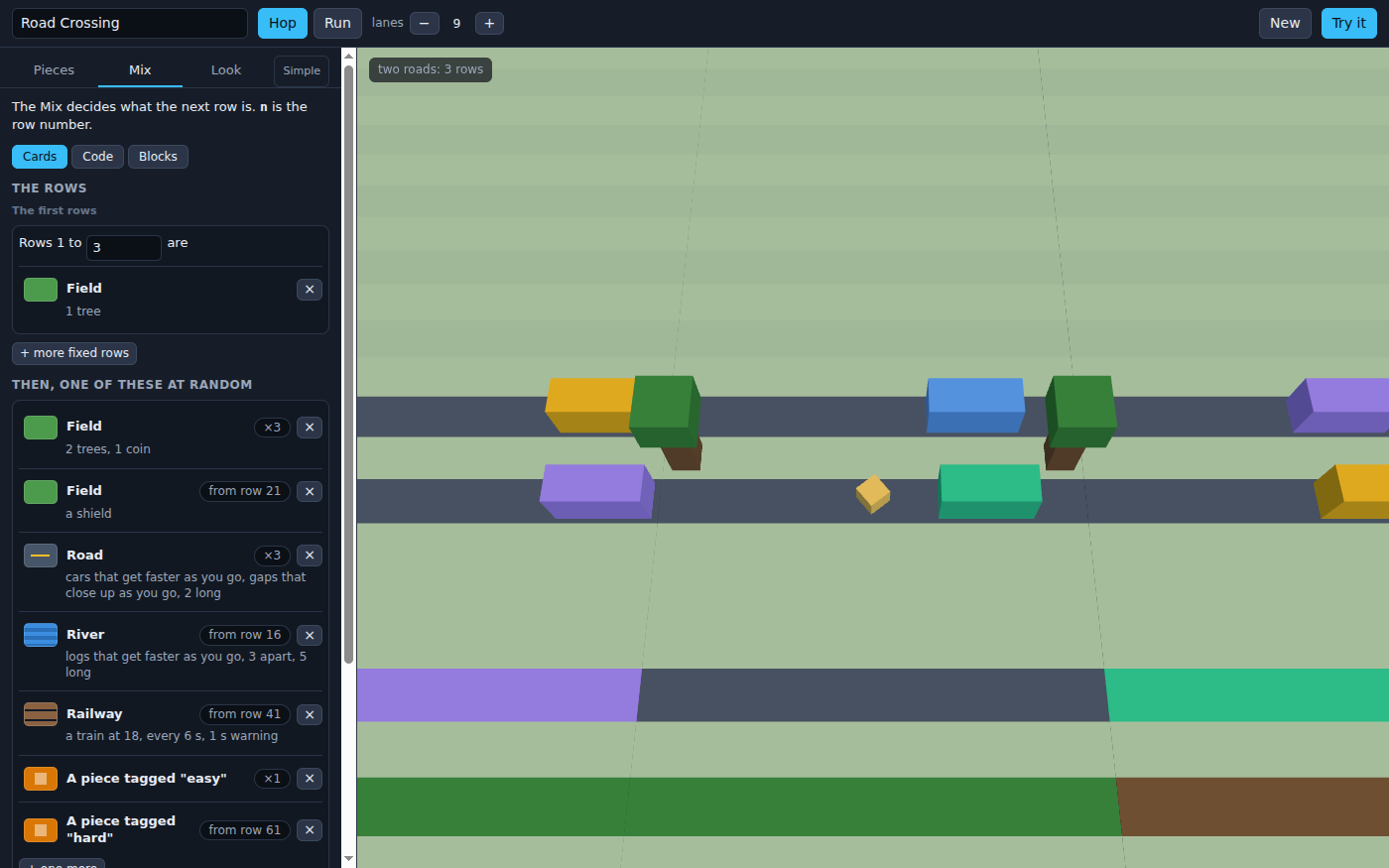
Road Crossing's Mix, in plain words. Rivers start at row 16, trains at 41 and the hard pieces at 61, so the game gets harder by itself. The same Mix opens as code or as blocks.
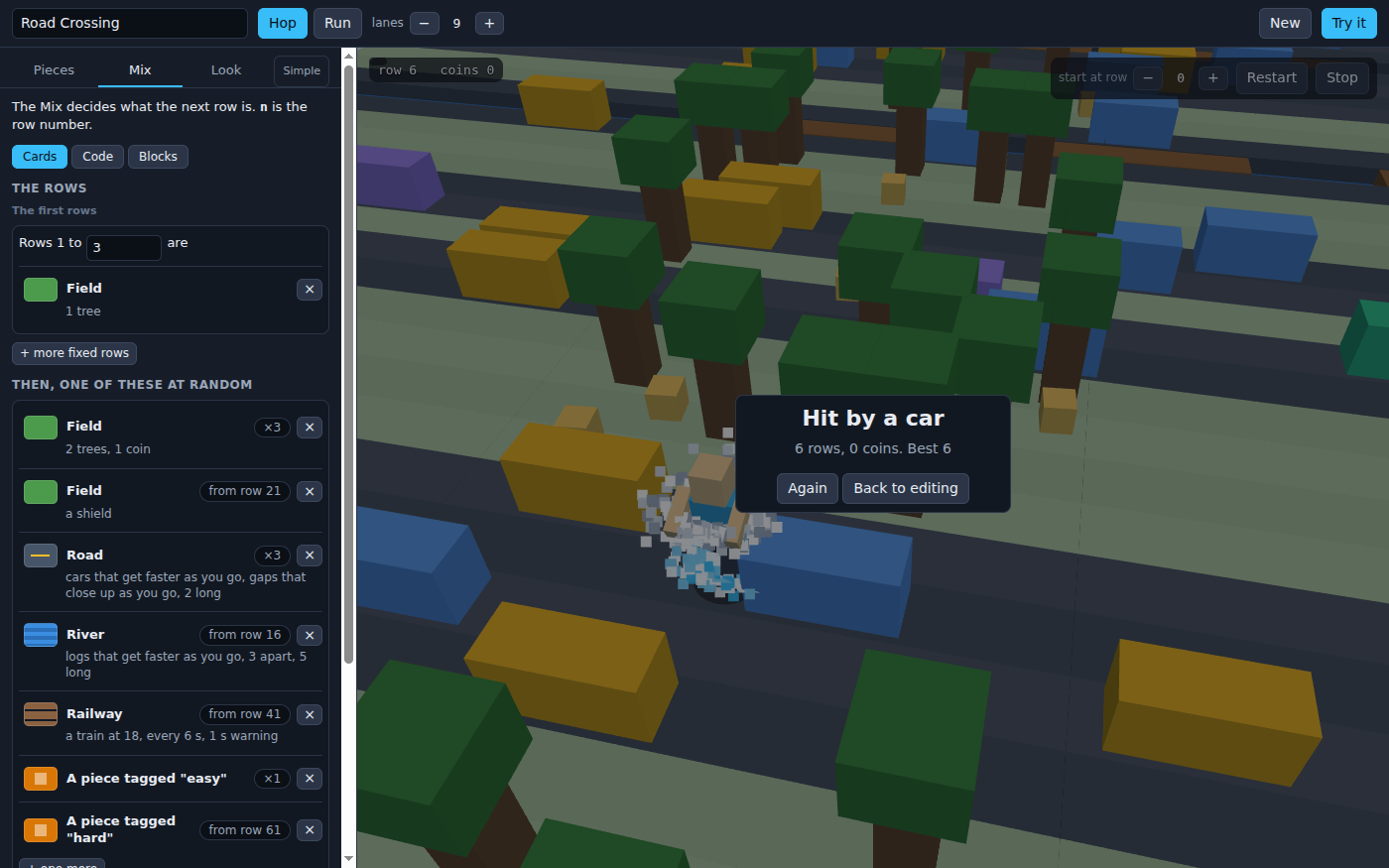
Six rows in and hit by a car. Again starts a new run on a new world; the Mix keeps the level coming for as long as the player lasts.
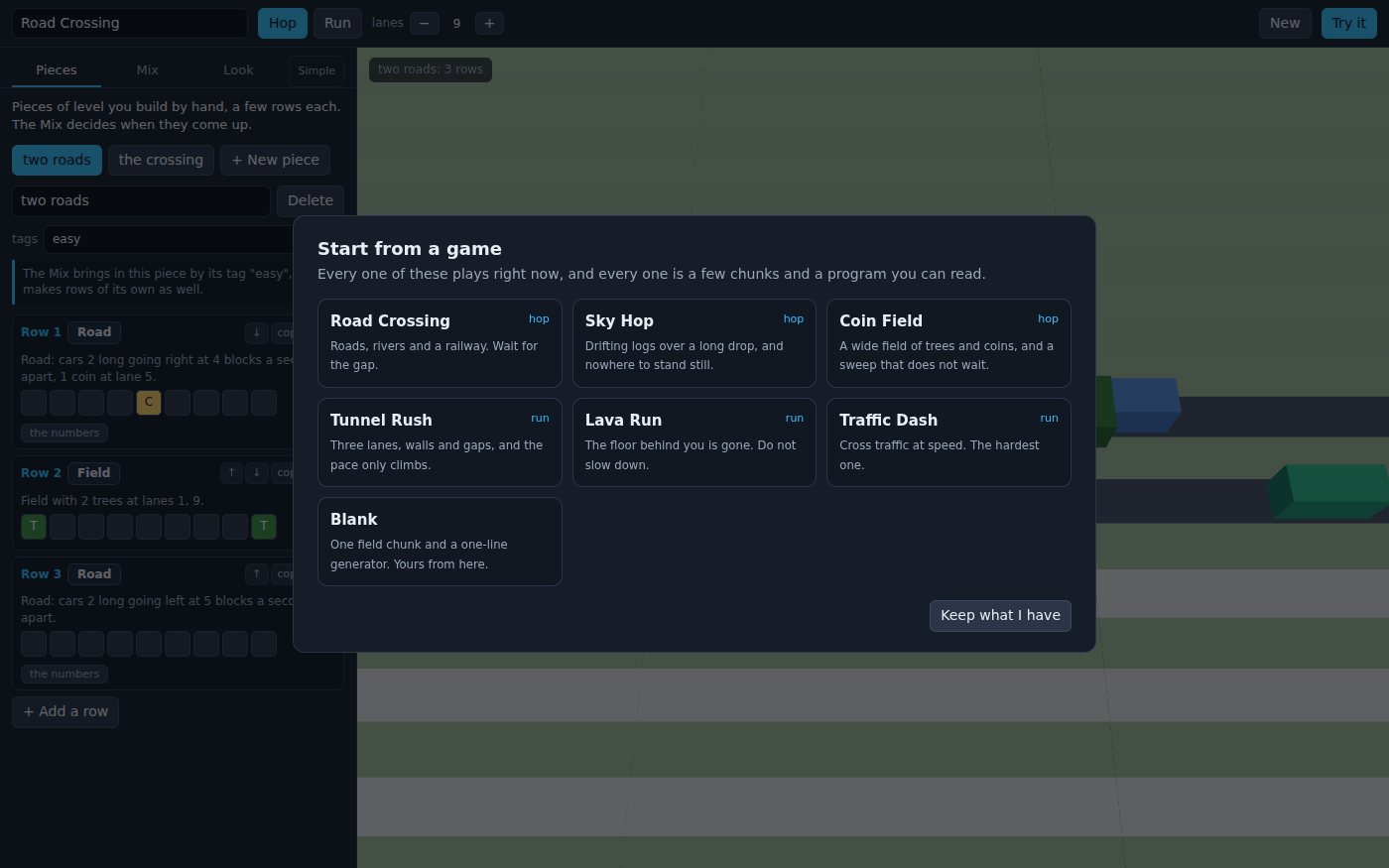
Where a visitor starts: six games that play right away, or a blank one.
What they are learning while they play
Nothing here is presented as a lesson. This is what the activity is made of.
| What the student does | What it is |
|---|---|
| Writes a Mix that brings rivers in after row 40 | Variables and conditionals. The Mix is handed n, the row number, and decides what comes next. Using n to make the game harder over time is the first program most students write here. |
| Builds a level that never ends from six short pieces | Procedural generation. Nobody builds an endless level by hand. Real games make their levels with rules like these, and the student writes one. |
| Gives a coin row a one-in-five chance | Probability and randomness. A chance in the Mix means every run is different. The seed makes a run repeatable, so a friend can race the same world. |
| Runs the dry run and finds the row where the bot always dies | Testing and debugging. A bot that plays twenty times finds the impossible gap faster than any person. Reading where it died is reading a test report. |
| Speeds up a stream of cars until the road cannot be crossed | Game balance. Speed, spacing and the runner's timing pull against each other. The Check says when a row has gone from hard to impossible. |
| Reads the same Mix as cards, then as code | One program, several notations. The cards, the blocks and the code are the same program. Seeing a change in one appear in the others is how code stops looking like a different thing. |
How to tell whether it landed
Ask, and let them show you. A student who has understood it can answer these without help.
- Read me your Mix. What comes up at row 10, and what comes up at row 100?
- Nobody built all of your level. Who decides what row 500 is?
- Where did the bot die most often, and what did you change there?
- Why can a friend race exactly the same world you played?
- What is the difference between your Pieces and your Mix?
Use it in your subject
Not a technology class? Then the app is how students show what they learned in your unit. More projects for every subject.
Computer science
Write a Mix that gets harder in three stages, run the dry run, and explain the bot's results with the code.
Math
Give a row a one-in-five chance, play to row 200 several times, and count how often it came up. Compare with what the chance predicts.
Game design
Make a game that is easy for 30 rows and hard after, playtest it with a classmate, and use the dry run to find the row that was unfair.
Practical notes
- AgesAges 8 through high school. Younger students pick a game, build pieces and dress the runner; middle schoolers change the Mix as cards or blocks; older students write it as code and use the Rules and the Check.
- TimeA minute to a first run. A good session is thirty to forty-five minutes: a game, a few pieces, one change to the Mix and a dry run.
- EquipmentA computer or Chromebook with a modern browser and a keyboard: it is played with the arrow keys. The game is 3D, so a very old or very slow computer may struggle. Nothing to install.
- CostFree. The app has no paid tier.
- PrepNone. Open the page and go. Play Road Crossing yourself first; it takes two minutes.
- In a groupStudents share games and race each other on the same world. Every run on a game's board is checked by replaying it, so a long run is a real one.
For co-ops, microschools, and classrooms
Make it a swap: everyone builds a game, then plays someone else's. With a free account the games are saved and shared, and each game's page keeps the longest runs, with a button to watch one or race the same world.
Common questions
Is Endless Runner Maker free?
Yes. It runs in your browser and there is no paid tier. A free account adds saving and sharing, but nothing on this page is behind a paywall.
Does my child need an account to try it?
No. The demo on this page is the complete maker, with six games to start from. Make a free account to save a game, share it, and see who ran furthest.
Is it violent?
No. The runner hops across roads and rivers or dodges walls and traffic; when it is hit or falls, the run ends and the next one starts. There is no fighting.
What does "the Mix" mean?
It is the small program that decides what the next row of the level is, forever. It is handed the row number and can pick a piece, a kind of row, or something at random. Students can read and change it as plain cards, as blocks, or as code.
Is it too complicated for younger students?
The editor opens simple, with three tabs in plain words. The Rules, the Check and the numbers are behind a switch for students who want them, and nothing is taken away to make it simple.
What subject can I log this as?
Most families log it as computer science or game design. The table above lists specifically what is covered, so you can pick the label your records need and point at the evidence.
Still have a question? Ask us, and a person will write back.
Where to go next
Start with Endless Runner Maker
Trying it costs nothing and takes about five minutes. An account is what makes the work last.
Endless Runner Maker is one of the making apps on the platform. It is a place to make things, not a course, and it is not a substitute for a teacher: it is at its best when an adult plays a game too and asks the questions above.
Page last reviewed October 2026.