Tower Defense Maker
Tower defense is a game students already know: enemies march down a road, towers along it try to stop them. Tower Defense Maker turns it inside out. Students paint the map, put the road where they want it, choose the waves, and write the small programs behind everything: which enemy a tower aims at first, which way an enemy takes when the road is blocked, when the next wave comes and what it brings. Then they publish the level, and a friend has to hold it.
Using this with a class? Make a free class and add your students yourself: each gets a username and password, with no email or Google account needed. Or give them one join code. Using Google Classroom? Post the link there; with a free class, the link also puts each student in your class, so you see their work.A first lesson: Everyone opens the same map and plays wave one with the towers as they are. Then each student changes one tower's brain, say aiming at the strongest enemy instead of the first, and plays again. Put each change and how many lives it saved on the board. Then swap: each student changes an enemy's brain so it takes the long way round, and the class finds out which tower rule copes best.
Set up a free class Share to Google ClassroomWhat a student actually does
They start from a level or one of five maps, the long snake, the open field, the canyon, the islands or the boss arena. On the Map tab they paint the ground: grass, road, rock, water, bridges and tunnels, and place where enemies come in and the base they are after. Enemies take the cheapest way, and grass costs five times what road does, so where the road goes is the level. A tower can never be placed where it would wall the base off completely. Decor and 3D models from the student's Files dress the board.
On the Towers and Waves tabs they set what the player has to work with and what is coming. There are nine towers, from an Arrow tower that shoots to a Frost tower that slows, a Tesla that chains, a Sniper that reaches and a Lookout that reveals the Sneak. There are eleven enemies: Runners and Tanks, Flyers that skip the road, Healers, Splitters that break into three bugs, a Digger that tunnels through rock, and Wreckers and Sappers that attack the towers themselves. Each wave says who comes, how many and how far apart, and the Types tab lets a student invent new ones; the price follows from the stats.
On the Brains tab they write the programs. Every tower of a type runs the same brain, so changing the Arrow brain changes every Arrow tower on the board, and every enemy of a type runs the same brain too. Above them sit the wave director, which decides what is sent and when; up to three spells the player can cast during a wave; and level rules over the whole game, like opening a gate at wave 5 or turning day to night. Each one can be written as blocks in a Glassbox drawer or as code.
Then they play it and publish it. A level can carry a par, the author's best run, and a balance check says how far a set of towers holds. A shared level keeps a board of who held it longest, and every result is checked by replaying the game, not taken on trust. The whole level also downloads as a single web page that plays anywhere.
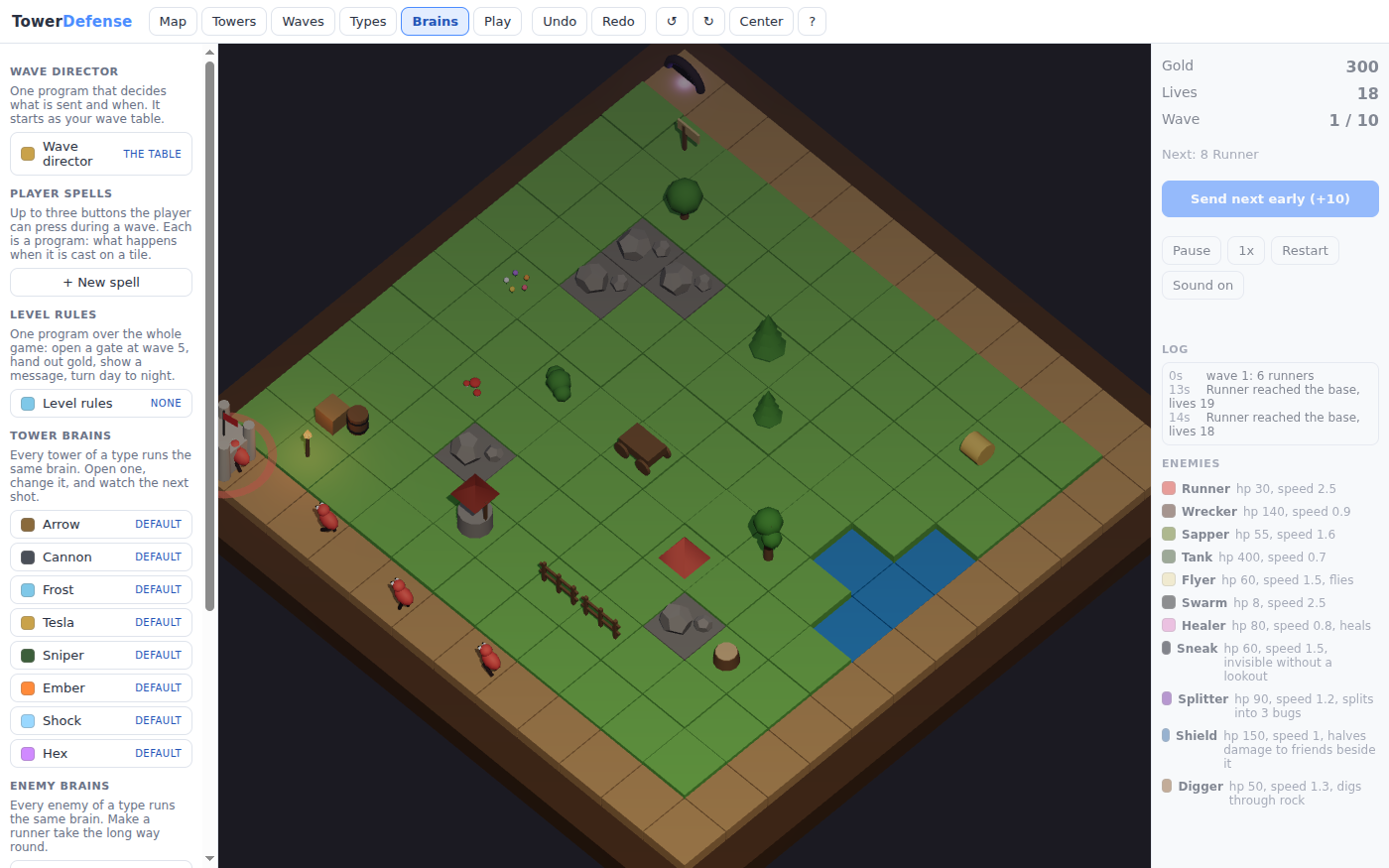
Every program in the level, in one list. A tower's brain decides what it shoots at, an enemy's which way it goes; the wave director, the spells and the level rules run the game around them.
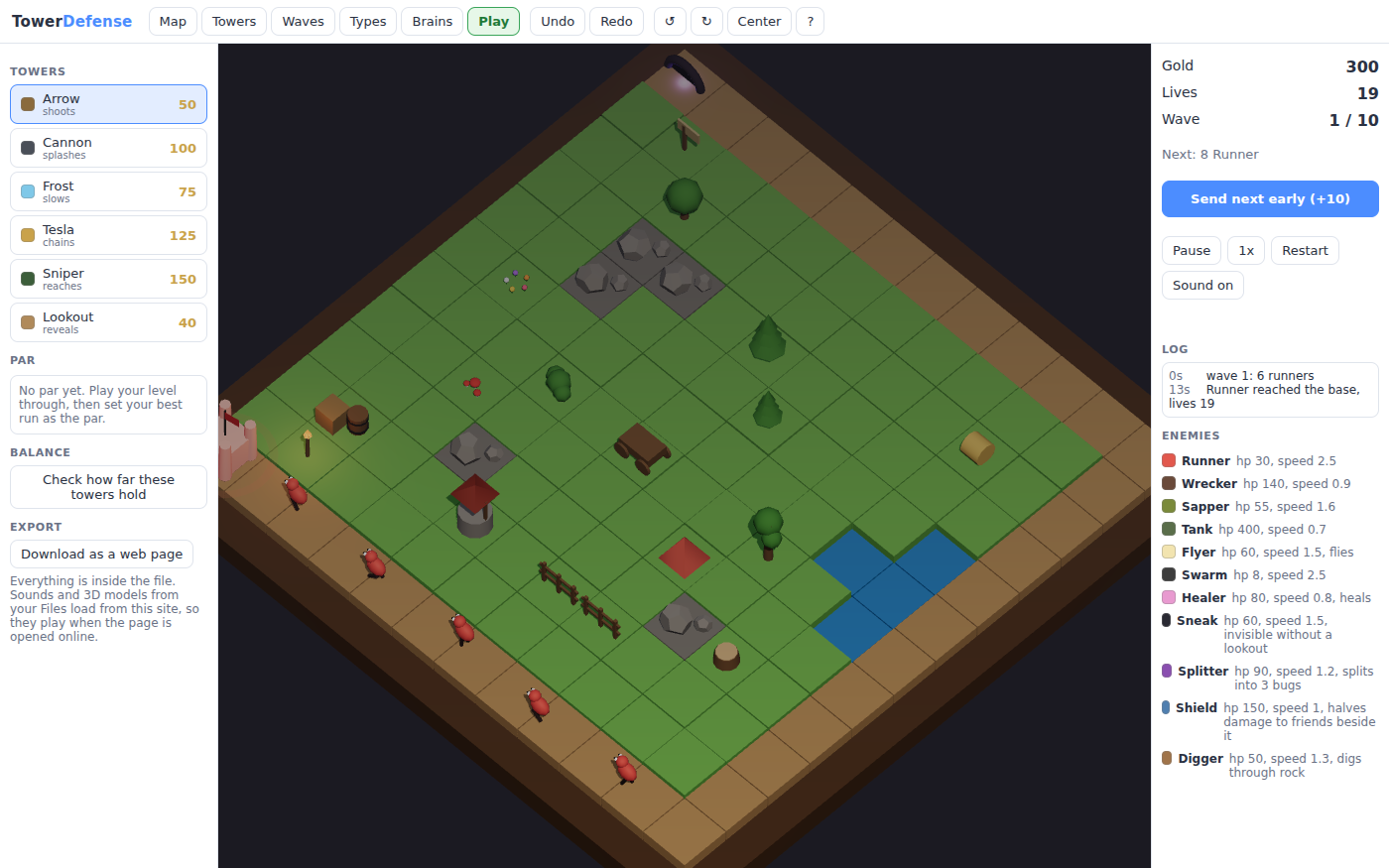
Wave one with nothing built, which is how most students learn why towers go on the corners. The towers' prices and jobs are on the left, and the log on the right says what happened and when.
What they are learning while they play
Nothing here is presented as a lesson. This is what the activity is made of.
| What the student does | What it is |
|---|---|
| Changes a tower's brain from the first enemy to the strongest one | Conditionals and choosing from a list. A tower brain looks at the enemies in range and picks one. First, strongest, closest to the base: each is a different loop over the same list, and the game shows which works. |
| Moves the road and watches every enemy take a new path | Graphs and shortest paths. The map is a graph with a cost on every tile, and enemies take the cheapest way to the base. Painting road or grass is changing those costs, which is how real route-finding works. |
| Writes an enemy brain that takes the long way round | Algorithms and tradeoffs. The long way avoids the towers but takes longer. An enemy's brain trades one against the other, and the student finds out when it pays. |
| Balances a level so it is hard but winnable | Game balance and economy. Gold, tower prices, enemy health and wave size all pull against each other. The par and the balance check give the student numbers to tune with. |
| Writes a wave director instead of a wave table | Procedural generation. A table lists the waves; a program makes them. The director can send harder waves to a player who is winning, which is how many real games adjust their difficulty. |
| Plays the same level twice and gets the same game | Determinism and verification. The game runs the same way every time from the same moves, which is how a record can be checked by replaying it instead of trusting it. |
How to tell whether it landed
Ask, and let them show you. A student who has understood it can answer these without help.
- Read me your tower's brain. Which enemy does it shoot at when three are in range?
- You moved one piece of road and the level got harder. Why?
- Why can a Lookout tower matter even though it never shoots?
- What does your wave director do when the player is winning?
- Why can a friend's record on your level be trusted?
Use it in your subject
Not a technology class? Then the app is how students show what they learned in your unit. More projects for every subject.
Computer science
Write three tower brains that pick targets differently, play the same waves with each, and explain the results with the code.
Math
Work out the road length on two maps and how long a Runner at speed 2.5 takes to walk each. Then predict which map needs more towers, and test it.
Game design
Build a level with a par, playtest it with two classmates, and change one thing that made it unfair.
Practical notes
- AgesAges 9 through high school. Younger students paint maps, build towers and play; middle schoolers change tower and enemy brains; older students write wave directors, spells and level rules.
- TimeTen minutes to play a level and change something. A good session is forty-five minutes: a map, a few waves, and one brain changed.
- EquipmentA computer or Chromebook with a modern browser. The board is 3D, so a very old or very slow computer may struggle. Nothing to install.
- CostFree. The app has no paid tier.
- PrepNone. Open the page and go. Play one level yourself first; it takes ten minutes.
- In a groupStudents publish levels for each other. Every result on a level's board is checked by replaying it, so a high score is a real one.
For co-ops, microschools, and classrooms
Make it a swap: everyone builds a level, then holds someone else's. With a free account the levels are saved and shared, and each level's page keeps who held it longest.
Common questions
Is Tower Defense Maker free?
Yes. It runs in your browser and there is no paid tier. A free account adds saving and sharing, but nothing on this page is behind a paywall.
Does my child need an account to try it?
No. The demo on this page is the complete maker with a level loaded. Make a free account to save a level, publish it, and see who held it.
Is it violent?
It is a strategy game with cartoon enemies and towers. Enemies pop when they are stopped; there is no blood and nothing realistic.
What does "program the towers" mean?
Each kind of tower runs a small program that picks what to shoot at from the enemies in range, and each kind of enemy runs one that picks its next step. Students can read the default programs, change them, and watch the next wave play differently. They can be written as blocks or as code.
Can a level be played outside the platform?
Yes. Download as a web page saves the whole level as one file that plays in a browser. Sounds and 3D models from the student's Files load from this site, so those play when the page is opened online.
What subject can I log this as?
Most families log it as computer science or game design. The table above lists specifically what is covered, so you can pick the label your records need and point at the evidence.
Still have a question? Ask us, and a person will write back.
Where to go next
Start with Tower Defense Maker
Trying it costs nothing and takes about five minutes. An account is what makes the work last.
Tower Defense Maker is one of the making apps on the platform. It is a place to make things, not a course, and it is not a substitute for a teacher: it is at its best when an adult plays a level too and asks the questions above.
Page last reviewed October 2026.