Escape Room
Building an escape room is a logic problem in disguise: every lock needs a key somewhere, every key needs to be findable, and a room with one missing link can never be left. Escape Room lets students build one in 3D, a room someone has to think their way out of, and the maker checks their logic as they go. It says whether the room can be escaped, how many steps the shortest way out takes, and, when it cannot, which link is missing. Then they hand it to a friend, who plays it against the clock.
Using this with a class? Make a free class and add your students yourself: each gets a username and password, with no email or Google account needed. Or give them one join code. Using Google Classroom? Post the link there; with a free class, the link also puts each student in your class, so you see their work.A first lesson: Everyone plays The Locksmith's Attic first and times themselves. Then each student builds a room with exactly three locks, and the maker's verdict must say it can be escaped before it counts. Swap and play. The class compares the shortest solve the maker found with how long a real person took, and talks about why they are so different.
Set up a free class Share to Google ClassroomWhat a student actually does
They start from The Locksmith's Attic, a finished room, or from an empty one. In Sketch mode they paint the room's shape on a grid, add walls inside it to make more than one room, and drop the marker where the player starts. In Build mode they furnish it from a kit of doors and windows, desks, bookcases, rugs, chests, safes and lockers, with up to ten 3D models from their Files. The Room tab sets the opening line the player reads, the walls, floor and ceiling, pictures for them, the light and the sound in the room.
Then the puzzle. Any piece can be given a lock, a hidden thing, something that only works with a certain item, or a line to say when it is looked at. Recipes add a whole working puzzle in one tap: hide a key for the door, a safe with a code and a note that hints at it, a keypad by the door, something under the rug, a key in two halves. The Puzzle tab then says whether the room can be escaped. The maker tries every move a player could make, and either reports the shortest way out, step by step, or names the link that is missing: a lock nothing opens, a key nothing provides, a thing hidden where nothing reveals it.
In Code mode the whole room's rules are one program, written as blocks in a Glassbox drawer or as code, and selecting a piece in the room shows its lines. The author also writes hints in order, and can set a target time, a goal rather than a cutoff, that the player sees on the way in.
Then they play it, and share it. In Play mode the player looks round at eye level, picks things up into their pockets, uses them on other things, and can ask for hints. A shared room keeps a board of who got out and how fast, and every result is checked by replaying the moves, not taken on trust. Anything a player can read in the room is filtered for bad words when it is saved.
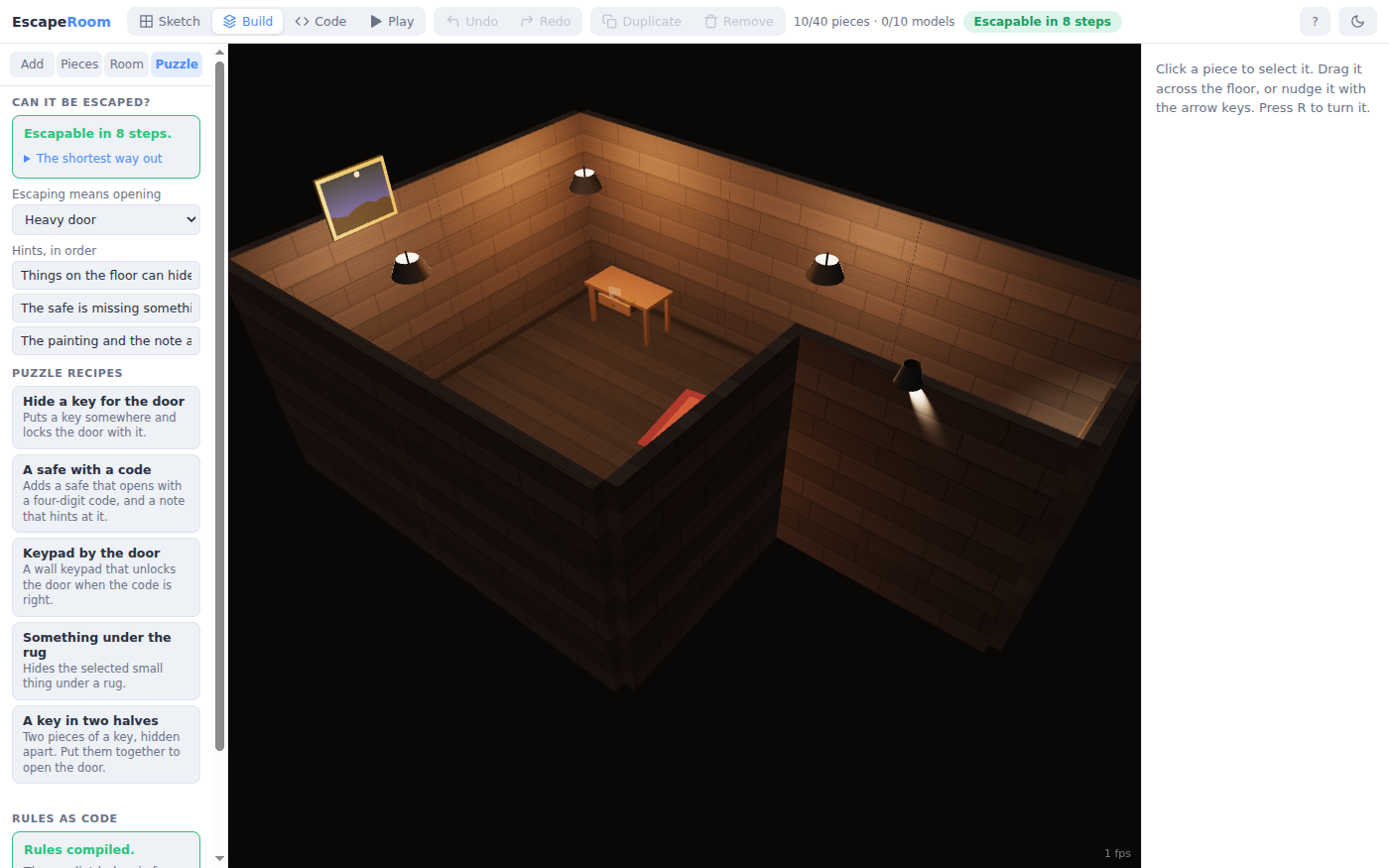
The maker checks the room. It finds the shortest way out by trying every move, says the room can be escaped in 8 steps, and would name the missing link if it could not. The recipes add a working puzzle in one tap.
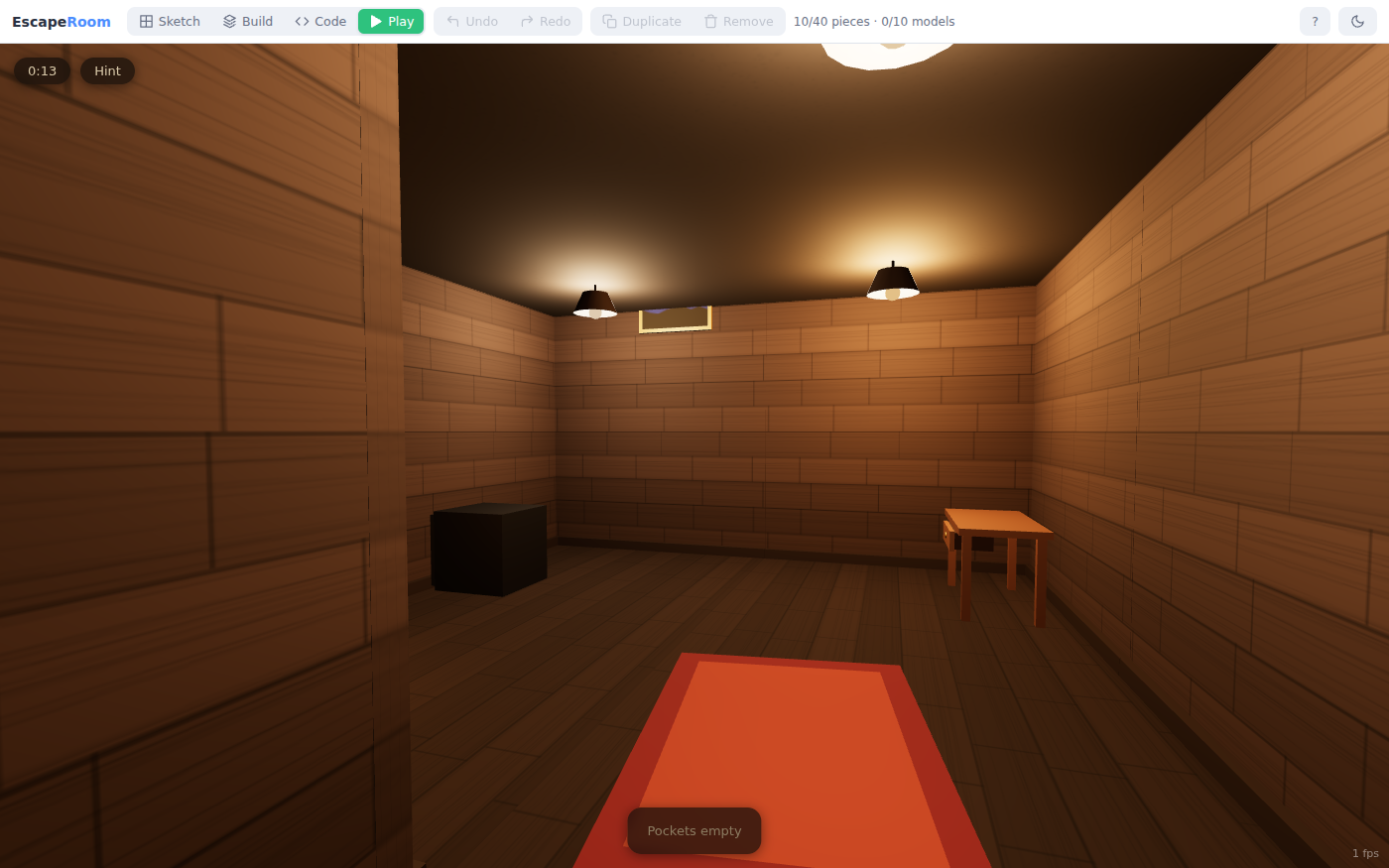
Thirteen seconds in, pockets empty. The player looks round, picks things up, uses them on other things, and can ask for the author's hints in order.
What they are learning while they play
Nothing here is presented as a lesson. This is what the activity is made of.
| What the student does | What it is |
|---|---|
| Builds a chain where a key opens a desk that holds the dial for a safe | Dependencies and sequence. A room is a chain of things that must happen in order. Drawing it out, what needs what, is the same skill as planning a program or a project. |
| Gets a verdict that the room cannot be escaped, and finds the missing link | Debugging. The maker names the problem: a lock nothing opens, a key nothing provides. The student traces back from the door to find where the chain breaks. |
| Reads the shortest way out the maker found | Search algorithms. The maker tries every move a player could make, breadth first, until it reaches the door. Its 8 steps are the minimum; a real player takes far more, and the difference is the design. |
| Adds a red herring that does nothing | Designing for a player. A candle that leads nowhere makes a room feel real. Students learn that a puzzle is about what the player thinks, not only what the logic needs. |
| Writes the safe's code as a clue the player has to read in a mirror | Encoding information. A clue is information hidden in a form the player has to decode. Writing one is writing a tiny cipher. |
| Turns on Code mode and sees the room as one program | Rules as code. Every lock and reveal the student made by clicking is a rule in a program. Reading it, and editing it, shows what the clicks were building. |
How to tell whether it landed
Ask, and let them show you. A student who has understood it can answer these without help.
- Walk me through your room from the door backwards. What does each step need?
- The maker says the shortest way out is 8 steps, but it took your friend four minutes. Why?
- Your room could not be escaped at first. What was missing, and how did you find it?
- Which thing in your room does nothing, and why did you put it there?
- How can the maker be sure your friend really got out in that time?
Use it in your subject
Not a technology class? Then the app is how students show what they learned in your unit. More projects for every subject.
Computer science
Draw a room's chain as a diagram of what needs what, build it, and compare the diagram with the maker's shortest way out.
English language arts
Write the room's story first, whose room is it and why is the door locked, then make every clue fit the story. The opening line and the hints are the student's writing.
Math
Build a safe whose code is the answer to a problem the player has to solve from things in the room.
Logic
Build a room with exactly one way out, then a room with two, and explain how the maker's step counts differ.
Practical notes
- AgesAges 9 through high school. Younger students play rooms and build simple ones with the recipes; older students build longer chains, write hints and edit the rules as code.
- TimeFive minutes to play the Locksmith's Attic. A good session is forty-five minutes: play one room, build one, and swap.
- EquipmentA computer or Chromebook with a modern browser. The room is 3D, so a very old or very slow computer may struggle. Nothing to install.
- CostFree. The app has no paid tier.
- PrepNone. Open the page and go. Play the Locksmith's Attic yourself first; it takes five minutes.
- In a groupStudents share rooms with each other. Every time on a room's board is checked by replaying the moves, so a fast time is a real one.
For co-ops, microschools, and classrooms
Make it a swap: everyone builds a room, then escapes someone else's. With a free account the rooms are saved and shared, and each room's page keeps who got out and how fast.
Common questions
Is Escape Room free?
Yes. It runs in your browser and there is no paid tier. A free account adds saving and sharing, but nothing on this page is behind a paywall.
Does my child need an account to try it?
No. The demo on this page opens on a finished room, The Locksmith's Attic, to play and take apart. Make a free account to save a room and share it.
Is it scary?
No. A room is a puzzle, not a horror game: no monsters, no time running out. The target time is a goal the author sets, not a cutoff.
How does it know a room can be escaped?
It tries every move a player could make, picking up, using, opening, entering codes, until it reaches the door. If it gets there, it reports the shortest way out; if it cannot, it names what is missing.
Can students put anything they like in a room?
Everything a player can read, the opening line, the hints, the notes and signs, is filtered for bad words when the room is saved. Pictures and 3D models come from the student's own Files.
What subject can I log this as?
Most families log it as computer science or logic, or English when the room's story is the point. The table above lists specifically what is covered, so you can pick the label your records need and point at the evidence.
Still have a question? Ask us, and a person will write back.
Where to go next
Start with Escape Room
Trying it costs nothing and takes about five minutes. An account is what makes the work last.
Escape Room is one of the making apps on the platform. It is a place to make things, not a course, and it is not a substitute for a teacher: it is at its best when an adult plays a room too and asks the questions above.
Page last reviewed October 2026.