Racer Lab
Every parent who has helped build a gravity race car has heard the same advice: put the weight at the back, polish the axles, lift a wheel. Racer Lab lets a student test all of it before cutting any wood. They carve the car out of a stock block, decide where the weight goes, prep the axles and wheels, and run it down a real-sized track. The time comes back to the thousandth of a second, with a picture of where the energy went: how much the hill gave, how much the axles took, how much the air took. Then the paper prints at actual size, to cut a real one.
Using this with a class? Make a free class and add your students yourself: each gets a username and password, with no email or Google account needed. Or give them one join code. Using Google Classroom? Post the link there; with a free class, the link also puts each student in your class, so you see their work.A first lesson: Everyone starts from the same block car and runs it once. Then each student may change one thing only, the weight's position, the axles or the wheels, and runs again. Put every change and its time on the board. The class finds out which change bought the most, and the energy picture says why. Then let them change two things and see whether the gains add up.
Set up a free class Share to Google ClassroomWhat a student actually does
They open the bench on a block car: a wooden block, four wheels and a weight limit, the kind of car a scout troop, a school or a family races down a sloped track. On the Block bench they drag yellow handles on a side view and a top view to carve the shape, and the outline cannot leave the block. Every cut changes how much wood is left and where the car's weight sits.
On the Weight bench they add metal in one to four pockets and drag the pockets along the car. A red dot shows the center of mass, and the bench says what the hill sees: how far the center sits ahead of the rear axle, how much higher up the hill it starts than the nose, and how many thousandths a centimeter back is worth on this track. One button brings the car to the weight limit. The Wheels bench sets how the axles are prepped and lubed, how far they turn in, and whether all four wheels touch the track or one rides lifted, and a green note says what each better setting would buy.
Then the Track bench. The car runs down a track of real length, 32 or 42 feet, with the camera following at true scale and the run slowed to half, a quarter or a tenth. It races a ghost of its last run, its best run or the starter car. The time comes back to the thousandth, with a breakdown of where the energy went. A solid dot is physics: gravity, the spin of the wheels, the air. A hollow dot is a rule of thumb, fitted so a well built car runs 32 feet in about 2.9 seconds. The bench says which is which.
The block car is one of five. A mousetrap car turns a spring's pull into a string round the axle; a balloon car pushes with a jet of air; a rubber band car winds up and runs out; a CO2 dragster rides a line for twenty meters, where the air matters most. The Drive bench sets each one's spring, balloon, band or cartridge, and on the floor the number that counts is how far it goes before it stops. The Cards bench has challenges that check the car against a target and say why it missed, how each piece of the advice works on this car, and the rules most races use, marked as not official.
When the design is done, the Export bench prints a cut template at actual size, the top and side of the block sharing a fold, with the saw lines, the axle slots, where the weight sits and a 100 mm bar to check the printer. Long cars tile across sheets. A build sheet has the drill guide and the weight worksheet, a run card is the thing to post, and an .stl prints the body, or a jig to hold a wooden one. A tire designed in Tire Lab can go on the wheels.
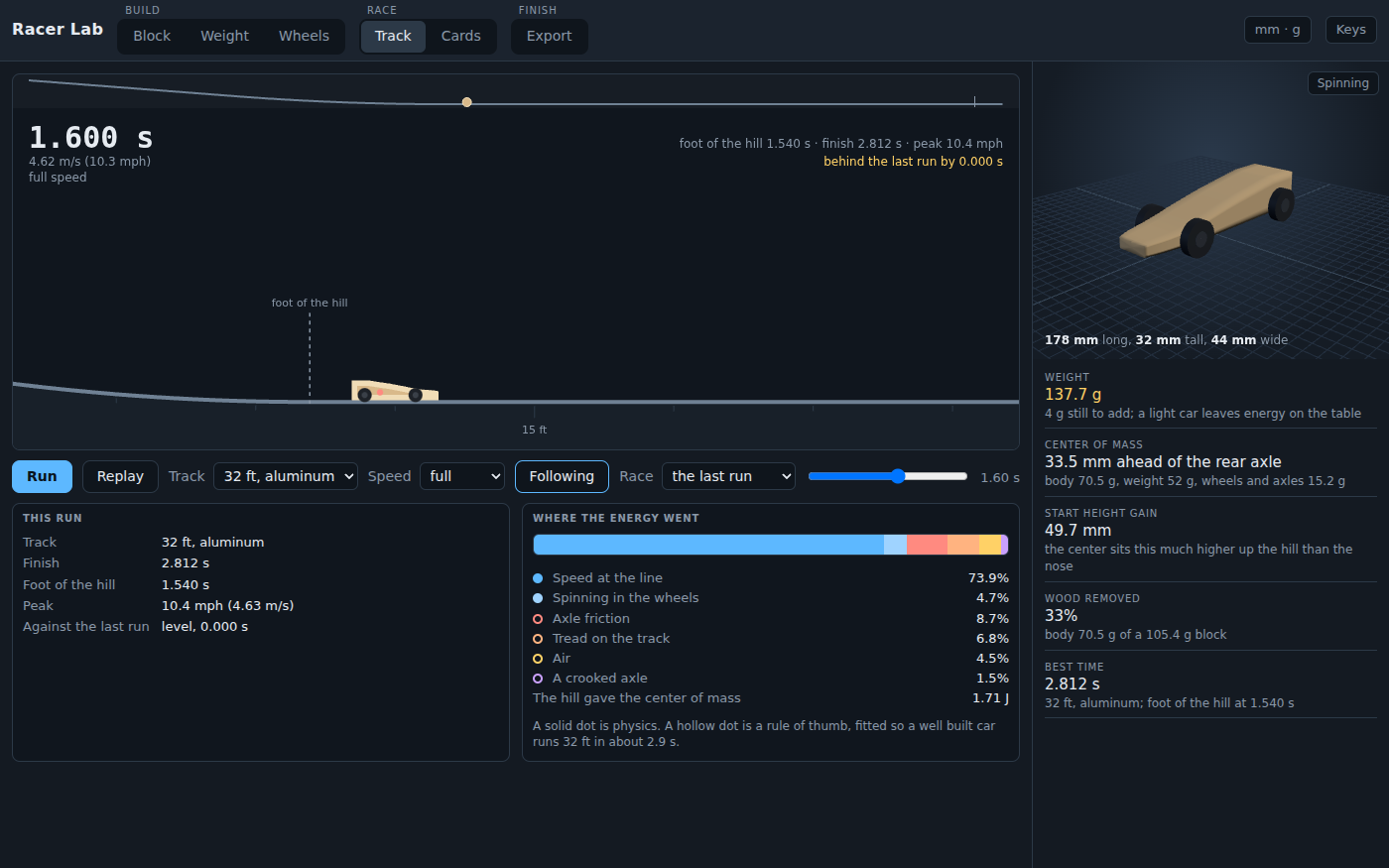
A run, raced against the car's own last one. The time is to the thousandth, and the energy bar says where the hill's 1.71 joules went. The solid dots are physics; the hollow ones are rules of thumb, and the bench says so.
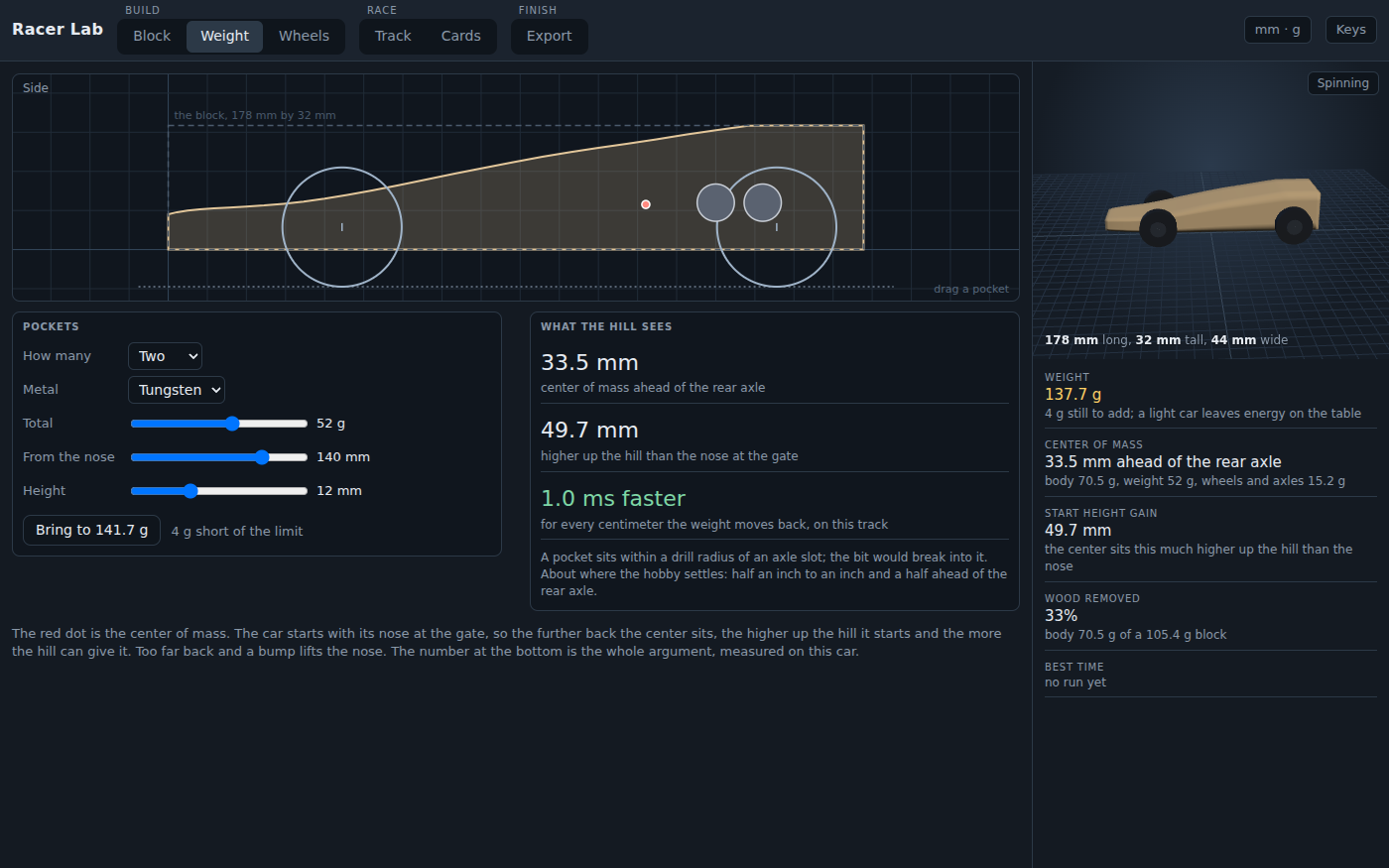
Where the weight goes, and what it buys. Sliding the pockets back raises the start, and the bench says how many thousandths each centimeter is worth on this track, and warns when a pocket would drill into an axle slot.
What they are learning while they play
Nothing here is presented as a lesson. This is what the activity is made of.
| What the student does | What it is |
|---|---|
| Slides the weight back and watches the time drop | Potential energy and center of mass. A car starts with its nose at the gate, so weight further back starts higher up the hill and has further to fall. The bench says how many thousandths a centimeter buys, on this track. |
| Reads where the energy went after a run | Conservation of energy. The hill gives the car energy; the axles, the rolling wheels and the air take some of it away, and what is left is speed. The breakdown adds up, and the student can see which loss is worth fighting. |
| Changes one thing, runs, then changes another | Controlled experiments. The same track and the same model every time, so a change in time is the change the student made. Changing two things at once hides which one helped. |
| Polishes the axles and lifts a wheel | Friction and rotational inertia. A wheel has to be spun up as well as moved, so a lifted wheel is one less to spin. Friction at the axle eats energy the whole way down. The bench gives each one a number. |
| Notices that some numbers carry a hollow dot | Models and their limits. Gravity is physics; axle friction is a rule of thumb fitted to real times. A good model says which of its parts are measured and which are guessed, and this one does. |
| Winds a mousetrap car's lever longer and finds it goes further but slower off the line | Force, distance and tradeoffs. A longer lever pulls with less force over more string. The same energy, spent differently, buys distance or speed, not both. |
| Prints the cut template and measures the 100 mm bar | Scale and measurement. A drawing at actual size is only true if the printer kept it that way. The bar is how a builder checks before cutting. |
How to tell whether it landed
Ask, and let them show you. A student who has understood it can answer these without help.
- Why is a car faster with its weight at the back? Show me on the hill where the weight starts.
- After your run, where did most of the lost energy go? What would you change first, and why that?
- You changed the axles and the weight at the same time and got faster. Which one helped? How would you find out?
- Which numbers on this bench are physics, and which are rules of thumb? How can you tell?
- Your mousetrap car went further with the long lever but lost the race to five meters. Why?
Use it in your subject
Not a technology class? Then the app is how students show what they learned in your unit. More projects for every subject.
Physics
Run the same car with the weight at three positions and chart the time against the distance from the rear axle. Then explain the line with potential energy.
Engineering and CTE
Design to a weight limit and a block, print the cut template at actual size, and build the car in the shop. Compare the real time on a real track with the bench's.
Math
Read the thousandths. How many thousandths is a centimeter of weight worth, and how many centimeters would it take to beat a classmate's time?
Science fair
Pick one piece of building advice, test it on the bench with everything else held still, and report what it bought and what the model cannot tell you.
Practical notes
- AgesAges 8 through high school. Younger students carve a car and run it; middle schoolers test one change at a time and read the energy picture; high schoolers work the numbers and the other four kinds of car.
- TimeA minute to a first run. A good session is thirty to forty-five minutes: a car, a few changes, and the one that bought the most.
- EquipmentA computer or Chromebook with a modern browser. Nothing to install. A printer for the cut template, and a block kit and a saw if a real car is being built.
- CostFree. The app has no paid tier.
- PrepNone. Open the page and go. Reading this page first takes about three minutes. If real cars are being cut, an adult does the cutting.
- In a groupEveryone can start from the same block car on the same track, so every time on the board is comparable. Local races have their own rules; the bench says so.
For co-ops, troops, microschools, and classrooms
Before race day, let each builder try their ideas on the bench, where a bad idea costs nothing. With a free account the cars are saved and shared, and a shared car's run plays on its page, so a group can compare designs before a block is cut.
Common questions
Is Racer Lab free?
Yes. It runs in your browser and there is no paid tier. A free account adds saving and sharing, but nothing on this page is behind a paywall.
Does my child need an account to try it?
No. The demo on this page is the complete bench with a block car loaded. Make a free account to save a car, share it, and keep the files it exports.
Can we use it for our derby?
Yes, to try ideas before building. The cut template prints at actual size for a standard block, and the build sheet says where to drill and how much metal goes where. Racer Lab is not connected with any derby organization, and its cards on the usual rules are not official: your race's own rules sheet decides.
How accurate are the times?
Gravity, the spin of the wheels and the air are physics. Axle friction, rolling resistance, the drag of the body and the cost of a crooked axle are rules of thumb, fitted so a well built block car runs 32 feet in about 2.9 seconds. The bench marks every number as one or the other. Use it to compare ideas on the same track, not to predict a race to the thousandth.
What kinds of car can it do?
A gravity block car, a mousetrap car, a balloon car, a rubber band car and a CO2 dragster. The block car runs down a hill against the clock; the three floor cars run until they stop, and distance is the number; the dragster runs a twenty meter line.
How does it connect to Tire Lab?
A tire designed in Tire Lab can go on Racer Lab's wheels, from the Wheels bench. Its grip and how it rolls come with it, so a student can find out what a tire does to a car's time.
What subject can I log this as?
Most families log it as physics or engineering. The table above lists specifically what is covered, so you can pick the label your records need and point at the evidence.
Still have a question? Ask us, and a person will write back.
Where to go next
Start with Racer Lab
Trying it costs nothing and takes about five minutes. An account is what makes the work last.
Racer Lab is one of the making apps on the platform. It is a place to make things, not a course, and it is not a substitute for a teacher: it is at its best when an adult asks the questions above and takes the answers seriously.
Page last reviewed October 2026.