Tire Lab
Every car tire has grooves cut into it, even though a smooth one would put more rubber on the road. Tire Lab lets students find out why. They carve a tire's tread, brake on a dry road and then in heavy rain, and watch from underneath as the water runs out through the grooves, or piles up in front and lifts the tire off the road. Then they take it off the road, into a muddy field and up a sand hill, and hear the note a tire hums as it rolls.
Using this with a class? Make a free class and add your students yourself: each gets a username and password, with no email or Google account needed. Or give them one join code. Using Google Classroom? Post the link there; with a free class, the link also puts each student in your class, so you see their work.A first lesson: Everyone starts from the same smooth tire, stopping in about 430 feet in heavy rain, and cuts grooves into it until it stops shorter. Then the class compares which grooves did the most, and why.
Set up a free class Share to Google ClassroomWhat a student actually does
They press Brake on a dry road, then in heavy rain, and see the same car need twice as far to stop. The top picture shows the part of the tire on the road from underneath, slowed down 120 times: grooves full of water on its way out, and a sheet of water pushing up under the front of the tire.
Then they design. They start from a smooth tire, a block tread, a winter tread or a mud tire, drag across the tread to cut grooves or put rubber back, and test again. Each change shows on a 3D tire, and a label grades the tread for grip in the rain, how easily it rolls, how quiet it is and how long it lasts.
A tire can be a car's, a run-flat's, a truck's, a bike's, a tractor's or an airliner's. A shop type (Highway, All-season, Performance, Winter, All-terrain or Mud-terrain) starts the tread from what a store sells. On the Size bench the student picks the speed the tire is built for, and on the Test bench a drum spins it faster, a letter at a time, until it holds or comes apart, and a wear test shows how long the tread lasts. On the Rim bench they pick one of eleven rim styles or cut their own spokes into the wheel.
Off the road, they drive courses through sticky mud, soft sand, rocky trail, snow and ice. A tire with narrow grooves packs full of mud until it is smooth, and the picture shows the packed grooves. A tire pumped too hard sinks into sand, and letting air out gets the car up the hill.
They hear the tire, too. Every block taps the road as it lands, and the lab plays the hum and shows how much of it falls on one note. Mixing pitches of three lengths, as tire makers do, makes it quieter. Older students write the order of the pitches as a program, write pit rules for a rally season, and write the rain rule the lab uses. The finished tire can be printed in flexible filament for a robot or a small car.
A finished tire can go on a car in Racer Lab, the platform's racing bench, from its Wheels bench. Its grip and how it rolls come with it, so a student can find out what a tire does to a car's time down the track.
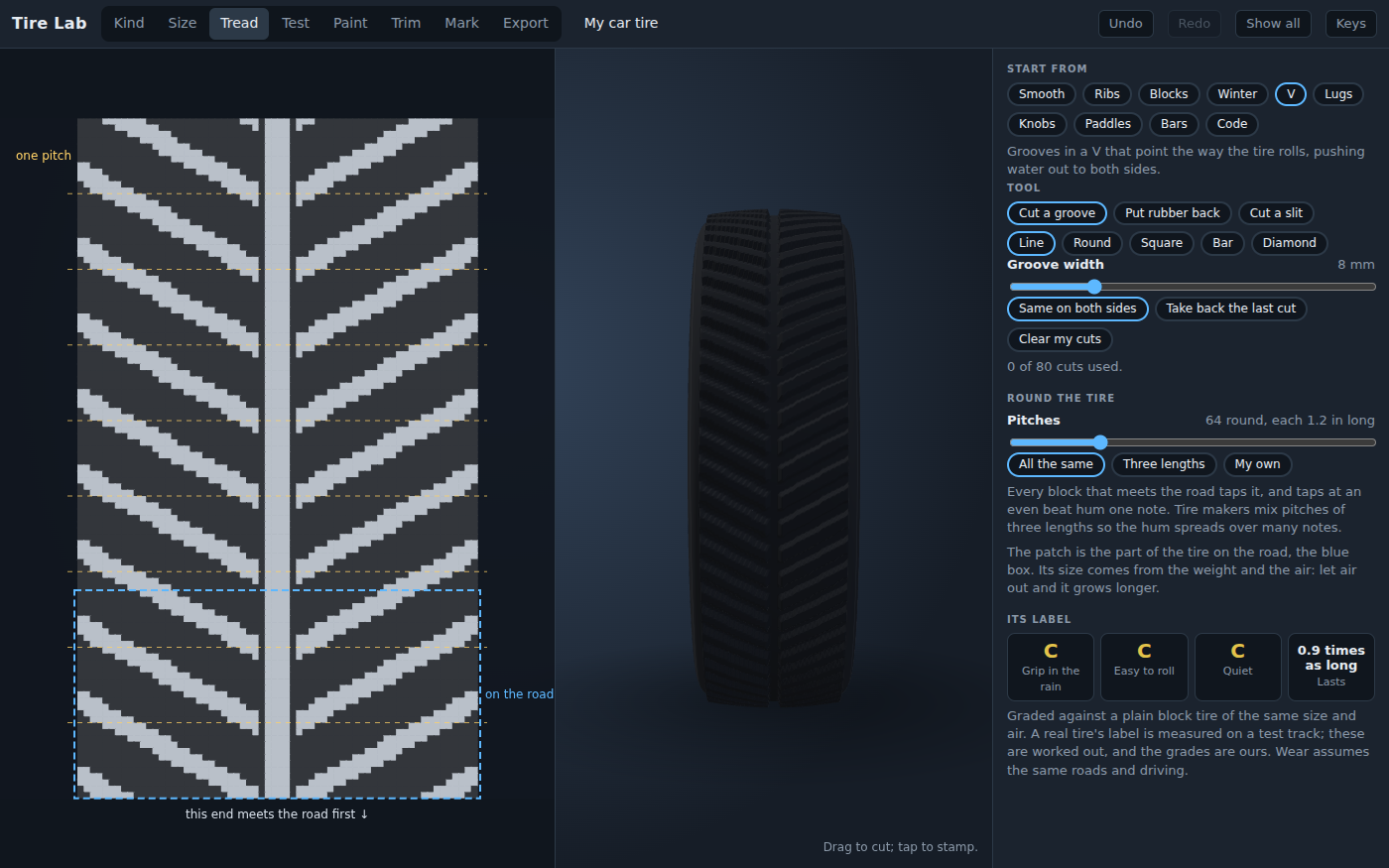
The Tread bench. A student drags across the picture to cut a groove, and the groove repeats all the way round the tire. The label under it says what the tread does, graded against a plain block tire.
What they are learning while they play
Nothing here is presented as a lesson. This is what the activity is made of.
| What the student does | What it is |
|---|---|
| Brakes on a dry road and in the rain, and compares the distances | Friction and stopping distance. A car stops as fast as its tires can grip. Water between the rubber and the road cuts the grip, so the same car needs further to stop. |
| Watches water run out of the grooves, or lift the front of the tire | Hydroplaning. Water that cannot get out of the way pushes up under the tire, harder with the square of the speed. NASA's rule gives the speed where a smooth tire lifts right off, from its air pressure. |
| Changes one thing at a time and keeps a table of the distances | Controlled experiments. Wear, air pressure and speed each change the stop. Changing one at a time is the only way to know which did what. |
| Cuts grooves into a smooth tire until it stops shorter in the rain | Engineering tradeoffs. Grooves clear water but take rubber off the road. A smooth tire wins on a dry road and loses in the rain, and every tread is a choice between them. |
| Gets stuck in mud and on a sand hill, and gets through | Traction and pressure. Mud packs narrow grooves until the tire is smooth; wide gaps that open at the side throw it out. A tire spread over more sand presses less and sinks less. |
| Hears the hum fall as the car slows, and spreads it with pitches of three lengths | Frequency and sound. Taps at an even beat make a note whose frequency is the number of taps a second. Uneven spacing spreads the same taps over many notes. |
| Writes the order of the pitches, pit rules, or the rain rule itself, in blocks or as code | Computational modeling. The lab's rules are written out for students to read and rewrite. The rain rule a student writes is checked against the lab's own on six cases. |
How to tell whether it landed
Ask, and let them show you. A student who has understood it can answer these without help.
- Why do racing cars use smooth tires on a dry track and change them when it rains?
- Why does a worn tire matter much more in the rain than on a dry road?
- Twice as fast takes four times as far to stop. Why four?
- Why do drivers let air out of their tires on a sandy beach, and pump them back up before the road?
- Why is a tire with pitches of three lengths quieter, when it taps the road just as often?
Use it in your subject
Not a technology class? Then the app is how students show what they learned in your unit. More projects for every subject.
Science
Forces and motion (NGSS MS-PS2-2): friction, stopping distance and why speed matters so much. Waves (MS-PS4-1): the hum of a tire as a frequency set by the taps of its tread.
Engineering
Design a tread against criteria and constraints, test it on roads, mud and sand, and improve it (MS-ETS1-1 to 4). The label grades the tradeoffs.
Math
Read stopping distances as a square law: twice the speed, four times the distance. Older students write the rain rule as a formula and check it against the lab.
Computer science
Write pit rules for a rally season and an order of pitch lengths, as Glassbox blocks or text, and a tread as a formula.
Practical notes
- AgesAges 11 through high school. Younger students brake, watch the water and cut grooves; older ones run controlled tests on wear, air and speed, write the rain rule, and program the pitches and the pit rules.
- TimeA minute to a first stop in the rain. A satisfying session is thirty to forty-five minutes. The free teaching notes plan four lessons.
- EquipmentA computer or Chromebook with a modern browser. Headphones for the lesson on sound. Nothing to install.
- CostFree. The app has no paid tier.
- PrepNone to try it. The teaching notes take about fifteen minutes to read.
- In a groupEveryone can start from the same smooth tire, then compare which grooves helped most and why.
For co-ops, microschools, and classrooms
Start everyone on the same smooth tire in the same heavy rain and see who can explain their tread best, not only who stops shortest. With a free account the tires are saved and shared, and a tire can be sent to a friend as a challenge: can they get further on the same course?
Common questions
Is Tire Lab free?
Yes. It runs in your browser and there is no paid tier. A free account adds saving and sharing, but nothing on this page is behind a paywall.
Does my child need an account to try it?
No. The demo on this page is the complete lab. Make a free account to save a tire, share it, and send it to a friend as a challenge.
Are there crashes?
No. A car that slides simply stops further on, and nothing is ever in its way. The lab is about the tire and the water, not accidents.
How real is it?
The hydroplaning speed is NASA's rule from its 1963 tests, and the rain rule is tuned so that worn tires stop as much further as real worn tires did in published tests. Some parts are the lab's own simplifications, such as how sticky mud is, and the lab says which ones.
Can it tell me whether my car's tires are safe?
No. It teaches how tires work. For a real tire, ask a tire shop.
Are there lesson plans?
Yes, free teaching notes with four lessons of forty-five minutes for ages eleven to fourteen, each step written in the words on the screen.
Does it connect to Racer Lab?
Yes. A tire designed here can go on a Racer Lab car, from Racer Lab's Wheels bench, and its grip and rolling come with it.
What subject can I log this as?
Most families log it as physical science or engineering. The table above lists specifically what is covered, so you can pick the label your records need and point at the evidence.
Still have a question? Ask us, and a person will write back.
Where to go next
Start with Tire Lab
Trying it costs nothing and takes about five minutes. An account is what makes the work last.
Tire Lab is one of the making apps on the platform. It is a place to experiment, not a course, and it is not a substitute for a teacher: it is at its best when an adult asks the questions above and takes the answers seriously. It does not judge real tires: for that, ask a tire shop.
Page last reviewed October 2026.