Shoe Lab
A shoe is a stack of decisions: how high the heel sits, what the toe is made of, how deep the tread is cut. Shoe Lab lets students make every one of them on a 3D shoe, then tests the result. Eight wearers try it on, from a basketball player to someone on a twelve hour shift, and each says in plain words whether they kept it and why. It opens on a court shoe that two of the eight would keep.
Using this with a class? Make a free class and add your students yourself: each gets a username and password, with no email or Google account needed. Or give them one join code.A first lesson: Everyone starts from the same court shoe and has one goal: get the wearer called Recess in the rain to keep it, without losing the court guard. Then each student explains which part they changed and why the water went where it did.
Set up a free classWhat a student actually does
They open the Test bench, pick a wearer and press Test it. The court shoe weighs 330 grams. The court guard keeps it, with a grip of 0.81 on a dry court. Recess in the rain sends it back: the feet were wet at minute 4, through the suede toe overlay.
So they make the toe leather and test again. The feet stay dry for twice as long, and then they are wet at minute 8, through the heel counter. The water did not stop. It found the next weakest part. That is the moment the lab is built for.
Someone else chases the road runner, who wants a shoe of 290 grams or less. Swapping the PU foam midsole for EVA foam brings the shoe to 288 grams. The runner still has one complaint, and it is a new one: the heel lands at 16.7 g, and the runner wanted 13 g or less. Every fix shows the next problem.
Along the way they reshape the last, cut and color panels, draw a pattern, carve their own tread on a grid, set the size in US, UK or EU, and program the lights in the shoe. When the shoe is done, the Export bench prints a paint plan and a tech pack, the papers a designer hands a factory.
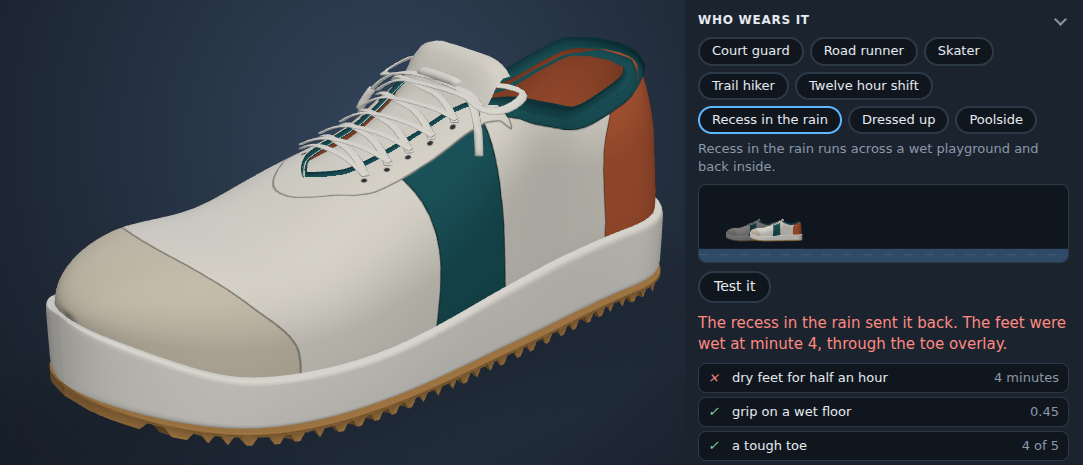
The starter court shoe, tested by the wearer who runs across a wet playground. The grip and the toe are fine; the feet are wet at minute 4, through the suede toe overlay. Make the toe leather and the water gets in at minute 8 instead, through the heel counter.
What they are learning while they play
Nothing here is presented as a lesson. This is what the activity is made of.
| What the student does | What it is |
|---|---|
| Fixes the toe, and the heel leaks instead | Weakest link. A system fails at its weakest point. Fix that one, and the next weakest becomes the problem. |
| Swaps one foam for another and loses 42 grams | Density and materials. The same shape made of a lighter material weighs less. Each material has a density, and the lab uses it to weigh every part. |
| Reads that the heel lands at 16.8 g | Impact and cushioning. A softer or thicker sole stops the foot more slowly, and a slower stop is a gentler one. The g number says how hard the landing is. |
| Carves grooves and watches the grip on wet rock change | Friction. Grip depends on the surface and on how much rubber touches it. Grooves let water out so the rubber can reach the ground. |
| Pleases one wearer and loses another | Design tradeoffs. No shoe suits everyone. A designer chooses who the shoe is for, and every choice costs something somewhere else. |
| Builds the same shoe for eight different people | User needs. Designers start from what a person does all day. A nurse on a long shift and a skater need different things from a sole. |
| Converts a foot length to US, UK and EU sizes | Standards and measurement. Shoe sizes come from formulas in a published standard. The lab uses them, and shows why two boxes can disagree. |
| Programs the lights and picks a battery | Programming and power. The lights follow rules written as short sentences, and the battery a student picks decides how long they last. |
How to tell whether it landed
Ask, and let them show you. A student who has understood it can answer these without help.
- Why did the feet get wet at the heel after you fixed the toe?
- Why does the road runner care about a different number once the shoe is light enough?
- Which wearer is hardest to please, and what would you have to give up to please them?
- Why is there no shoe all eight wearers keep?
- Which number on the Test bench is a rule of thumb, and how can you tell?
Use it in your subject
Not a technology class? Then the app is how students show what they learned in your unit. More projects for every subject.
Engineering
Run the design cycle for one wearer: test, read the reason, change one thing, test again. Keep a log of each change and what it did.
Science
Compare the foams on the Sole bench. Which is lightest, which gives back the most energy, and which lands the heel most gently?
Math
Take a foot length in millimeters and work out the US, UK and EU sizes by hand with the formulas from the standard, then check them against the lab.
Art and design
Design a colorway, then use the paint plan to paint a real pair of plain canvas shoes.
Computer science
Program a light show for the heel, or build a tread from a function, then explain the rule in words.
Practical notes
- AgesAges 10 through high school. Younger students shape and color shoes and read the wearers' verdicts; older ones chase a wearer and explain the numbers.
- TimeA minute to the first verdict. A satisfying session is thirty to forty-five minutes.
- EquipmentA computer or Chromebook with a modern browser. The shoe is 3D, so a very old or very slow computer may struggle. Nothing to install.
- CostFree. The app has no paid tier.
- PrepNone. Open the page and go. Reading this page first takes about three minutes.
- In a groupEveryone can start from the same court shoe and chase the same wearer, then compare which part each student changed.
For co-ops, microschools, and classrooms
Give each group one wearer and one hour. The shoes that come back are very different, and each group can say exactly which part they changed and which number moved. The Cards bench has twelve ready-made challenges, like Featherweight and Twelve hours, for students who finish early.
Common questions
Is Shoe Lab free?
Yes. It runs in your browser and there is no paid tier. A free account adds saving and sharing, but nothing on this page is behind a paywall.
Does my child need an account to try it?
No. The demo on this page is the complete lab with a starter court shoe. Make a free account to save a shoe and share it.
Are the numbers real?
Some are measured and some are not, and the lab tells you which. Every reading on the Test bench has a dot: solid when it is worked out from figures that have a source, hollow when it is a rule of thumb. Press a reading to see where it came from.
What kinds of shoes can it make?
A court shoe, a runner, a skate shoe, a trail boot, a slide, a wedge and a heel. Each one can be reshaped, cut into panels, colored and given its own tread.
Which shoe sizes does it use?
US, UK and EU sizes, from the formulas in the international standard ISO/TS 19407. Some brands mark their boxes about a size differently, and the lab says so.
Can students 3D print or paint their shoe?
Yes. The Export bench makes STL files for 3D printing a small model of the shoe and a lace tag, a 3D file for games and viewers, and a paint plan for painting a real pair.
What ages is it for?
Ages 10 through high school. Shaping and coloring a shoe works for anyone; chasing a wearer's numbers suits older students.
What subject can I log this as?
Most families log it as engineering or science. The design cycle, materials, friction and impact are engineering and physical science, and the size formulas are math. The table above lists specifically what is covered, so you can pick the label your records need and point at the evidence.
Still have a question? Ask us, and a person will write back.
Where to go next
Start with Shoe Lab
Trying it costs nothing and takes about five minutes. An account is what makes the work last.
Shoe Lab is one of the making apps on the platform. It is a place to make things, not a course, and it is not a substitute for a teacher: it is at its best when an adult asks the questions above and takes the answers seriously.
Page last reviewed September 2026.