RideMaker
A dark ride is the slow kind of theme park ride: a car on a track, through rooms full of scenes, timed so every rider sees the same show. RideMaker lets students design one from above and then ride it. It opens on The Haunted Voyage, a loop through a seance hall and a crystal cave: ride it, drop a ghost beside the track, and ride again to see it jump out at you. Free, in the browser, no account needed to try it.
Using this with a class? Make a free class and add your students yourself: each gets a username and password, with no email or Google account needed. Or give them one join code.A first lesson: Everyone designs one room for a class ride with a single theme, then the rooms are strung together on one track and the whole group rides it.
Set up a free classWhat a student actually does
They press Ride it and the car carries them through The Haunted Voyage: into the seance hall where a ghost glows in a pool of violet light, round the bend and into a cave of crystals, and back to the station. They stop, pick the ghost from the props, click beside the track, and ride again, and this time their own ghost is waiting for them.
From there it is a ride designer. Track pieces snap together into a loop, and Close my loop finishes it for them. Rooms can be added and themed, props come in spooky, sea, space, fantasy, carnival and jungle sets or from their own 3D models, show stops pause the car in front of a scene, and the ride can be a car or a boat. Sky, weather and a ride photo set the mood, and Operate runs a whole park day with a queue and grades how well the ride kept up.
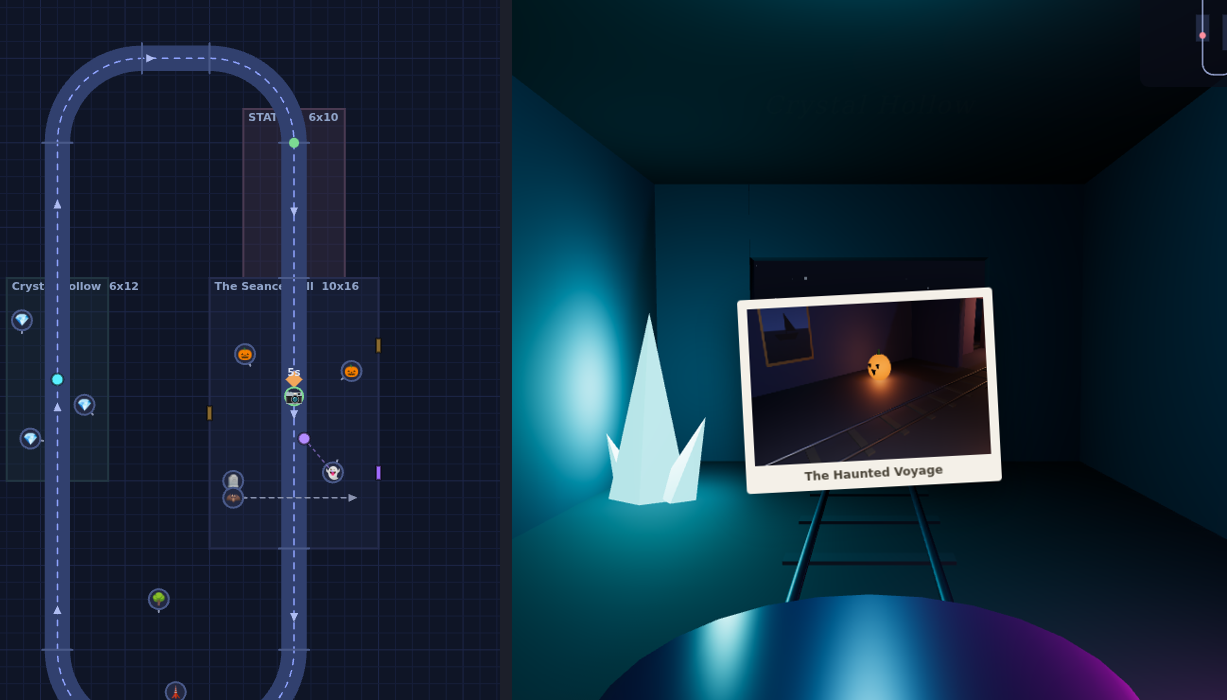
The same ride from above and from the seat. Everything on the plan, the loop of track, the rooms, the little markers for props, becomes the ride on the right. The camera marker in The Seance Hall is the ride photo: it snaps every rider as they pass and shows them the picture later on, like a real park.
What they are learning while they play
Nothing here is presented as a lesson. This is what the activity is made of.
| What the student does | What it is |
|---|---|
| Joins track pieces into a loop | Closed paths. The track has to end where it began. Every turn has to be undone by the others, which is geometry in practice. |
| Designs from the floor plan | Top-down plans. Architects and park designers work from a view from above, then check it at eye level. |
| Rides it and moves the ghost | Point of view. Something can look perfect on the plan and be invisible from the seat. Designing means checking from the rider's side. |
| Adds a show stop | Timing and pacing. A dark ride is a story told at a set speed. Stops and speeds decide what the rider sees and for how long. |
| Changes ride speed | Speed, distance and time. The ride is a fixed length, so a faster car means a shorter ride. The toolbar shows both. |
| Picks a sky and weather | Lighting and mood. The same rooms read as cozy or creepy depending on light. Dark rides are built around it. |
| Runs a park day in Operate | Throughput and queues. How many riders an hour a ride can carry decides how long the line gets. Real parks plan around that number. |
| Adds more cars | Systems. More cars carry more riders, until they start waiting on each other. Every system has a limit like that. |
How to tell whether it landed
Ask, and let them show you. A student who has understood it can answer these without help.
- Where would you put something so every rider sees it?
- Why does the track have to come back to the station?
- Your ride is too long. What would you change without cutting a room?
- In Operate, the line keeps growing. What could you change about the ride?
- What looks different from the seat than it did on the plan?
Practical notes
- AgesAges 8 through high school. Younger students decorate rooms and ride; older ones design whole rides and tune them in Operate.
- TimeUnder a minute to the first ride. A ride of their own takes thirty to sixty minutes.
- EquipmentA computer or Chromebook with a modern browser and 3D graphics (WebGL). A mouse helps. Nothing to install.
- CostFree. The app has no paid tier.
- PrepNone. Open the page and go. Reading this page first takes about three minutes.
- In a groupEach student can design one room of a class ride, and everyone rides the result.
For co-ops, microschools, and classrooms
Pick a theme as a group, haunted, underwater or space, and give each student a room. String the rooms together on one track and ride it on the big screen. Then open Operate and let the room argue about why the line got so long.
- Three starter rides: The Haunted Voyage, Under the Sea by boat, and Blast Off.
- Props in six themes, or students' own 3D models.
- Operate mode for queues, capacity and a graded park day.
- No install, no per-seat license. Student work is private by default.
Common questions
Is RideMaker free?
Yes. It runs in your browser and there is no paid tier. A free account adds saving and sharing, but nothing on this page is behind a paywall.
Does my child need an account to try it?
No. The demo on this page is the complete designer with a starter ride. Make a free account and the ride you changed comes with you as your first project.
Is it a roller coaster game?
No. It is deliberately the slow kind of ride, where the point is the scenes and the story, not speed or drops. Students design what riders see and when.
Can friends ride it?
Yes, with a free account. A finished ride can be shared as a page where anyone can watch it from above and climb aboard.
What ages is it for?
Ages 8 through high school. Decorating and riding work for anyone; planning a ride and running it in Operate suits older students.
What subject can I log this as?
Most families log it as engineering or design. Track loops are geometry, speed and ride length are math, queues and capacity are systems thinking, and the rooms are 3D design. The table above lists specifically what is covered, so you can pick the label your records need and point at the evidence.
Where to go next
Start with RideMaker
Trying it costs nothing and takes about five minutes. An account is what makes the work last.
RideMaker is one of the making apps on the platform. It is a place to make things, not a course, and it is not a substitute for a teacher: it is at its best when an adult asks the questions above and takes the answers seriously.
Page last reviewed September 2026.