Snowflake Maker
A paper snowflake is one cut made through many layers at once. Every cut shows up all the way around when the paper opens, mirrored across every fold, and that is where its symmetry comes from. Snowflake Maker folds the paper on screen, lets students cut the folded wedge, and opens it one crease at a time, so they see a single cut become twelve. Then it prints the lines to cut on real paper.
Using this with a class? Make a free class and add your students yourself: each gets a username and password, with no email or Google account needed. Or give them one join code. Using Google Classroom? Post the link there; with a free class, the link also puts each student in your class, so you see their work. mytekDev is also available from the Google Workspace Marketplace, so your school's Google admin can install it for everyone.A first lesson: Every student starts from the same uncut paper and makes one cut that touches no fold. Before anyone unfolds, they write down how many holes it will make. Then they unfold and count. Then they drag the same cut onto a fold and guess again. Why are there fewer holes now?
Set up a free class Share to Google ClassroomWhat a student actually does
They open the app on a finished paper snowflake, six arms with side branches. They press Fold it up and watch it fold back the way real paper folds: corner to corner into a triangle, then into thirds, then in half, one crease at a time. What is left is a thin wedge, with the two folded edges drawn as dashed lines.
They cut the wedge. The Cuts tab drops a notch, a round hole, a diamond, a slit, a side branch, a heart or a star on the paper, and each can be dragged, sized and turned. Students can also draw a cut of their own, corner by corner. The Tip tab cuts the top of the wedge into a point, a flat edge, a curve or a notch, and decides the outline of the whole flake.
Then they press Unfold and watch the paper open, one crease at a time in the reverse order, until each cut has turned into six, or twelve. Show mirror lines draws the lines of symmetry on the result. Guess first, if it is switched on, shows two or three unfolded snowflakes before the paper opens and asks which one these cuts will make.
In the corner, Will it hold? watches every cut: if a cut runs right across the paper, a piece falls off; if a strip is too thin to cut through all the layers, it is ringed in orange. When it holds together, Print gives two pages: the square with the lines to cut, and the folding steps with a picture of what will open. A Real snow tab shows the shapes real snow crystals grow in.
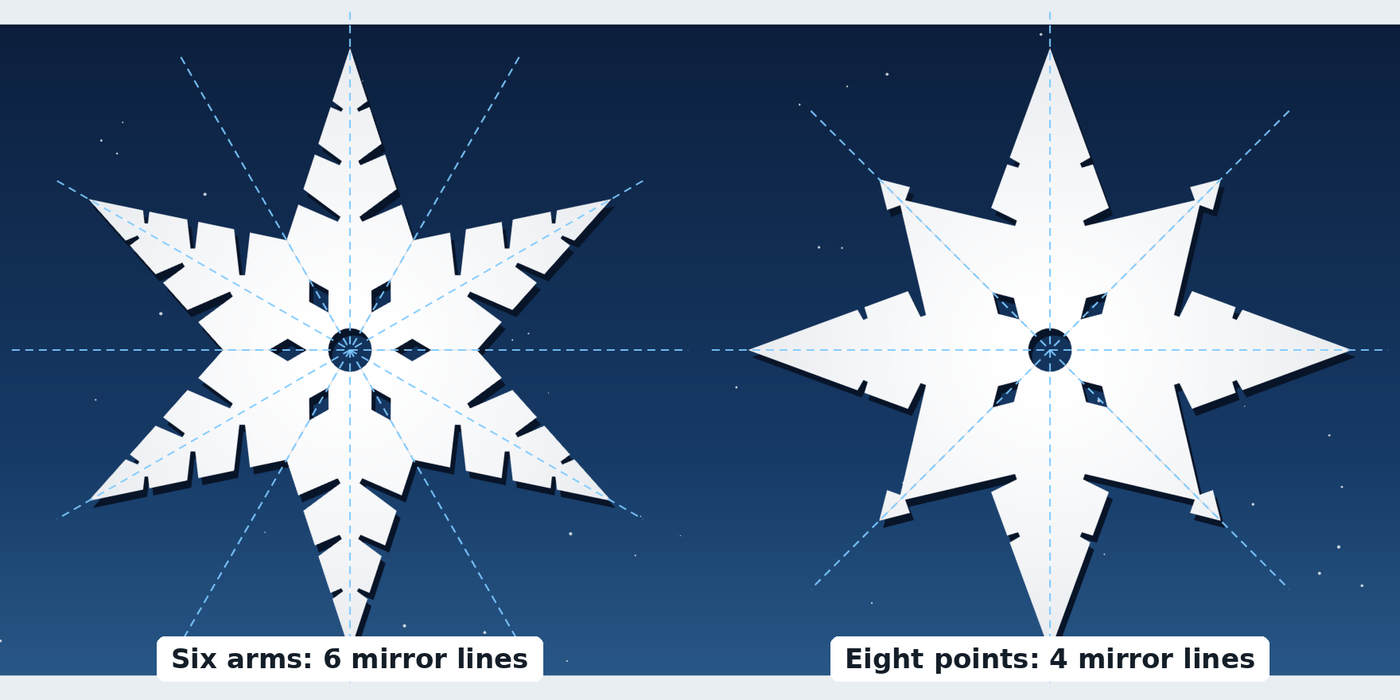
The same cuts, folded two ways. Six arms opens into six matching arms with 6 mirror lines. The classroom eight-point fold opens into eight points, but only 4 mirror lines: the points take turns, long and short, so the flake only matches itself every quarter turn, and only 4 lines fold it into matching halves.
What they are learning while they play
Nothing here is presented as a lesson. This is what the activity is made of.
| What the student does | What it is |
|---|---|
| Shows mirror lines on the open snowflake | Lines of symmetry. A line the snowflake could be folded along so both halves match. The app works them out from the snowflake the student made, not from the fold: with no tip cut, six arms of folding open back into a square, which has only the square's 4. |
| Makes one cut and counts the holes after it unfolds | Reflection. Each layer of the folded paper is a mirror image of the one next to it. A cut through all of them lands once in every layer, flipped each time. |
| Picks the wrong snowflake in Guess first: the one with every cut turned, not flipped | Reflection and rotation. Turning a shape and flipping it are different moves. A paper snowflake is made of both: the arms match by turning, and each arm matches itself by flipping. |
| Folds the same cuts as Six arms, then as Eight points | Six-fold and four-fold symmetry. Six arms opens with 6 mirror lines and matches itself 6 times in one full turn. The classroom eight-point fold opens with only 4 mirror lines, however many points it seems to have. |
| Drags a cut onto a fold, then off it again | Cause and effect in a fold. A cut that touches a fold opens into one hole, mirrored across the fold. A cut that touches no fold opens into separate holes, one for every layer. |
| Fixes the arm Will it hold? says will fall off | Designing for a material. Paper is only paper where cuts leave it joined. Through twelve layers of copy paper, the app treats a strip thinner than about 2 mm as too thin to cut, and rings it. |
| Opens the Real snow tab | Why real snow has six arms. When water freezes, its molecules line up in a six-sided pattern, so a snow crystal grows six arms. No real snow crystal has eight. |
How to tell whether it landed
Ask, and let them show you. A student who has understood it can answer these without help.
- You made one cut. Why are there twelve holes?
- Why does a cut on a fold make fewer holes than a cut in the middle of the paper?
- Point to one line of symmetry on your snowflake. How do you know it is one?
- The eight-point fold has eight points. Why does it have only four mirror lines?
- Why do real snow crystals have six arms and never eight?
Use it in your subject
Not a technology class? Then the app is how students show what they learned in your unit. More projects for every subject.
Math
Lines of symmetry the way the grade 4 standard defines them, by folding. Older students sort the turns and flips that carry the snowflake onto itself, and compare six-fold with four-fold.
Art and design
A paper snowflake planned before it is cut: positive and negative space, a pattern that repeats round a center, and a design that has to survive the scissors.
Science
The Real snow tab: the shapes snow crystals grow in, how big they are, and the temperatures they grow near. A paper snowflake is a model of a real one, and the tab says where the model is wrong.
Practical notes
- AgesAges 6 through high school. Younger students fold on Simple, which has only four layers, pick shapes and print. Older ones compare folds, count mirror lines and turns, and draw cuts of their own.
- TimeA minute to a snowflake of their own. A satisfying session on screen is twenty to thirty minutes. Folding and cutting the printed one is another ten to fifteen.
- EquipmentA computer or Chromebook with a modern browser. Nothing to install. A printer, copy paper and scissors to cut the real one; coffee filters work too.
- CostFree. The app has no paid tier.
- PrepNone to try it. Print one snowflake yourself first, at Actual size (100%), and fold and cut it, so you know the steps.
- In a groupEveryone can start from the same uncut paper and compare snowflakes after the same number of cuts. Guess first works well called out as a class.
For co-ops, microschools, and classrooms
Hang a window of them. Each student designs a snowflake, checks that it holds together, prints it and cuts it. No two come out the same, and every one has the same symmetry. Put the six-armed ones and the eight-pointed ones side by side and ask which look like real snow.
Common questions
Is Snowflake Maker free?
Yes. It runs in your browser and there is no paid tier. A free account adds saving and sharing, but nothing on this page is behind a paywall.
Does my child need an account to try it?
No. The demo on this page is the complete app with a snowflake loaded. Make a free account to save a snowflake and share it.
Can we cut the real snowflake?
Yes. Print gives the square with the lines to cut on every layer, and a second page with the folding steps and a picture of what will open. Print at Actual size (100%), not Fit to page; the page has a square that should measure one inch. Letter paper and coffee filters work too.
Why six arms and not eight?
Real snow crystals have six arms, so Six arms is where the app starts. Eight points is there too, labeled as the classroom fold, because it is the one most of us learned. Comparing the two is part of the lesson.
Is it a Christmas activity?
No. There are no holiday words in the app. It is about snow and symmetry, so it works all winter, in any school.
What ages is it for?
Ages 6 through high school. Picking shapes and printing works for younger students, with Simple for fewer layers to cut. Counting mirror lines and turns, and comparing folds, fits older ones.
Still have a question? Ask us, and a person will write back.
Where to go next
Start with Snowflake Maker
Trying it costs nothing and takes about five minutes. An account is what makes the work last.
Snowflake Maker is one of the making apps on the platform. It is a place to make things, not a course, and it is not a substitute for a teacher: it is at its best when an adult asks the questions above and takes the answers seriously.
Page last reviewed November 2026.
Google, Google Classroom and Chromebook are trademarks of Google LLC.