Wind Lab
Hold a hand out of a car window and you feel it: the wind pushes, and it pushes harder the faster you go. Wind Lab is the machine engineers use to measure that push. Students put a cube in the test section, turn the wind up, and read a scale; then a teardrop the same size, which pulls a twenty-sixth as hard, and the smoke shows why. They draw a shape of their own and try to beat it, send a rising wind down a campsite and read why each tent and chair went when it did, and run a wind turbine through a week with a hurricane in it, with rules they write themselves.
Using this with a class? Make a free class and add your students yourself: each gets a username and password, with no email or Google account needed. Or give them one join code. Using Google Classroom? Post the link there; with a free class, the link also puts each student in your class, so you see their work.A first lesson: Everyone starts with the cube on the scale at 15 mph, doubles the wind, and writes down what the push did. Then the class compares the cube with the teardrop, the sphere and the flat plate at the same wind, and argues about where the push comes from.
Set up a free class Share to Google ClassroomWhat a student actually does
They turn a dial and read a scale. The cube in the tunnel is pushed with about 1.6 pounds at 15 mph and 6.5 at 30: double the wind, four times the push. Beside it a teardrop the same height reads a quarter of a pound, and the dashed smoke shows the difference: it closes up behind the teardrop and churns behind the cube. A shelf holds nine shapes at the same size, a trash can, a tent, a cyclist, a golf ball beside a smooth ball, a wire that hums, and the air can be taken up a mountain where it is thinner.
On the Shape bench they draw a profile in a box four times as long as it is tall and watch its number change as they drag a dot. Making the front pointed takes it down to the ball's number and no further; only a long taper at the back takes it lower, which is the lesson. A ranking shows where their shape sits against the starters. A student who prefers to write can make the shape from a four-line formula instead, and the lab reads it rather than running it.
On the Street bench the same wind meets a row of things. They pick a campsite, a backyard, a parking lot or a bridge, set the dial and the gusts, press Send the wind, and watch the wind rise over nine seconds: the loose tent tumbles off at 15 mph, the chair at 38, the staked tent holds until its stakes pull out on a gust, the tree comes down, the person leans and holds a railing. Every thing gets a sentence with the two numbers that decided it, and in the All view each one's weight and base can be changed and the street run again, last time against this time.
On the Turbine bench they read the power the wind carries through a rotor, see that twice the wind is eight times the power, and that no rotor can take more than about six tenths of it. Then they write the rules that run the turbine through a week with a hurricane: feather above a speed, brake above a gust, run again below one. The week scores their rules against a perfect controller, and a turbine nobody stops is wrecked on Friday.
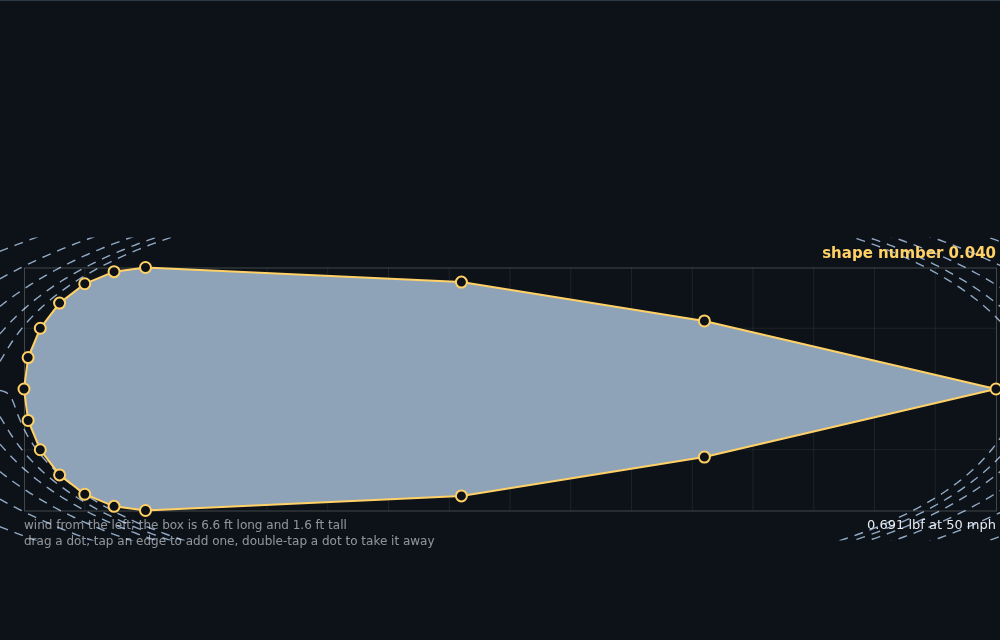
The Shape bench. Everyone draws in the same box, so the only way to pull less is the shape. The number comes from two things a student can see: whether the front is flat, and how long the back takes to close.
What they are learning while they play
Nothing here is presented as a lesson. This is what the activity is made of.
| What the student does | What it is |
|---|---|
| Doubles the wind on the dial and reads the scale | Drag and the square of the speed. The push of the wind is half the air's density, times the speed squared, times the area it meets, times a number for the shape. The scale reads that rule, and the All view writes it out with the numbers filled in. |
| Compares a cube, a sphere, a plate and a teardrop at the same wind | The drag coefficient. The shape number is what a real wind tunnel measures. A flat plate is about 1.3, a cube 1.05, a sphere 0.47, a teardrop 0.04. The card says where each came from, with a solid dot for a measured table and a hollow one for the lab's own guess. |
| Draws a shape and tries to beat the teardrop | Wakes and streamlining. A flat front lets the air go at a sharp edge; a rounded one keeps it attached to the widest point; only a long taper keeps the wake narrow. The number falls in that order and no other, which is the engineering design cycle with a scale on it. |
| Takes the tunnel up a mountain | Air has weight. The same wind pushes a sixth less a mile up, because a cubic meter of the air weighs less. The density comes from the standard atmosphere and the temperature of the day. |
| Sends a gale down the campsite and reads the sentences | Friction, torque and terminal velocity. A thing slides when the push beats its weight times a friction number, tips when the push, acting part way up, turns it harder than its weight holds it through half its base, and is carried away when the push equals its weight. The sentences show both numbers each time. |
| Reads the dial past force 12 | The Beaufort, Saffir-Simpson and EF scales. The dial carries the Weather Service's words for every wind, the hurricane categories past force 12, and the tornado rating gusts like it would earn. The EF scale rates damage, not measured wind, and the lab says so. |
| Runs a turbine at 11, 22 and 44 mph | Power goes with the cube; Betz's limit. Faster air brings more air past each second, so the power is the cube of the speed. No rotor can take more than 16/27 of it, and the best real ones reach about three quarters of that. The generator caps the rest. |
| Writes rules for the turbine, the awning or the patio flag | Control as rules, blocks or text. The same rules read as sentences with blue words, as Glassbox blocks, or as text, and the week scores them. Feather too early and the week makes less; too late and the turbine is wrecked. That is a real controller's tradeoff. |
How to tell whether it landed
Ask, and let them show you. A student who has understood it can answer these without help.
- The wind doubles. How many times does the push go up, and why is it not two?
- A cube and a teardrop are the same height. Why does the teardrop pull so much less, and where does the push on the cube come from?
- You made the front of your shape pointed and the number stopped at the ball's. What did you have to change to get below it?
- A trash can slides before it tips. What would make it tip first?
- Why did the staked tent last to 64 mph when the loose one went at 15?
- Why does doubling the wind give a turbine eight times the power, when the push only went four times?
- Your turbine was feathered on Friday and never ran again. What did the rule forget?
Use it in your subject
Not a technology class? Then the app is how students show what they learned in your unit. More projects for every subject.
Science
Forces and motion (NGSS MS-PS2-2): the push of the wind, measured and doubled. Energy (MS-PS3-1): the square and the cube of the speed, read off a scale and a turbine. Earth science: the Beaufort, Saffir-Simpson and EF scales on one dial.
Engineering
Design a shape against a fixed box and a measured number (MS-ETS1-1 to 4); set up a campsite to hold at 45 mph; write a controller for a turbine and score it against a perfect one.
Math
Squares and cubes as things you can see: four times the push, eight times the power. Ratios between shapes. Reading a power curve.
Computer science
Rules as sentences, as Glassbox blocks and as text, run every hour of a week and scored. The drag equation written by the student and checked against the scale at two winds, so a number tuned to one speed fails.
Practical notes
- AgesAges 11 through high school. Younger students turn the dial, compare shapes and send the wind down the street; older ones write the drag equation themselves, run controlled tests on weight and base, and write the turbine's controller.
- TimeA minute to feel the push; a class period for one bench; four lessons for the teaching notes.
- EquipmentAny computer or Chromebook with a browser and a mouse or trackpad. Sound is optional: a wire in the tunnel hums, and it is quiet.
- CostFree. A free account adds saving and sharing.
- PrepTry lesson 1 yourself, ten minutes. Know where the dial is and what Compare with another does.
- In a groupOne screen per student, or one per pair with the dial shared. The campsite is a good pair activity: one sets up, one reads the sentences.
For co-ops, microschools, and classrooms
Start everyone on the cube at 15 mph and the same question: what will the scale say at 30? Then the Shape bench, where the box is the same for everyone and the ranking makes the comparison for you. With a free account a shape or a street is saved and can be shared, so a class can collect its lowest numbers in one place. The teaching notes give four lessons with every step in the words on the screen.
Common questions
Is Wind Lab free?
Yes. It runs in your browser and there is no paid tier. A free account adds saving and sharing, but nothing on this page is behind a paywall.
Does my child need an account to try it?
No. The demo on this page is the complete lab. Make a free account when there is a shape or a street worth keeping.
Are the numbers real?
The scale reads the drag equation, which is the rule engineers use for a first answer. The shape numbers come from measured tables and the card says which; where a number is the lab's own guess for a thing no table lists, the card shows a hollow dot and says so. The Beaufort, hurricane and EF ladders are copied from the Weather Service's pages. The smoke is a sketch of what a real tunnel shows, not a flow calculation, and the lab says that too.
Does anything get hurt?
No. The person on the street leans, steps back and holds a railing, and is never knocked down or carried. Things that go are tents, chairs, cans and trucks, and they tumble off the far edge. No real place or storm is shown.
What is the Awning bench?
A patio with an awning, an umbrella and a flag, run by rules a student writes: roll in the awning above a gust speed, roll it out when the wind drops. The same week of weather for everyone, and a score of shade kept against things lost. It is the youngest rung of the programming in the lab; the turbine's rules are the next.
Can it be used for high school physics?
Yes. The All view shows the drag equation with the numbers in, the Reynolds number and a sphere's drag crisis, the air's density from altitude and temperature, and the power curve of a turbine against Betz's limit. The Code rung has the student write the push and checks it against the scale at two speeds.
Still have a question? Ask us, and a person will write back.
Where to go next
Start with Wind Lab
Trying it costs nothing and takes about five minutes. An account is what makes the work last.
Wind Lab is one of the making apps on the platform. It is a place to experiment, not a course, and it is not a substitute for a teacher: it is at its best when an adult asks the questions above and takes the answers seriously. It does not judge real tents, signs or vehicles.
Page last reviewed October 2026.