Egg Drop Lab
The egg drop is assigned from fourth grade to AP Physics, and a student gets one egg, one drop and a verdict. Egg Drop Lab is the rehearsal. The capsule is built the way a real one is: the egg in a zip bag, wraps around it, a cup or a box it has to fit inside, and fill packed around that. The fall plays in real time, the landing plays at one fiftieth speed with a clock in milliseconds, and one chart draws the force on the egg against time with the area under it shaded: the impulse. Then the student builds it for real, and the app keeps both answers.
Using this with a class? Make a free class and add your students yourself: each gets a username and password, with no email or Google account needed. Or give them one join code. Using Google Classroom? Post the link there; with a free class, the link also puts each student in your class, so you see their work. mytekDev is also available from the Google Workspace Marketplace, so your school's Google admin can install it for everyone.A first lesson: Everyone follows the guide: drop a bare egg from a desk, then the same egg wrapped in bubble wrap in a paper cup of cotton balls, then that cup from a ladder. Ask why the shaded area under the curve is the same size every time from the same height. Finish with each group printing a build sheet for the class drop height, and drop the real ones the next day.
Set up a free class Share to Google ClassroomWhat a student actually does
They build the capsule in the order a real one is built. The egg goes in a zip bag. Up to six wraps go around it, inside out, each with its own number of turns and its real thickness: small or big bubble wrap, paper towel, craft foam, cotton batting, a sock. Then a container with real inside sizes: a 16 oz paper cup or a cut 2-liter bottle stands the egg up, a small or a big box lays it down, and if the wrapped egg does not fit, Drop waits and says by how much. Then the fill around it, packed loose, snug or tight: cotton balls, crumpled paper, packing peanuts, sponge pieces, popped popcorn, or rubber bands that hang the egg in the middle of a box.
They drop it. Heights go from a desk at 1 m to a third-floor balcony at 10 m, and anything above a student's head is marked as an adult's drop. Straw legs, a paper cone or bubble wrap outside give the capsule a crush zone. A coffee filter or a plastic bag gives it a parachute, which needs height before it pulls. The landing replays at one fiftieth speed, with a clock in milliseconds and each layer squashing in the cut-away.
They read it. The chart draws the force on the egg against time with the impulse shaded, and two dashed lines show where an egg cracks: about 35 N on a hard spot, more when the push is spread through padding. The readings give the landing speed, the momentum before and after, the change, the stopping time, the average and peak force, and what each layer under the egg did at the deepest squash, so a student sees which one gave out. A short card after each drop says what changed from the drop before, in one sentence.
They build it and drop the real one. The build sheet prints the capsule with every material weighed and cut to size, the steps to put it together, the prediction at the class's height and a box for what really happened. The drop log keeps one row per drop, and The real drop adds what happened beside the prediction: the height, survived or cracked, and if it was filmed in slow motion, the frames from touch to stop, which turn into a real stopping time and a real average force. Rules sets the class drop height, a mass limit and whether parachutes are allowed, and travels with a shared project.
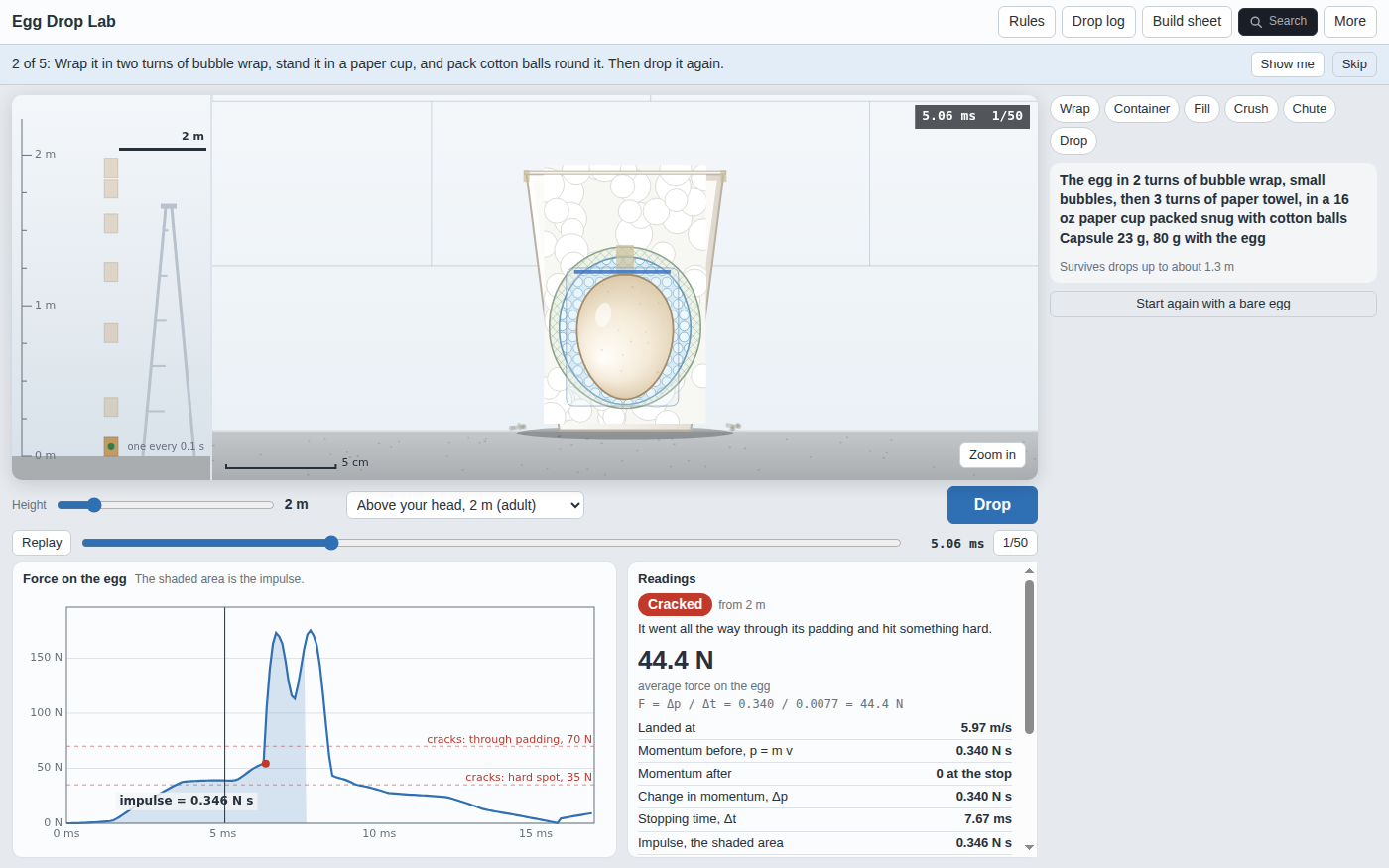
The same cup that survives a desk, from above a student's head. The momentum change is fixed by the height, so the padding can only stretch the stop; this one ran out of padding and the force spiked. The readings say which layer gave out.
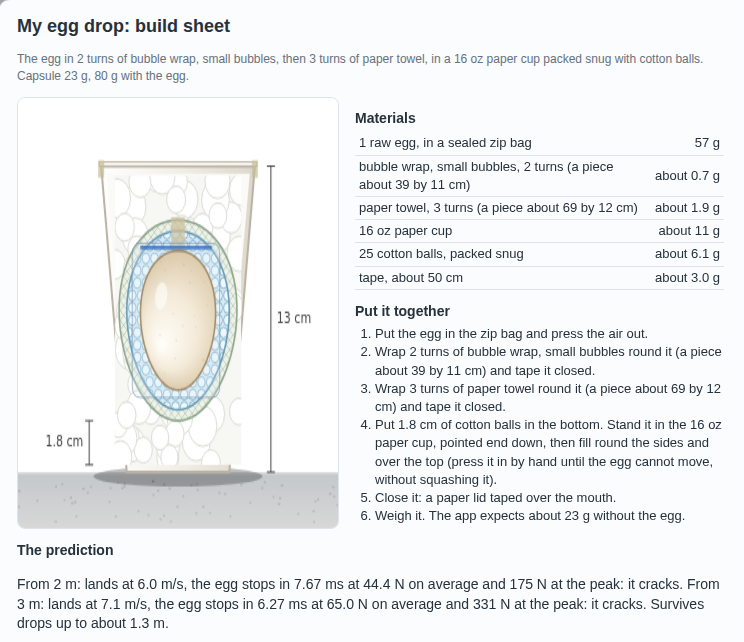
The build sheet is the capsule as drawn, with every piece cut to a size and counted, the prediction at the class height, and a box for the real drop. A phone's slow-motion frames from touch to stop give a real stopping time to set against the app's.
What they are learning while they play
Nothing here is presented as a lesson. This is what the activity is made of.
| What the student does | What it is |
|---|---|
| Drops the bare egg and the padded egg from the same height | Momentum and its change. The egg lands with momentum p = m v whatever it is wrapped in. Stopping it takes all of that away, so the change in momentum is set by the height alone. |
| Reads the shaded area under the force curve | Impulse. Force times time is the change in momentum. The area under the curve is the same from the same height; padding makes it longer and lower, and lower is what saves the egg. |
| Divides the change by the stopping time | Average force. F = Δp / Δt, shown with the numbers filled in on every drop. Twice the stopping time is half the push. |
| Packs the same cup loose, snug and tight | How cushioning works. Padding helps only while it is still squashing. Too little, or packed so tight it cannot give, and the egg reaches something hard before it stops. |
| Adds a parachute and drops from 1 m, then from 6 m | Drag and terminal speed. A parachute is the one part that lands the egg slower, so it is the only one that shrinks the momentum change. It needs height to open and pull. |
| Prints the build sheet, drops the real one and logs it | Prediction and testing. A model is a guess with numbers. The real drop says how close it was, and a wrong prediction kept in the log is the most useful row in it. |
How to tell whether it landed
Ask, and let them show you. A student who has understood it can answer these without help.
- The bare egg and the padded egg fell from the same height. Which one had more momentum to lose?
- Why is the shaded area the same size, but the padded curve so much lower?
- Your capsule survived 1 m and cracked at 3 m. What two things could you change, and what does each one do?
- Why does a parachute help a lot from the bleachers and hardly at all from a desk?
- Your real egg survived but the app said it would crack. What would you measure to find out why?
Use it in your subject
Not a technology class? Then the app is how students show what they learned in your unit. More projects for every subject.
Science
Physical science and physics: momentum, impulse, force and time, energy at the landing, and drag on a parachute, all as numbers on every drop.
Math
Reading a force against time graph, the area under a curve as a quantity, and F = Δp / Δt worked with the student's own numbers.
Engineering
Design under constraints: a mass limit, a drop height and the materials on the table, then a build sheet, a test and a redesign.
Practical notes
- AgesGrades 4 to 12. Younger students follow the guide and read Cracked or Survived and the average force. Middle school works the momentum and impulse readings. Physics classes turn on Numbers in More for the energy, the g on the egg and the capsule's force, and use the slow-motion real drop.
- TimeThe guide takes ten minutes. Designing a capsule for the class height takes twenty to thirty. The real drop is a second session.
- EquipmentA computer or Chromebook with a modern browser. Nothing to install. For the real drop: the materials on the build sheet, eggs in zip bags, and a phone that films slow motion if you want the real stopping time.
- CostFree. The app has no paid tier.
- PrepNone for the app. For the real drop, an adult does any drop from above head height, nobody stands under it, and everyone washes their hands after touching raw egg. The build sheet prints those rules.
- In a groupPairs work well: one builds, one predicts. Set the class height and mass limit in Rules once and share the project, so every group designs to the same contest.
For co-ops, microschools, and classrooms
The egg drop, with the step it was missing: a place to try the capsule before the egg is spent. One period for the guide and a design at the class height, one for the real drop and the log.
- Built from what a class really has: cups, bottles, boxes, cotton balls, paper, bubble wrap, popcorn, straws, rubber bands, a coffee filter, a grocery bag.
- The force on the egg in milliseconds, with the impulse shaded on every drop.
- A printable build sheet and a drop log that keeps the prediction and the real result side by side.
- A free teacher account covers up to 50 students, and student work is private by default.
Common questions
Is Egg Drop Lab free?
Yes. It runs in your browser and there is no paid tier. A free account adds saving and sharing, but nothing on this page is behind a paywall.
How accurate are the numbers?
The egg's mass, 57 g for a US large egg, and the roughly 35 N an egg takes between two flat plates come from published measurements. The padding, straw and box numbers are the app's own estimates, kept simple on purpose, and the crack forces can be changed in Rules. The real drop is where you find out how close they are.
Can students type in any material?
No. They choose from the materials a class usually has, each with a real thickness or size, so every design can be built from the build sheet.
Can I set the rules for my class?
Yes. Rules sets the class drop height, a capsule mass limit and whether parachutes are allowed. The rules travel with the project, so set them once and share it.
What ages is it for?
Ages 9 to 18. The guide works for upper elementary, the momentum and impulse readings for middle school, and the Numbers and slow-motion real drop for high school physics.
Still have a question? Ask us, and a person will write back.
Where to go next
Start with Egg Drop Lab
Trying it costs nothing and takes about five minutes. An account is what makes the work last.
Egg Drop Lab is one of the making apps on the platform. It is at its best the day before the real egg drop, and the day after, when the log shows which predictions were wrong.
Page last reviewed October 2026.
Google, Google Classroom and Chromebook are trademarks of Google LLC.