Mask Lab
A mask is a shell over a face with holes in the right places. Mask Lab lets students make one in 3D: a comedy or tragedy mask for a play, a Venetian half mask, a Mardi Gras mask with feathers, a skull, a fox. They cut the eyes where their own eyes are, check how far they can see out of it, light it from above and from below on a dark stage, and print it as a card template at its real size to cut out and wear.
Using this with a class? Make a free class and add your students yourself: each gets a username and password, with no email or Google account needed. Or give them one join code. Using Google Classroom? Post the link there; with a free class, the link also puts each student in your class, so you see their work.A first lesson: Everyone makes a mask for a character in a play or a story, checks they can see out of it, prints the card template, and wears it. Before the printing, ask why the eye holes on the paper are further apart than the eyes on the face.
Set up a free class Share to Google ClassroomWhat a student actually does
They open the lab on a comedy mask; the Head button over the stage puts a plain gray head under it, to see whether the eyes line up. On the Style bench there are twenty-three masks in four groups: Theater, Carnival, Halloween and Animals. On the Shape bench they pick an outline (across the eyes, cat-eye, butterfly, half face, full face, bauta, skull and more) and slide it wider, higher or swept up at the corners, and shape the face under it: a longer nose, a jutting chin, a grin or a frown. The size is the space between the eyes, from a small child's to an adult's.
On the Eyes bench, a pair of eyes is one press, and the pair lands where a wearer's eyes are at every size. A mouth is another press. The saw, the engrave tool and the punch cut by hand on the mask itself, with Mirror on so each cut is made again on the other side. Or they type commands in millimeters across and up from the nose, or snap the same commands together as blocks.
Can you see out? looks out through the holes from where a wearer's eyes would be and says how many degrees each eye sees to the side, up and down. A full mask with no opening below the nose is told it needs a way to breathe. On the Light bench the mask goes onto a dark stage with one light that moves round it.
Then the mask leaves the lab. A card template prints at its real size on Letter or A4, with the eye holes, slots for elastic, and a gray wedge (a dart) to cut and glue wherever the mask curves too much for flat card. The same lines come as an .svg for a cutting machine. An .stl prints the mask to wear, and a 3D model goes to the student's Files for the platform's other 3D apps.
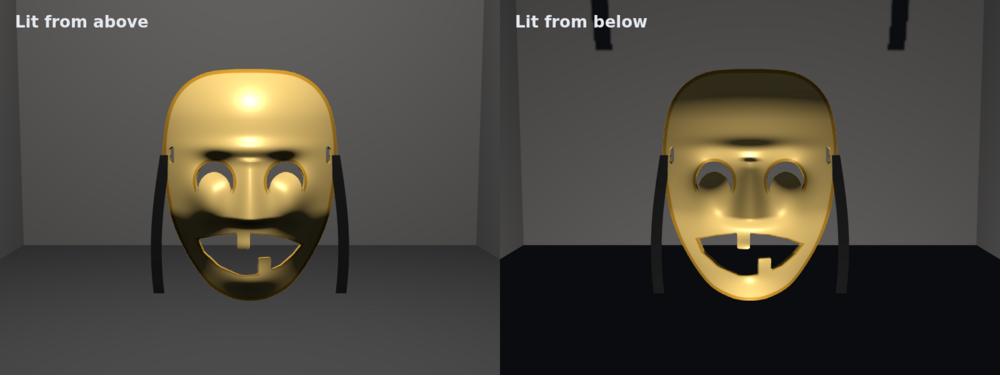
Lit from above and from below, from the Export bench. The mask is the same; only the light moved.
What they are learning while they play
Nothing here is presented as a lesson. This is what the activity is made of.
| What the student does | What it is |
|---|---|
| Turns Mirror off and cuts one eye bigger than the other | Symmetry. Most masks are the same on both sides of a middle line. Breaking that on purpose shows what the line is doing. |
| Moves the size from a child's to an adult's and watches the eyes move apart | Measuring a body. The size is the distance between the middles of the eyes. Students can measure their own with a ruler and a mirror and type it in. |
| Puts a cut at 30 across and 10 up | Coordinates. A place on the mask is two numbers, millimeters across and up from the bridge of the nose: x and y without the names. |
| Changes the diamonds' rule from dividing by 2 to dividing by 3 | Remainders and patterns. Each diamond has a row and a column; the remainder after dividing picks its color. A different divisor makes a different pattern. |
| Reads that each eye sees 30 degrees down | Angles and field of view. Straight down is 90 degrees. The holes and how far the eye is behind them set how much of the floor a wearer can see. |
| Lights the same mask from above, then from below | Light and shadow. Shadows fall away from the light. Lit from below, the brows throw their shadows up, and a calm face looks frightening. |
| Prints the template and finds the eyes further apart on paper | Flattening a curved surface. The paper measures round the curve. Bent back round the face, the holes come back over the eyes. Where a surface curves two ways at once, flat card cannot follow it without a dart. |
How to tell whether it landed
Ask, and let them show you. A student who has understood it can answer these without help.
- Why are the eye holes further apart on the printed template than your eyes are?
- Your mask sees 30 degrees down. What would you change to see the floor in front of your feet?
- Write one command that cuts a star above the left eye, then one line that makes the right side match.
- Why does the same mask look different lit from below?
- What does a dart do to a flat piece of card?
Use it in your subject
Not a technology class? Then the app is how students show what they learned in your unit. More projects for every subject.
Drama
Make the mask for a character, then light it from above and from below and decide which the character is. Comedy and tragedy masks are both on the Style bench.
Math
Cut the whole face by code in millimeters across and up, then use mirror and repeat. Change the diamonds' rule and predict the pattern before tapping.
Art and design
Design in the lab, print the card template, glue it to card, and cut and wear it. Decide where the darts go before printing.
Science
Use Can you see out? to compare eye holes: tall against wide, close to the face against far. Then measure a real mask the same way.
Practical notes
- AgesAges 7 through high school. Younger students pick a mask, press a pair of eyes and paint it; older ones shape the outline, cut by code, and change the diamonds' rule.
- TimeA minute to a mask of their own. A satisfying session is thirty to forty-five minutes, plus the cutting if a template is printed.
- EquipmentA computer or Chromebook with a modern browser. Card, glue, scissors and elastic or a stick for a printed template; a 3D printer for a printed mask.
- CostFree. The app has no paid tier.
- PrepNone. Open the page and go. If templates are printed, print at 100 percent, not fit to page, and an adult helps with any knife.
- In a groupEveryone can start from the same mask, then compare what each student changed, or make a set of masks for one play.
For co-ops, microschools, and classrooms
Give each group a story and one mask per character. Each student makes one, the group lights them all from below and from above, and they decide together which light suits each character. Then print, cut and perform.
Common questions
Is Mask Lab free?
Yes. It runs in your browser and there is no paid tier. A free account adds saving and sharing, but nothing on this page needs one.
Does my child need an account to try it?
No. The demo on this page is the complete lab with a starter mask. Make a free account to save a mask, share it, and use it in the other 3D apps.
How are the eyes cut?
Press a pair of eyes on the Eyes bench and it lands where a wearer's eyes are for the size picked. Any eye can be dragged, resized or turned, or cut by hand with the saw and the punch, by typing commands, or by snapping blocks together.
Can we make a real mask from it?
Yes. The Export bench prints a card template at its real size on Letter or A4, with the eye holes, the slots for elastic and any darts. Glue it to card and cut it out; an adult helps with the knife. An .svg of the same lines goes to a cutting machine or a laser, and an .stl prints the mask on a 3D printer.
Is it safe to wear?
The lab checks geometry only. Can you see out? says how far each eye sees and says when a full mask has no way to breathe. It never says a mask is safe; an adult checks a real one before it is worn.
Are there sacred or traditional masks in it?
No. The masks to start from are theater, carnival, Halloween and animal masks. Masks that belong to living traditions are not offered as costumes.
Still have a question? Ask us, and a person will write back.
Where to go next
Start with Mask Lab
Trying it costs nothing and takes about five minutes. An account is what makes the work last.
Mask Lab is one of the making apps on the platform. It is a place to make things, not a course, and it is not a substitute for a teacher: it is at its best when an adult asks the questions above and takes the answers seriously.
Page last reviewed October 2026.