Shield Lab
Heraldry is a picture language with a grammar. A herald could read a short sentence, called a blazon, and draw the same coat of arms as a herald who had never seen it. Shield Lab lets students design arms on a 3D shield, and the shield writes the blazon as they tap. They can also type a blazon and watch the shield draw it. The shield prints as a cardboard template at its real size, as a 3D plaque with the arms raised, or goes into a game as a 3D model.
Using this with a class? Make a free class and add your students yourself: each gets a username and password, with no email or Google account needed. Or give them one join code. Using Google Classroom? Post the link there; with a free class, the link also puts each student in your class, so you see their work.A first lesson: Each student designs arms and copies the blazon onto a card, without the picture. Partners swap cards and draw each other's arms from the words alone. Then they compare the drawing with the shield.
Set up a free class Share to Google ClassroomWhat a student actually does
They open the lab on a knight's shield, a heater, 70 centimeters tall. It is blue with a gold band from the top left to the bottom right and two silver stars. Under the stage it says: Azure, a bend Or between two mullets Argent. They drag it round, pick a Viking round shield or a Roman scutum instead, and slide the curve, the dome, the rim and the boss.
On the Arms bench they build the arms in the order heralds use. First the field: one tincture, or two in a division such as quarterly. Then an ordinary, a big shape such as a cross, a chevron or a band across the top. Then charges, such as stars, crescents, keys, a lion or an eagle, placed on the ordinary or around it. The blazon at the top changes word by word as they tap.
They can also go the other way. They type a blazon and press Enter, and the shield draws it. Words the lab understands turn blue. The first word it does not understand is named, with a plain reason.
Older students write rules for their arms, such as never color on color, or at most three charges. They can also write a short loop that makes the arms of a whole family, each son's arms with its own small mark. Then the shield leaves the lab. A template prints at real size to cut from cardboard and paint. A 3D plaque prints with the arms raised. A 3D model goes to the student's Files for SceneMaker and the other 3D apps.
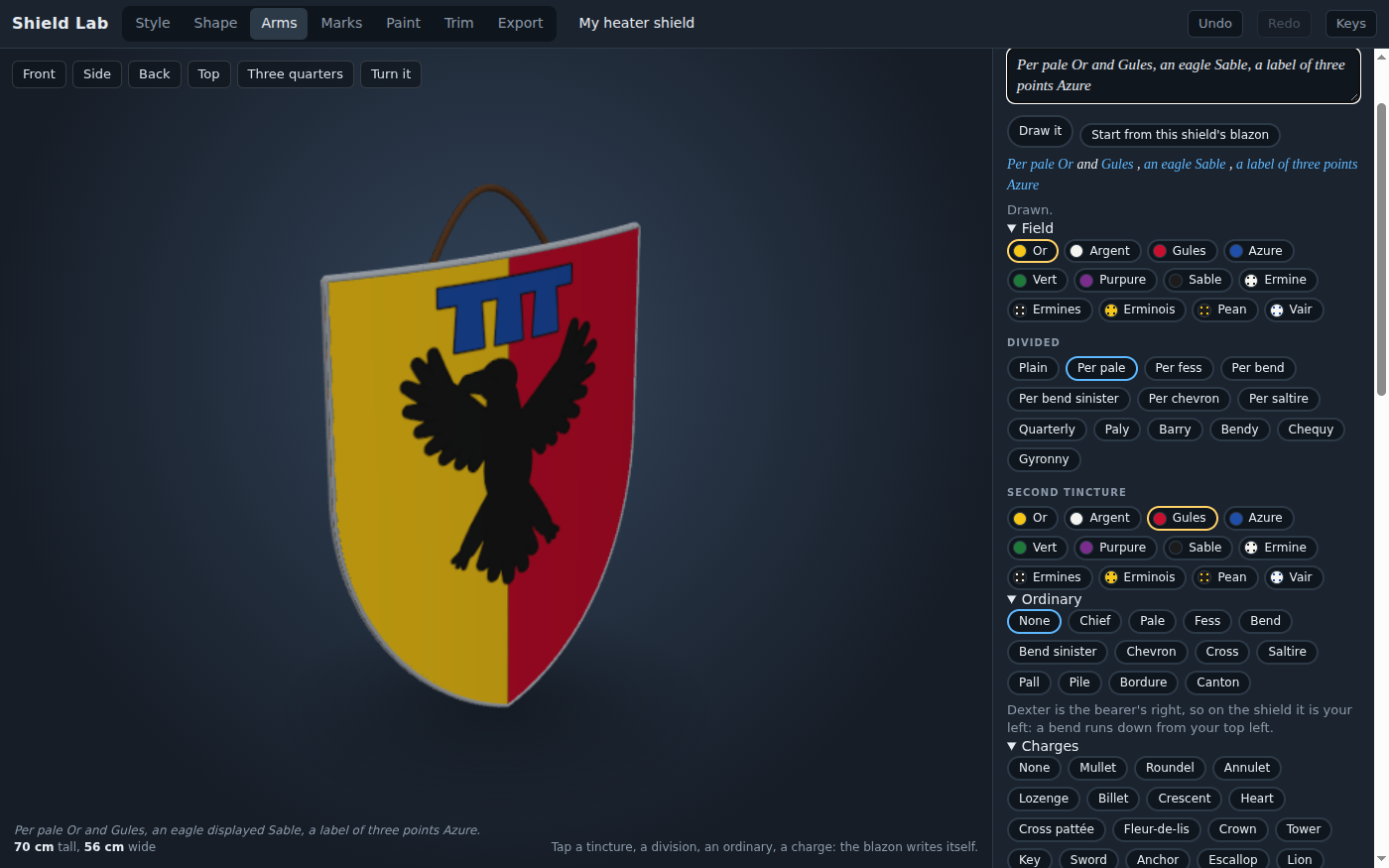
A blazon typed into the Write a blazon box and drawn with Enter. Each word the lab understands turns blue. The shield on the stage is built from the words alone.
What they are learning while they play
Nothing here is presented as a lesson. This is what the activity is made of.
| What the student does | What it is |
|---|---|
| Taps a cross onto a green field and reads: Vert, a cross Or | A formal language. A blazon has fixed parts in a fixed order: the field, then what lies on it. Each word has one meaning. That is what lets two people who never met draw the same picture. |
| Types a blazon and sees the shield draw it | Parsing. The lab reads the sentence word by word and builds the arms from it. A word it does not know stops the reading, and the lab says which word and why. |
| Puts gold on silver and reads the line under the blazon | Contrast. Heralds kept metal off metal and color off color, so a shield could be read from far away. The lab says when a design breaks the rule and never stops it, because some famous arms broke it on purpose. |
| Writes a rule: keep at least 25% difference in lightness | Measuring color. The rule compares how light two colors really are, as a number. Gold on blue passes. Blue on red fails, even though the two colors look very different. |
| Writes a loop from son 1 to son 6 and gets six shields | Loops and variables. The same lines run six times. The number counts up, and each time it chooses a different mark: a label, a crescent, a star, a bird, a ring, a lily. |
| Prints the template and tapes the pages together | Scale and true size. A full-size heater is nine letter pages. The template is never shrunk to fit, so the cardboard shield is the size the lab says. |
| Bends the shield and looks at the arms from the side | Surfaces and length. A curved shield is a flat sheet bent round a cylinder. The arms keep their size in millimeters on the curve, which is why the template is flat. |
How to tell whether it landed
Ask, and let them show you. A student who has understood it can answer these without help.
- Read your blazon aloud. Which word is the field, which is the ordinary, and which are the charges?
- Write a blazon on paper for a partner. Can they draw the shield from the words alone?
- Why might heralds keep gold off silver? Show a design that breaks the rule and one that keeps it.
- Which side is dexter, and why is it on your left when you look at a shield?
- In your loop, what changes each time it runs, and what stays the same?
Use it in your subject
Not a technology class? Then the app is how students show what they learned in your unit. More projects for every subject.
History
For a unit on the Middle Ages: why did knights need arms that could be read from far away? Design arms for a character in a story you are reading, and blazon them.
English
A blazon is precise writing. Students write a blazon, swap, and draw. Every difference between the drawing and the shield is a word that was not precise enough.
Computer science
Treat the blazon as a programming language. What are its keywords? What is its grammar? Then write the family loop and explain what each line does each time it runs.
Art and design
Contrast and simple shapes: design arms that can be read across the room. Test them by stepping back from the screen. Then cut and paint the cardboard template.
Practical notes
- AgesAges 8 through high school. Younger students tap tinctures and charges and read the blazon. Older ones type blazons, write rules and loops, and print the template or a plaque.
- TimeA minute to a shield of their own. A satisfying session is thirty to forty-five minutes, plus cutting and painting if the template is used.
- EquipmentA computer or Chromebook with a modern browser. Nothing to install. A printer for the template, cardboard, scissors and paint if you want a real shield, or a 3D printer for the plaque.
- CostFree. The app has no paid tier.
- PrepNone. Open the page and go. Reading this page first takes about three minutes. If students cut cardboard, an adult helps with the knife or the heavy scissors.
- In a groupEveryone can start from the same shield and compare what each student changed. The blazon swap works best in pairs.
For co-ops, microschools, and classrooms
Run a heralds' table. Each student designs arms and writes the blazon on a card. The cards are mixed, each student draws from a card, and the class guesses whose arms each drawing is. With a free account, students save their shields and use them in the other 3D apps.
Common questions
Is Shield Lab free?
Yes. It runs in your browser and there is no paid tier. A free account adds saving and sharing, but nothing on this page is behind a paywall.
Does my child need an account to try it?
No. The demo on this page is the complete lab with a starter shield. Make a free account to save a shield, share it, and use it in the other 3D apps.
What is a blazon?
A blazon is the written description of a coat of arms, in a fixed order with its own words. For example, Azure, a bend Or means a blue shield with a gold band from the top left to the bottom right. The lab writes the blazon as students design, and reads a blazon they type.
Will it show my family's coat of arms?
No. Coats of arms belong to a person, not to a surname, so there is no arms for a family name. Students design their own arms. The lab does not say what colors or shapes mean either, because there are no fixed meanings in old heraldry.
Can we make a real shield from it?
Yes. The Export bench prints a template at full size, half size, or on one page. A full-size knight's shield is nine letter pages taped together. The outline is the cutting line, and the arms are drawn in light gray lines to paint between.
Can students 3D print it?
Yes. The Export bench makes an STL file of the shield lying face up: a mini 8 centimeters tall, a plaque 15 centimeters tall, or full size. One choice raises the arms off the face, so they show on a print with no paint.
What ages is it for?
Ages 8 through high school. Tapping and reading the blazon works for younger students. Typing blazons, writing rules and loops, and printing fit older ones.
Still have a question? Ask us, and a person will write back.
Where to go next
Start with Shield Lab
Trying it costs nothing and takes about five minutes. An account is what makes the work last.
Shield Lab is one of the making apps on the platform. It is a place to make things, not a course, and it is not a substitute for a teacher: it is at its best when an adult asks the questions above and takes the answers seriously.
Page last reviewed October 2026.