Hat Lab
Every hat is a crown, a brim and a few decisions: how tall, how wide, how far the brim tips down. Hat Lab lets students make those decisions on a 3D hat, from a ball cap or a beanie to a top hat, a pirate hat or a royal crown. They paint it, add trims and their own marks, size it for a real head, and take it out of the lab as a picture, a design sheet, a file for a 3D printer, or a model for a game.
Using this with a class? Make a free class and add your students yourself: each gets a username and password, with no email or Google account needed. Or give them one join code.A first lesson: Everyone measures a real head with a strip of paper, sets that size in Hat Lab, and designs a hat for that person. Then each student explains why their hat grew or shrank with the head, and whether it would fit on the school's 3D printer.
Set up a free classWhat a student actually does
They open the lab on a ball cap made for a head 57 centimeters around, which is a US size 7 1/8. The readout under the hat says 10.4 cm crown, 72 mm bill. They pick a cowboy hat instead, slide the sides of the brim up, pinch the front of the crown, and the hat changes as they drag.
Then they set the size to a real head. Moving from 57 to 60 centimeters makes the whole cap about five percent bigger: the crown goes to 10.9 cm and the bill to 76 mm. The hat is scaled, not stretched, so its shape stays the same.
On the Paint bench they tap a part and give it a color or a pattern: knit ribs, woven straw, stripes, dots, stars, check, plaid or zigzag. The patterns are painted at their real size, so a stripe keeps its width as it goes up a curved crown. The Trim bench adds a band, a bow, a feather, a pom-pom, ears, a chin cord or ear flaps, and the Mark bench puts up to twelve stars, hearts, words, drawings or pictures anywhere on the hat.
Then the hat leaves the lab. The Export bench makes a picture, a design sheet showing four sides of the hat with its size and colors, a file for a 3D printer, and a 3D model for a game. A full-size ball cap prints 27 centimeters long, bigger than most school printers, and the lab says so before anyone walks to the printer. The half-size cap is 14 centimeters and fits.
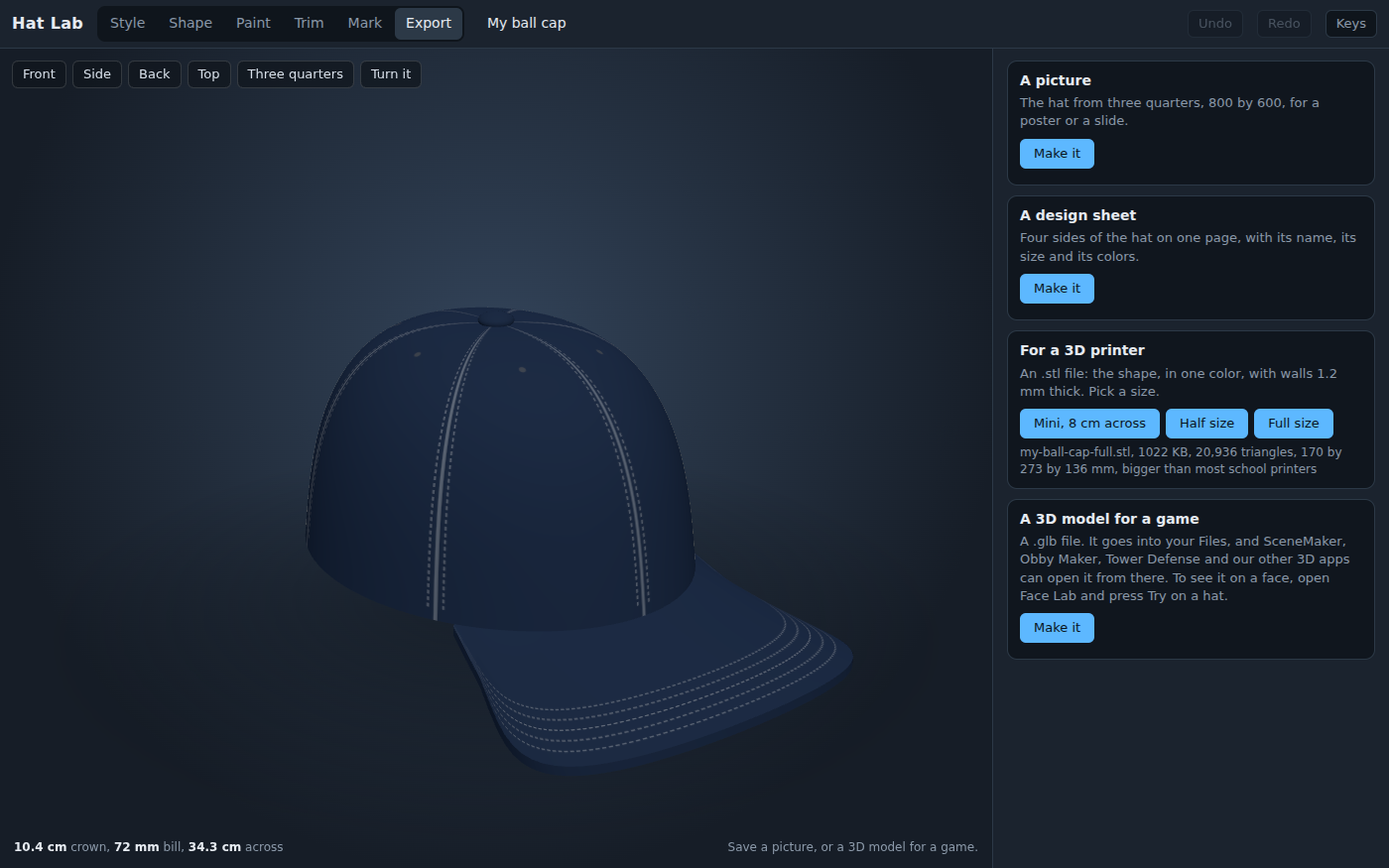
The starter cap sent to a 3D printer at full size: 170 by 273 millimeters, and the lab says it is bigger than most school printers before anyone walks to one. At half size the same cap is 85 by 136 millimeters and fits.
What they are learning while they play
Nothing here is presented as a lesson. This is what the activity is made of.
| What the student does | What it is |
|---|---|
| Sets a head size of 57 cm and reads US 7 1/8 | Circumference and pi. A US hat size is the distance round the head, in inches, divided by pi. It is the width the head would have if it were a circle. |
| Makes the head bigger and watches the bill grow too | Scale and proportion. Scaling multiplies every length by the same number. A head five percent bigger gets a crown and a bill five percent bigger, so the shape does not change. |
| Switches between centimeters, US, UK and S M L | Units and standards. The same head has several names. The centimeters are a measurement; the letter sizes are a rule of thumb that hat makers do not agree on, and the lab says so. |
| Paints stripes that stay the same width up a curved crown | Mapping flat onto curved. A pattern is drawn on a flat picture, then wrapped onto a 3D shape. To keep it true size, the lab measures the surface before it paints. |
| Picks mini, half or full size for the 3D printer | Scale models and constraints. A printer bed has a size limit. A design has to be scaled to fit the machine that will make it, and the lab gives the size in millimeters to check against. |
| Saves the hat as a 3D model and opens it in another app | 3D files and game assets. A model file carries the shape, the colors and a starting point. Hat Lab puts that point in the middle of the head opening, so a game knows where the head goes. |
| Turns a top hat into a bowler with the same sliders | Design variables. Very different hats share the same few measurements: crown height, top, brim width, brim angle. A designer changes one at a time to see what it does. |
| Reads the names of the parts: crown, brim, bill, band, cuff | Design vocabulary. Every trade has words for its parts. Using them is how a designer explains a hat to someone who has to make it. |
How to tell whether it landed
Ask, and let them show you. A student who has understood it can answer these without help.
- Measure a head with a strip of paper. What hat size is it in US sizes, and how did you work it out?
- When you made the head bigger, why did the bill get longer too?
- Why would a full-size hat not print on most school printers, and what size would you pick instead?
- Which two sliders turn a top hat into a bowler?
- Why does a pattern need to know the size of the surface it is painted on?
Use it in your subject
Not a technology class? Then the app is how students show what they learned in your unit. More projects for every subject.
Math
Measure heads around with a strip of paper, then work out each US size by hand: centimeters to inches, divided by pi, to the nearest eighth. Check the answers in the lab.
Art and design
Design a hat for a character from a book or a period of history, then explain which shape, colors and trims fit that person and why. The design sheet is the finished page to hand in.
History
Pick three styles, like the top hat, the cloche and the newsboy cap. Find out when and by whom each was worn, and design one that belongs to that time.
Computer science
Save a hat as a 3D model and put it in a game or a scene in another app. Talk about what the file has to carry for another program to use it.
Practical notes
- AgesAges 8 through high school. Younger students pick a style, paint it and add trims; older ones measure real heads, work the sizes out by hand and prepare a hat for a 3D printer.
- TimeA minute to a hat of their own. A satisfying session is thirty to forty-five minutes.
- EquipmentA computer or Chromebook with a modern browser. The hat is 3D, so a very old or very slow computer may struggle. Nothing to install. A strip of paper and a ruler for measuring heads, if you like.
- CostFree. The app has no paid tier.
- PrepNone. Open the page and go. Reading this page first takes about three minutes.
- In a groupEveryone can start from the same style and the same head size, then compare what each student changed.
For co-ops, microschools, and classrooms
Pair students up. Each measures the other's head, and each designs a hat for their partner, not for themselves. With a free account the hats can go to a 3D printer as mini models, or into the other 3D apps on the platform as game pieces.
Common questions
Is Hat Lab free?
Yes. It runs in your browser and there is no paid tier. A free account adds saving and sharing, but nothing on this page is behind a paywall.
Does my child need an account to try it?
No. The demo on this page is the complete lab with a starter ball cap. Make a free account to save a hat, share it, and use it in the other 3D apps.
What kinds of hats can it make?
Nineteen styles to start from: ball cap, beanie, bucket hat, sun hat, fedora, cowboy hat, top hat, bowler, boater, beret, newsboy cap, visor, cloche, wizard hat, party hat, pirate hat, royal crown, chef's hat and hard hat. Each one can be reshaped with sliders, so a student can make hats that are not on the list.
Which hat sizes does it use?
Centimeters around the head, US and UK fitted sizes, and small, medium and large. The US size is the distance round the head in inches divided by pi, to the nearest eighth, and the UK size is an eighth smaller. Letter sizes differ from maker to maker, and the lab says so.
Can students 3D print their hat?
Yes. The Export bench makes an STL file with walls 1.2 mm thick, at mini size (8 centimeters across), half size or full size. It gives the size in millimeters and warns when a hat is bigger than most school printers.
Can the hat go into a game?
Yes. The Export bench saves a 3D model (a .glb file) to the student's Files, and SceneMaker, Obby Maker, Tower Defense and the platform's other 3D apps can open it from there. Face Lab can try it on a 3D face.
Can students put their own pictures on a hat?
Yes. The Mark bench places shapes, words, freehand drawings and pictures from the student's own Files anywhere on the hat, up to twelve at a time.
What ages is it for?
Ages 8 through high school. Picking and painting a hat works for anyone; measuring heads, working out sizes and preparing a print suit older students.
What subject can I log this as?
Most families log it as art and design, or as math when the sizes are worked out by hand. The table above lists specifically what is covered, so you can pick the label your records need and point at the evidence.
Still have a question? Ask us, and a person will write back.
Where to go next
Start with Hat Lab
Trying it costs nothing and takes about five minutes. An account is what makes the work last.
Hat Lab is one of the making apps on the platform. It is a place to make things, not a course, and it is not a substitute for a teacher: it is at its best when an adult asks the questions above and takes the answers seriously.
Page last reviewed September 2026.