Burger Lab
A burger is a stack of decisions: which bun, how thick a patty, what goes on it and in what order, and how long it sits on the grill. Burger Lab lets students make those decisions on a 3D burger, from a classic to a tower that leans, cook the patty until a thermometer says it is done, and put it on a menu. Then they run the kitchen that serves it: tickets with no pickle and extra mayo on them, a grill with six spots, a fryer with two baskets, customers who will not wait forever, and a cook who does what the student's rules, or the student's program, tell it to do next.
Using this with a class? Make a free class and add your students yourself: each gets a username and password, with no email or Google account needed. Or give them one join code. Using Google Classroom? Post the link there; with a free class, the link also puts each student in your class, so you see their work.A first lesson: Everyone builds the same cheeseburger, puts it on the menu, and runs the same lunch rush (rush number 7) with the station rules set to "by the clock". Read the report together: the patties went out under. Switch to "by the thermometer", run it again, and compare. Then each student changes one rule and runs it a third time to beat their own score.
Set up a free class Share to Google ClassroomWhat a student actually does
They open the lab on a classic: a sesame bun, ketchup and mustard, a beef patty, pickles and onion. The readout under it says 7 layers, 3.4 inches tall, standing, patty 164 °F, done. On the Stack bench they add layers from a list of twenty, move them up and down, and swap the bun, the patty (beef or plant-based) and the cheese. Wet layers slide and grippy ones hold, so a tall burger with mayo under the tomato leans, the readout names the layer that is sliding, and past a point it falls over.
On the Grill bench they cook the patty. A heat model moves warmth through it slice by slice; they set the heat, the time on each side and a rest, and a thermometer reads the middle. Beef is done at 160 °F, plant-based at 165 °F, and the cut view shows a plant patty that is fully cooked and still pink. The rule the card teaches is the one real kitchens follow: you cannot tell by looking.
On the Sauce bench each sauce is squeezed on in a zigzag, a spiral, dots or lines, or in a path the student writes as commands: squeeze 46, turn 90, repeat 3. Sauce squeezed past the edge is counted as fallen off. Up to six burgers go on a menu with a price, and the Export bench makes a picture, a build card with every layer named, the menu board, a 3D model the platform's game apps can open, and a file for a 3D printer.
Then the Kitchen bench. Tickets are drawn from the student's own menu by a rush number, with modifiers and an allergy flag on some, and customers queue at the counter and in the drive-thru lane. The student writes the line as sentences with the numbers editable in place: when side one reaches 2:30, flip it; when the middle reaches 160 °F, bin it; when a ticket carries an allergy, leave out what carries it. Or as blocks in a Glassbox drawer, or as a program, a function the kitchen calls once a second that returns what the cook does next. A second program, the ticket reader, turns the printed ticket into what to make; it is scored on forty tickets, and switched in, whatever it misses goes out wrong. The report scores the shift, and the same rush number is the same tickets, so a friend can run it and the report says who did better.
The burger they stacked is the burger the kitchen sells. With I build them switched on, the kitchen stops at the pass when a ticket's food is ready, and the student builds that ticket's burger on the same 3D stack: the printed ticket on one side, their menu's recipe under it, the burger growing as they add to it. The ticket may say no pickles, or plant-based, or carry a sesame allergy, so the recipe is only the start. What they send is checked against what the ticket asked for, and a miss goes out wrong with its reason: left off the cheese, served sesame to a sesame allergy.
A kitchen can add robots to its cook, one to a station: a grill arm, a fry arm, and an assembly line with a belt to the window. A cook does one thing at a time and walks between stations; a robot stays where it is, keeps its own list and runs the same rules, so three things happen at once. Each robot is rented by the shift in pretend dollars, and the report says how busy each one was. Often the answer is that the grill's six spots were the limit all along, and the robot that sat idle did not earn its rent.
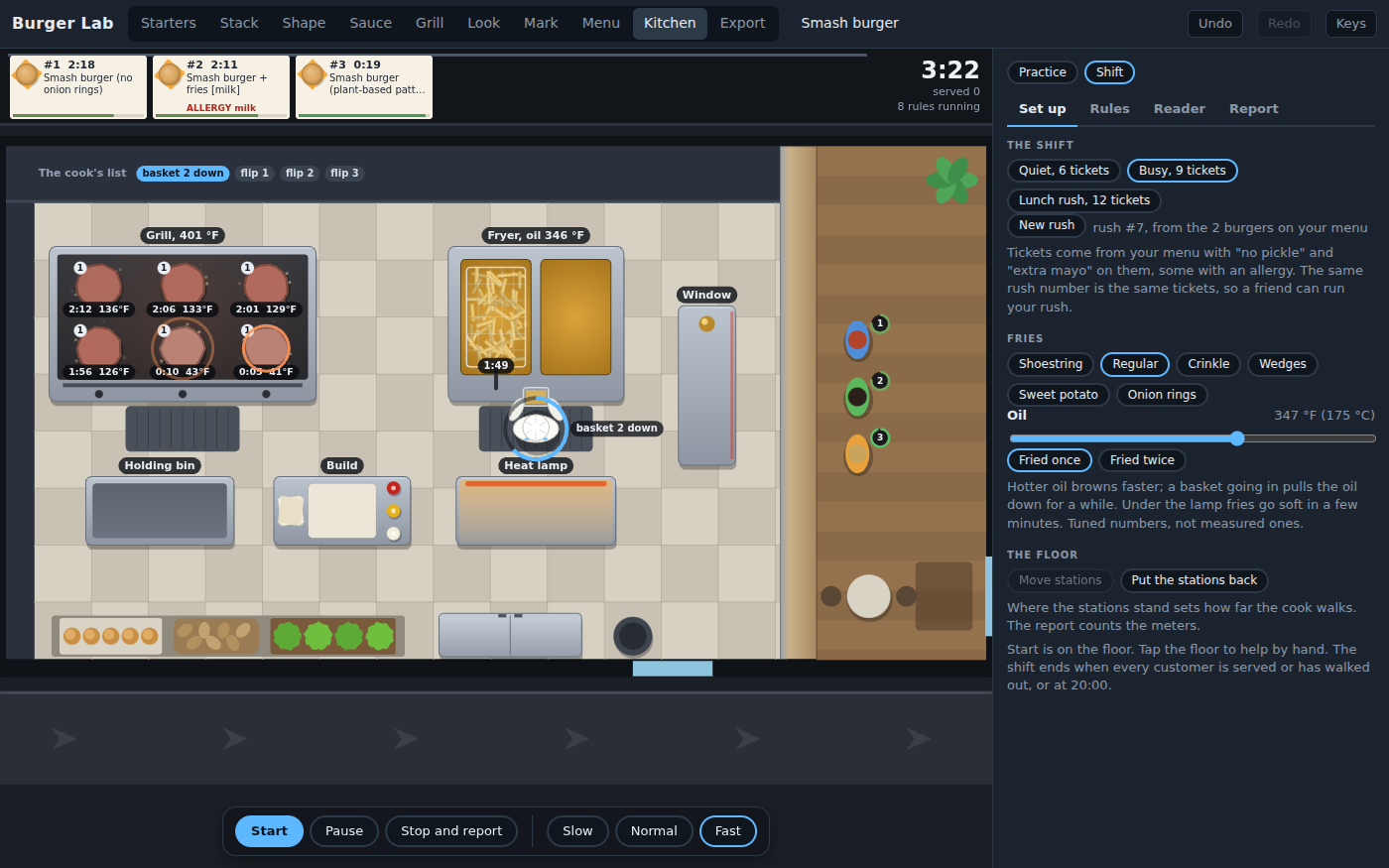
Two and a half minutes into a nine-ticket rush run by eight rules. Four patties are on, the flip rule has not fired yet, and the second ticket carries a milk allergy that the line will have to leave the cheese off for. The report at the end says what the student could not see while it ran: the average wait, who walked out, which patties went out under, and when the grill was full.
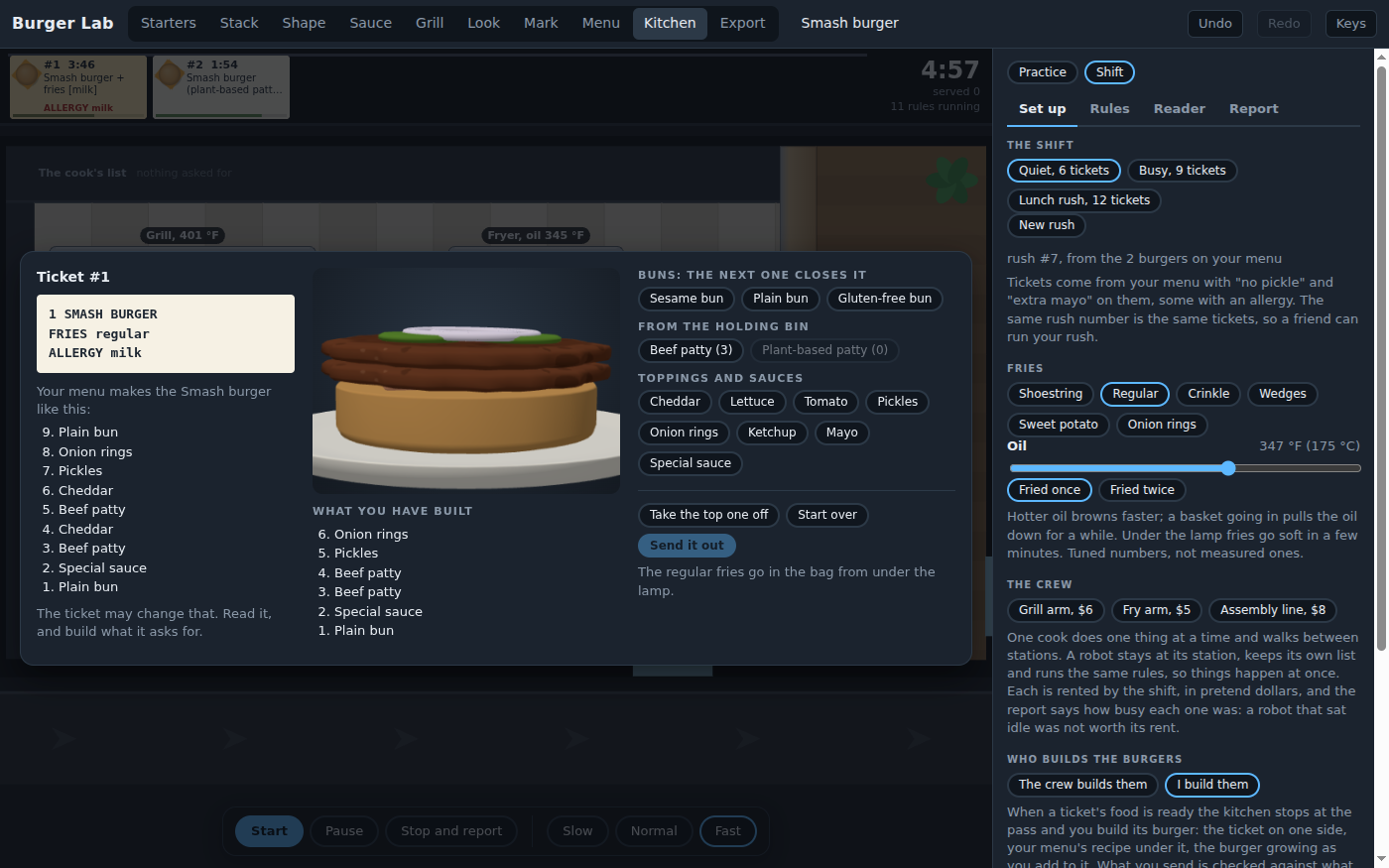
Building to the ticket. The recipe says cheddar twice; the ticket says a milk allergy, so this one is built without it. What goes out is checked against what the ticket asked for.
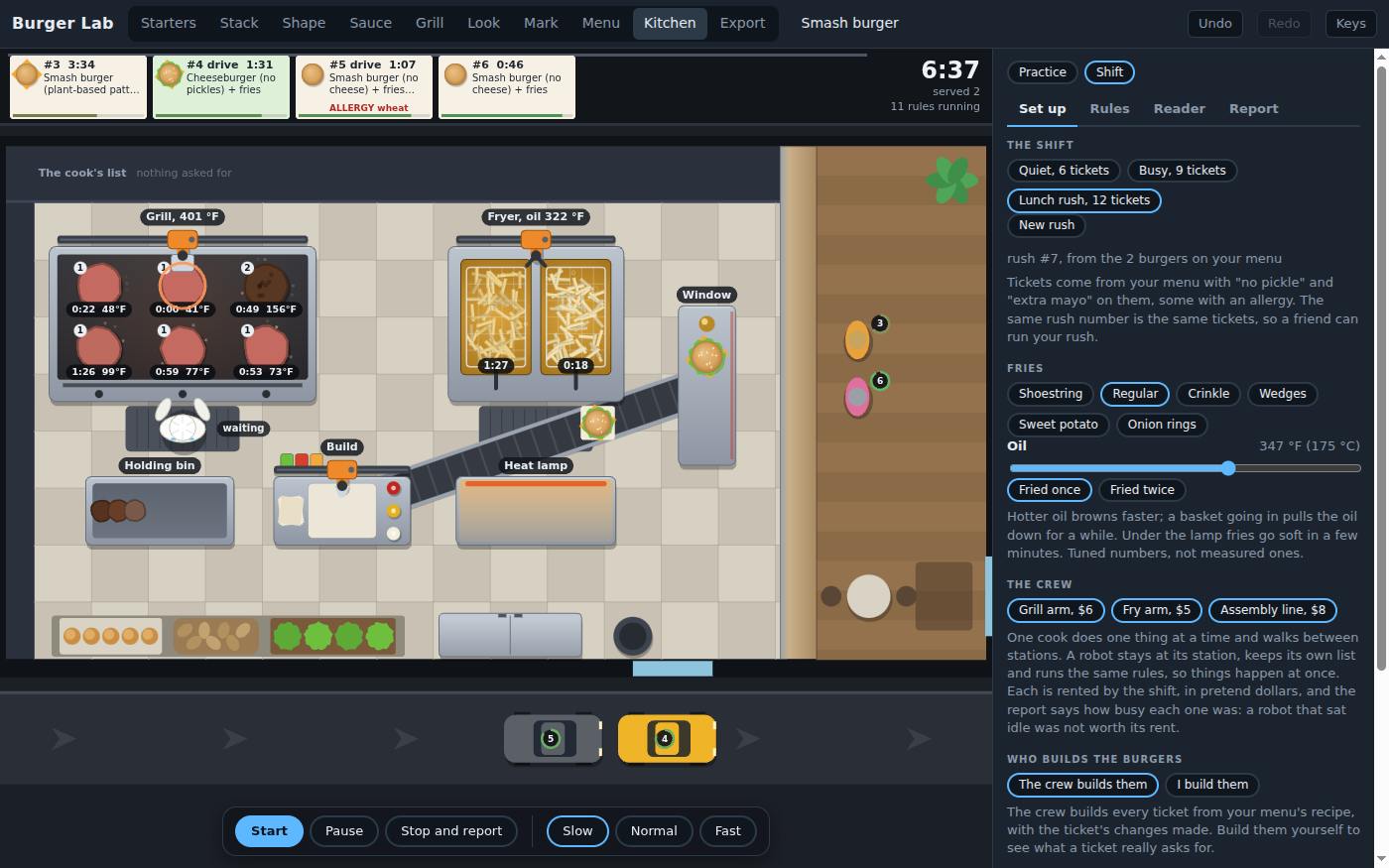
Robots on the crew: a grill arm, a fry arm and an assembly line, each running the student's rules on its own list. The report says how busy each one was, and whether it earned its rent.
What they are learning while they play
Nothing here is presented as a lesson. This is what the activity is made of.
| What the student does | What it is |
|---|---|
| Builds a burger that leans, and reads which layer is sliding | Structures and friction. Each layer has a slip. Sauce under a tomato lets it slide; lettuce low in the stack holds. The tallest burger that still stands is a problem in foundations. |
| Cooks a patty by the clock and gets it under; cooks it by the thermometer and gets it done | Heat conduction and measurement. Heat moves into a patty from its faces, so the middle is last. A thick patty needs far longer than a thin one. The thermometer measures what the clock can only guess, and food safety is written in degrees for that reason. |
| Writes a sauce path as squeeze, turn, repeat | Sequencing and loops. A path is a list of steps. A repeat block makes a spiral out of two steps. The first program a student writes here is on the picture they share. |
| Builds each ticket's burger by hand, to what the ticket says and not to habit | Reading a specification. A ticket is a small specification: the standard burger, minus this, with that changed. Building the usual one is the most common mistake, and the report names what was missed. It is the work a program does later, done first by hand. |
| Adds the rule that leaves out what carries an allergy, after a ticket went out wrong | Conditionals. The allergy flag is data on the ticket. Without a rule that reads it, the kitchen serves sesame to a sesame allergy and the report says so. One if-statement fixes it. |
| Watches a flip asked for behind four starts come late | Queues and limited resources. One cook does one thing at a time, in order. Six grill spots and two baskets are all there is. Asking early matters more than asking often. |
| Rents a grill arm for the lunch rush and reads how busy it was | Parallel work and bottlenecks. One cook is one queue. Add a robot and two things happen at once, but only the slowest step sets the pace. If the grill is full, more hands do not serve more burgers, and the report shows it: the cook 40 percent busy, the arm 30, and the same customers walking out. |
| Drops the fries late enough to land with the burger | Backward scheduling. Fries go soft under the lamp in minutes, so they cannot be made early. Working back from when the burger is ready is how a line cook thinks and how a scheduler is written. |
| Cooks patties ahead and throws some out | Tradeoffs. Patties waiting in the bin mean shorter waits and more waste. There is no single right answer, and the report puts both numbers next to each other. |
| Rewrites the sentence rules as a function that returns the next action | From rules to code. The same decisions, written in JavaScript: a loop over the grill, a condition on each ticket, a list of actions returned. The function saves as a file that runs outside the app. |
| Writes a reader that turns the printed ticket into what to make, and scores it on forty tickets | Text as data, parsing. A ticket is lines of text with a shape: a count, a name, modifiers after commas, a FRIES line, an ALLERGY line. A program that reads half of it serves half the order, and the report says which half. |
How to tell whether it landed
Ask, and let them show you. A student who has understood it can answer these without help.
- Why did the tower lean, and which layer would you move to make it stand?
- A patty flipped at 2:30 and binned at 2:30 came out under. What should the second rule look at instead of the clock, and why?
- A ticket said ALLERGY sesame and the order went out wrong. Which rule was missing, and what does it change on the build?
- The report said the grill was full from 0:52 to 8:34. What are two different ways to fix that, and what does each one cost?
- In your program, why does the flip rule come before the ticket rules?
Use it in your subject
Not a technology class? Then the app is how students show what they learned in your unit. More projects for every subject.
Computer science
Run the same rush three ways: by hand, by sentence rules, and by a program. Keep the three reports and explain where each minute of waiting went.
Science
Cook the same patty at 10 mm, 18 mm and 30 mm with one plan and chart the middle temperature over time from the Grill bench. Explain why the thick one is not done.
Family and consumer science
Build a burger for a sesame allergy and one for a milk allergy, and read the allergen line on the build card. Compare the Food Code's rule for restaurants with the number on a package at home.
Math
Price the menu. The lab suggests three times the food cost plus a dollar; the shift report shows sales, food cost and profit. Change prices and run the rush again.
Practical notes
- AgesAges 8 through high school. Younger students build and cook burgers and run the kitchen by tapping the floor; middle schoolers write the sentence rules; high schoolers write the program.
- TimeTwo minutes to a burger of their own. A good session is forty-five minutes: a burger, a menu, and two or three runs of the same rush.
- EquipmentA computer or Chromebook with a modern browser. The burger is 3D, so a very old or very slow computer may struggle. Nothing to install.
- CostFree. The app has no paid tier.
- PrepNone. Open the page and go. Reading this page first takes about three minutes.
- In a groupEveryone can run the same rush number with their own rules and compare reports. The money is pretend and the numbers are tuned, not measured, and the lab says so.
For co-ops, microschools, and classrooms
Name a restaurant, put six burgers on its menu, and run one rush number as a group. Each student takes a copy, changes the rules, and tries to beat the class's score; the report says who did better by the restaurant's name. With a free account the burgers are saved and shared, and a burger's 3D model can be a pickup in a student's Obby Maker course.
Common questions
Is Burger Lab free?
Yes. It runs in your browser and there is no paid tier. A free account adds saving and sharing, but nothing on this page is behind a paywall.
Does my child need an account to try it?
No. The demo on this page is the complete lab with a classic loaded. Make a free account to save a burger, share it, and use it in the other 3D apps.
Is there a vegetarian option?
Yes. The patty can be beef or plant-based, with its own cooking numbers, and the Garden burger starter is plant-based on a wheat bun. A lettuce-wrap bun and a gluten-free bun are in the list too.
Are the cooking temperatures real?
The three the lab quotes are: 160 °F for ground beef is the USDA's safe minimum, 165 °F for plant-based is the line on the package, and 155 °F held for 17 seconds is the FDA Food Code's rule for restaurants. The heat model behind the thermometer is a classroom model checked against package times, not a food-science simulation, and the sources are listed in the project's notes.
Does it count calories?
No. The lab never counts calories or calls a food healthy or unhealthy. It does show allergens, the nine the FDA names, and the money on the report is pretend.
What does "program the kitchen" mean?
Four ways, in order of age. Tap the floor and the cook does it by hand. Write rules as sentences with the numbers editable in place, or as the same rules in blocks. Or write a JavaScript function, next(kitchen), that the kitchen calls once a second and that returns what the cook should do next; it saves as a file that runs in Node outside the app. A second program reads the printed ticket into what to make, and is scored on forty tickets.
Can the kitchen have robots?
Yes. A grill arm, a fry arm and an assembly line can each be added beside the cook, one to a station. They run the same rules the student already wrote, each on its own list, so work happens at the same time. They cost pretend rent by the shift, and the report says how busy each was, so a student can find out whether a robot was worth it for that rush.
Can a friend run my rush?
Yes. The same rush number is the same tickets. A copy of the project carries the rush, the menu and your result, and when the friend runs it the report says who did better, by your restaurant's name.
Can the burger go into a game?
Yes. The Export bench saves a 3D model (a .glb file) to the student's Files, sitting on its bottom so it lands on a floor, and SceneMaker, Obby Maker and the platform's other 3D apps can open it from there.
What ages is it for?
Ages 8 through high school. Building and cooking suit anyone; the sentence rules are for middle school up; the program is for students who have met JavaScript, or are about to.
What subject can I log this as?
Most families log the kitchen as computer science and the grill as science. The table above lists specifically what is covered, so you can pick the label your records need and point at the evidence.
Still have a question? Ask us, and a person will write back.
Where to go next
Start with Burger Lab
Trying it costs nothing and takes about five minutes. An account is what makes the work last.
Burger Lab is one of the making apps on the platform. It is a place to make things, not a course, and it is not a substitute for a teacher: it is at its best when an adult asks the questions above and takes the answers seriously.
Page last reviewed October 2026.